Department of Population Health, NYU Grossman School of Medicine, New York, NY.
Department of Epidemiology, Columbia University Mailman School of Public Health, New York, NY.
Geospat Health. 2021 Mar 11;16(1). doi: 10.4081/gh.2021.926.
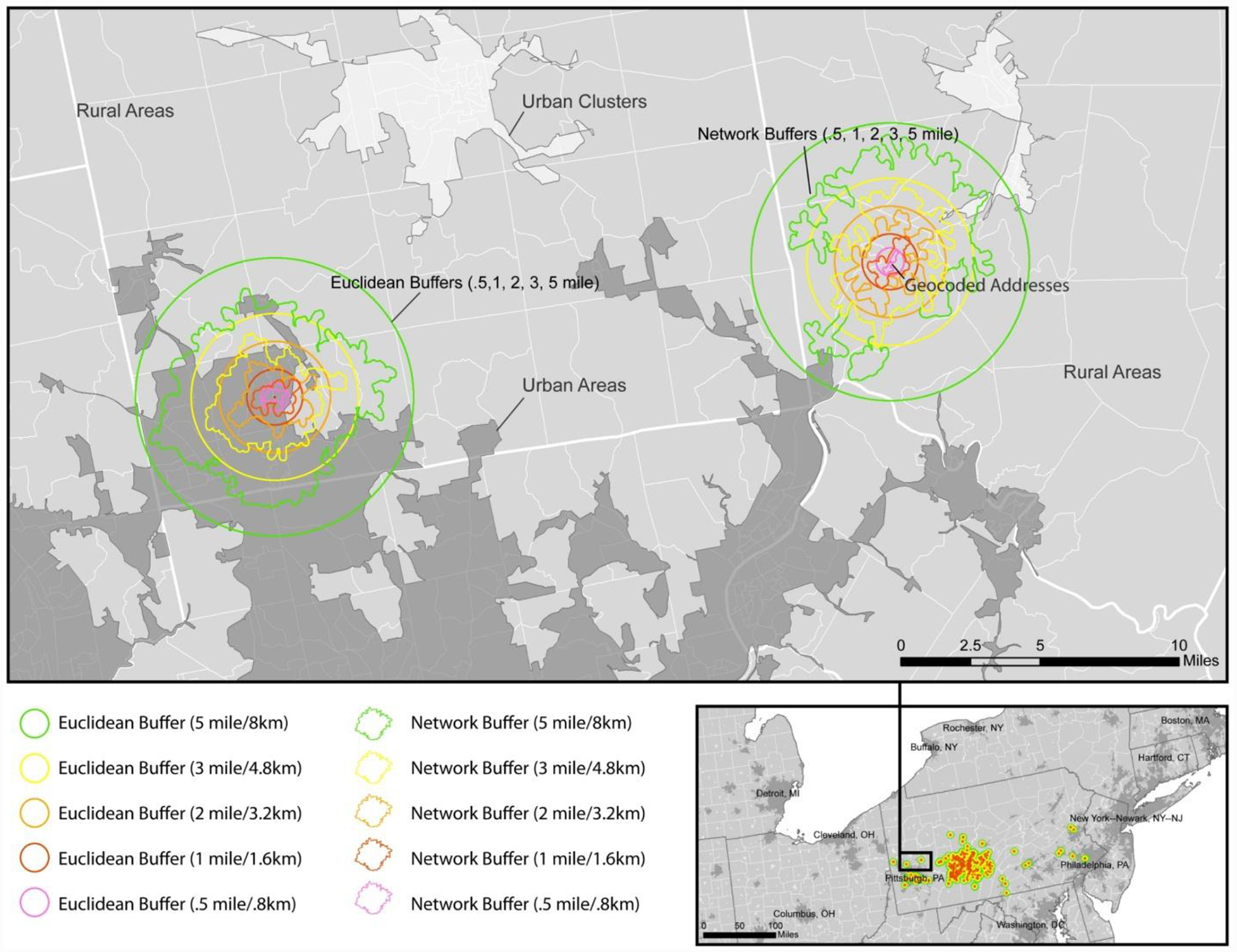
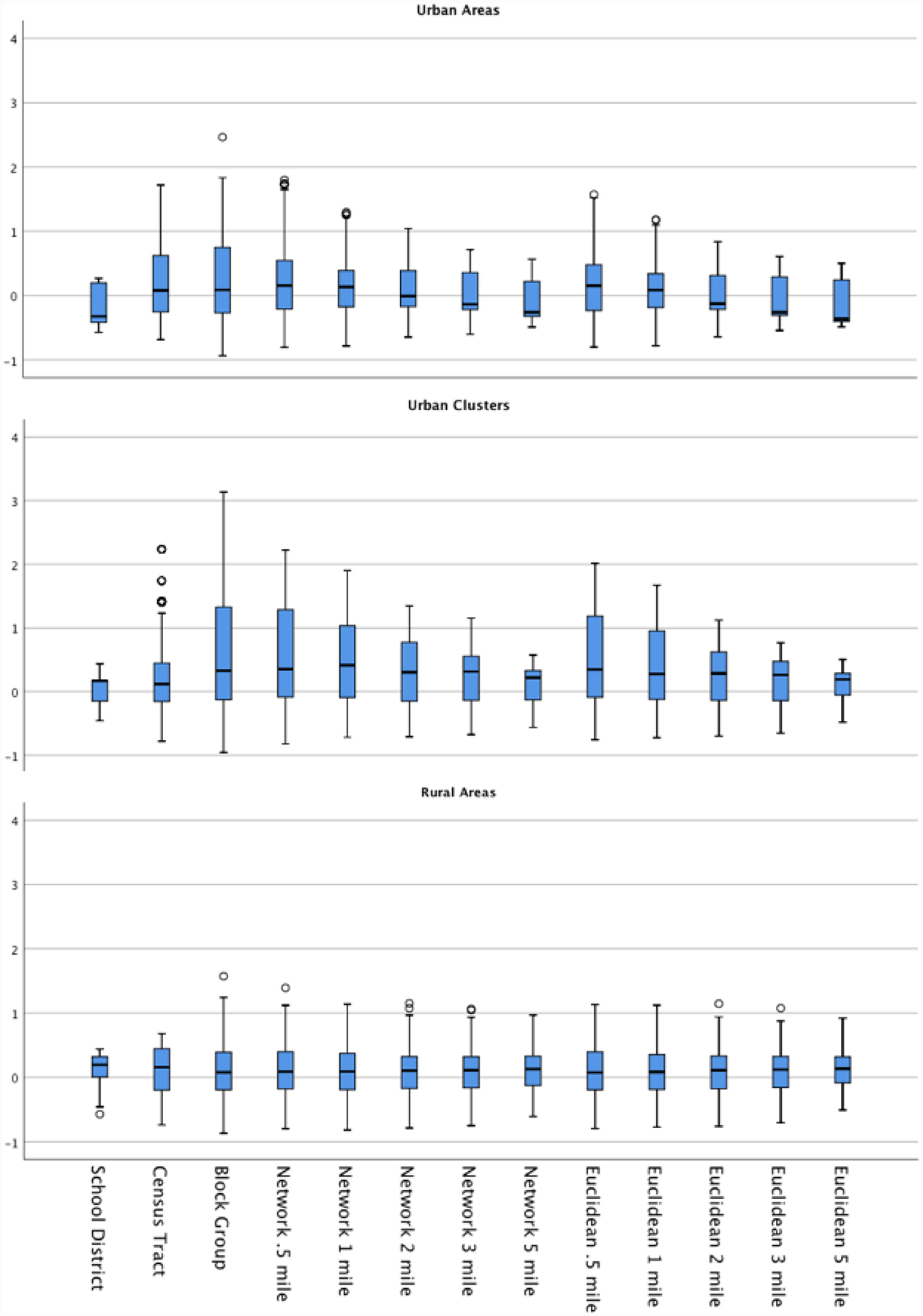
Neighborhood deprivation plays an important role in childhood health and development, but defining the appropriate neighborhood definition presents theoretical as well as practical challenges. Few studies have compared neighborhood definitions outside of highly urbanized settings. The purpose of the current study was to evaluate how various administrative and ego-centric neighborhood definitions may impact measured exposure to deprivation across the urban-rural continuum. We do so using the Family Life Project, a prospective longitudinal population-based sample of families living in North Carolina and Pennsylvania (USA), which also sets the stage for future investigations of neighborhood impacts on childhood health and development. To measure neighborhood deprivation, a standardized index of socioeconomic deprivation was calculated using data from the 2007-2011 American Community Survey. Families' residential addresses when children were 2 months of age (n=1036) were geocoded and overlaid onto a deprivation index layer created at the census block group level to construct multiple administrative and ego-centric neighborhood definitions. Friedman tests were used to compare distributions of neighborhood deprivation across these neighborhood definitions within urbanized areas, urban clusters, and rural areas. Results indicated differences in urbanized areas (Chisquare= 897.75, P<0.001) and urban clusters (Chi-square=687.83, P<0.001), but not in rural areas (Chi-square=13.52, P=0.332). Findings imply that in urban areas, choice of neighborhood definition impacts measured exposure to neighborhood deprivation. Although exposure to neighborhood deprivation appears to be less sensitive to neighborhood definition in rural areas, researchers should apply theoretical reasoning to choose appropriate definitions of children's neighborhood.
社区剥夺在儿童健康和发展中起着重要作用,但定义适当的社区定义在理论和实践上都存在挑战。很少有研究在高度城市化环境之外比较社区定义。本研究的目的是评估各种行政和自我中心的社区定义如何影响城市-农村连续体中衡量的剥夺暴露程度。我们使用家庭生活项目来实现这一目标,该项目是一个前瞻性的、基于人群的、居住在北卡罗来纳州和宾夕法尼亚州(美国)的家庭的纵向样本,该项目也为未来研究社区对儿童健康和发展的影响奠定了基础。为了衡量社区剥夺程度,我们使用 2007-2011 年美国社区调查的数据,计算了一个社会经济剥夺标准化指数。当孩子 2 个月大时,家庭的居住地址(n=1036)被地理编码,并覆盖在创建的普查区组层面的剥夺指数层上,以构建多个行政和自我中心的社区定义。弗里德曼检验用于比较这些社区定义内城市地区、城市集群和农村地区的社区剥夺分布。结果表明,在城市地区(卡方=897.75,P<0.001)和城市集群(卡方=687.83,P<0.001)存在差异,但在农村地区(卡方=13.52,P=0.332)没有差异。研究结果表明,在城市地区,社区定义的选择会影响对社区剥夺的衡量暴露程度。尽管在农村地区,社区剥夺的暴露程度似乎对社区定义的敏感度较低,但研究人员应根据理论推理选择适当的儿童社区定义。