Robinson Lara R, Holbrook Joseph R, Bitsko Rebecca H, Hartwig Sophie A, Kaminski Jennifer W, Ghandour Reem M, Peacock Georgina, Heggs Akilah, Boyle Coleen A
Division of Human Development and Disability, National Center on Birth Defects and Developmental Disabilities, CDC, Atlanta, Georgia.
Oak Ridge Institute for Science and Education, CDC Research Participation Programs, Oak Ridge, Tennessee.
MMWR Surveill Summ. 2017 Mar 17;66(8):1-11. doi: 10.15585/mmwr.ss6608a1.
PROBLEM/CONDITION: Mental, behavioral, and developmental disorders (MBDDs) begin in early childhood and often affect lifelong health and well-being. Persons who live in rural areas report more health-related disparities than those in urban areas, including poorer health, more health risk behaviors, and less access to health resources.
2011-2012.
The National Survey of Children's Health (NSCH) is a cross-sectional, random-digit-dial telephone survey of parents or guardians that collects information on noninstitutionalized children aged <18 years in the United States. Interviews included indicators of health and well-being, health care access, and family and community characteristics. Using data from the 2011-2012 NSCH, this report examines variations in health care, family, and community factors among children aged 2-8 years with and without MBDDs in rural and urban settings. Restricting the data to U.S. children aged 2-8 years with valid responses for child age and sex, each MBDD, and zip code resulted in an analytic sample of 34,535 children; MBDD diagnosis was determined by parent report and was not validated with health care providers or medical records.
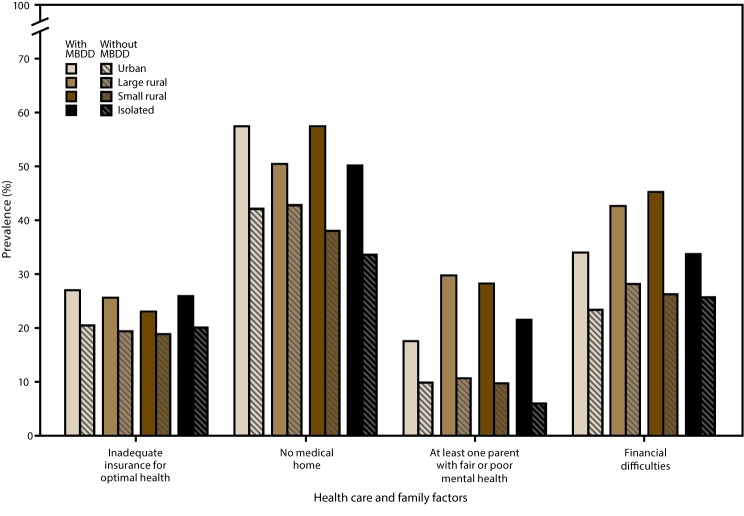
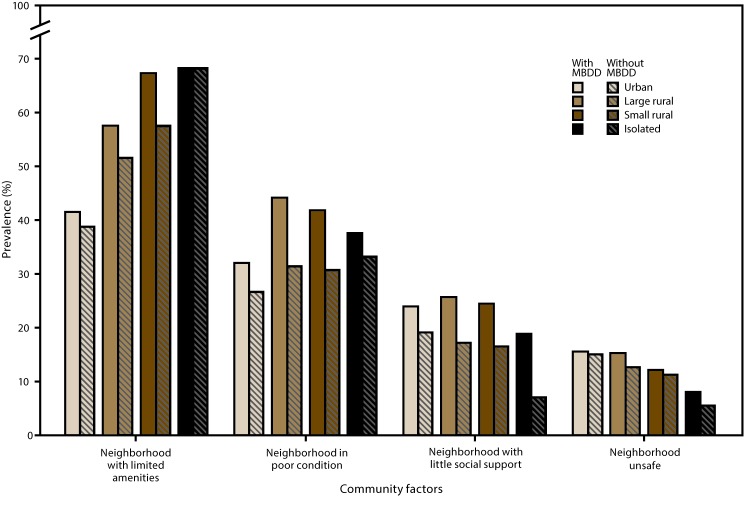
A higher percentage of all children in small rural and large rural areas compared with all children in urban areas had parents who reported experiencing financial difficulties (i.e., difficulties meeting basic needs such as food and housing). Children in all rural areas more often lacked amenities and lived in a neighborhood in poor condition. However, a lower percentage of children in small rural and isolated areas had parents who reported living in an unsafe neighborhood, and children in isolated areas less often lived in a neighborhood lacking social support, less often lacked a medical home, and less often had a parent with fair or poor mental health. Across rural subtypes, approximately one in six young children had a parent-reported MBDD diagnosis. A higher prevalence was found among children in small rural areas (18.6%) than in urban areas (15.2%). In urban and the majority of rural subtypes, children with an MBDD more often lacked a medical home, had a parent with poor mental health, lived in families with financial difficulties, and lived in a neighborhood lacking physical and social resources than children without an MBDD within each of those community types. Only in urban areas did a higher percentage of children with MBDDs lack health insurance than children without MBDDs. After adjusting for race/ethnicity and poverty among children with MBDDs, those in rural areas more often had a parent with poor mental health and lived in resource-low neighborhoods than those in urban areas.
Certain health care, family, and community disparities were more often reported among children with MBDDS than among children without MBDDs in rural and urban areas.
Collaboration involving health care, family, and community services and systems can be used to address fragmented services and supports for children with MBDDs, regardless of whether they live in urban or rural areas. However, addressing differences in health care, family, and community factors and leveraging community strengths among children who live in rural areas present opportunities to promote health among children in rural communities.
问题/状况:精神、行为和发育障碍(MBDD)始于幼儿期,常常影响一生的健康和幸福。与城市地区的人相比,农村地区的人报告了更多与健康相关的差异,包括健康状况较差、更多健康风险行为以及获得医疗资源的机会更少。
2011 - 2012年。
全国儿童健康调查(NSCH)是一项针对家长或监护人的横断面随机数字拨号电话调查,收集美国18岁以下非机构化儿童的信息。访谈内容包括健康和幸福指标、医疗保健可及性以及家庭和社区特征。本报告利用2011 - 2012年NSCH的数据,研究了农村和城市地区有和没有MBDD的2至8岁儿童在医疗保健、家庭和社区因素方面的差异。将数据限制为对儿童年龄和性别、每种MBDD以及邮政编码有有效回复的美国2至8岁儿童,得到了一个34,535名儿童的分析样本;MBDD诊断由家长报告确定,未通过医疗保健提供者或病历进行验证。
与城市地区的所有儿童相比,小农村地区和大农村地区的所有儿童中,有更多家长报告经历经济困难(即难以满足诸如食物和住房等基本需求)。所有农村地区的儿童更常缺乏便利设施,且居住在条件较差的社区。然而,小农村地区和偏远地区的儿童中,报告居住在不安全社区的家长比例较低,偏远地区的儿童较少居住在缺乏社会支持的社区,较少缺乏医疗之家,且较少有心理健康状况一般或较差的家长。在不同农村亚型中,约六分之一的幼儿有家长报告的MBDD诊断。小农村地区儿童的患病率(18.6%)高于城市地区(15.2%)。在城市和大多数农村亚型中,与每种社区类型中没有MBDD的儿童相比,患有MBDD的儿童更常缺乏医疗之家,有心理健康状况较差的家长,生活在经济困难的家庭中,且居住在缺乏物质和社会资源的社区。只有在城市地区,患有MBDD的儿童中缺乏医疗保险的比例高于没有MBDD的儿童。在对患有MBDD的儿童的种族/族裔和贫困情况进行调整后,农村地区的儿童比城市地区的儿童更常有心理健康状况较差的家长,且居住在资源匮乏的社区。
在农村和城市地区,患有MBDD的儿童比没有MBDD的儿童更常报告某些医疗保健、家庭和社区差异。
涉及医疗保健、家庭和社区服务及系统的合作可用于解决针对患有MBDD的儿童的分散服务和支持问题,无论他们生活在城市还是农村地区。然而,解决医疗保健、家庭和社区因素方面的差异,并利用农村地区儿童的社区优势,为促进农村社区儿童的健康提供了机会。