Department of Animal Science, University of Minnesota, 1988 Fitch Ave., St. Paul, MN55108, USA.
Department of Veterinary Population Medicine, University of Minnesota, 1365 Gortner Ave., St. Paul, MN55108, USA.
Br J Nutr. 2022 Jan 28;127(2):177-187. doi: 10.1017/S0007114521000866. Epub 2021 Mar 12.
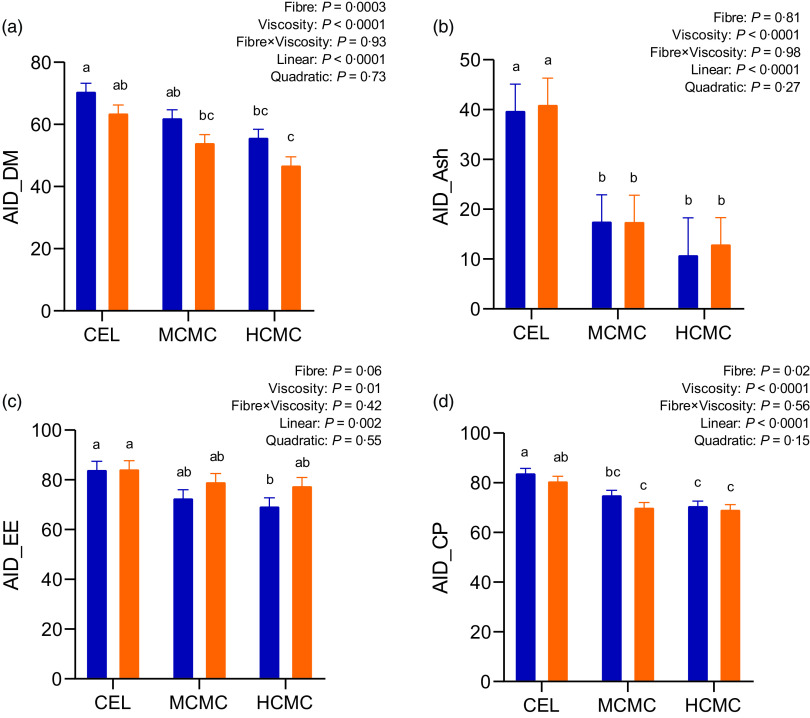
Fibre content and its effect on chyme viscosity are associated with changes in the digestive system of humans and pigs. It is unclear if fibre content and viscosity affect digestive function independently or interactively. We evaluated apparent ileal digestibility (AID) of nutrients and intestinal function in thirty-six ileal-cannulated barrows fed for 29 d either maize-soyabean meal (MSBM) or high-fibre MSBM + 30 % distillers dried grains with solubles (MSBM + DDGS) modified to three levels of viscosity by adding 5 % non-viscous cellulose (CEL), 6·5 % medium-viscous carboxymethylcellulose (MCMC) or 6·5 % high-viscous CMC (HCMC). Digesta were collected on days 27 and 28 and intestinal samples on day 29. Feeding CMC, regardless of fibre content, increased viscosity of whole digesta (P = 0·003) and digesta supernatant (P < 0·0001) compared with CEL. Feeding MSBM + DDGS or CMC decreased AID of DM (P = 0·003; P < 0·0001) and crude protein (P = 0·02; P < 0·0001) compared with MSBM or CEL. Feeding CMC regardless of fibre content increased jejunal crypt depth (P = 0·02) and ileal goblet cell area (P = 0·004) compared with CEL. Adding DDGS or CMC did not affect villus height and gene expression of jejunal monosaccharide and amino acid transporters. Feeding HCMC, regardless of fibre content, elevated amylase activity by 46 and 50 % in jejunal (P = 0·03) and ileal digesta (P = 0·01) compared with CEL. In summary, diets with increased viscosity decreased nutrient digestibility and induced intestinal changes that were independent of the amount of fibre fed.
纤维含量及其对食糜黏度的影响与人类和猪的消化系统变化有关。目前尚不清楚纤维含量和黏度是否独立或相互作用影响消化功能。我们用 29 天时间评估了 36 头回肠末端被套管的阉公猪的养分表观回肠消化率(AID)和肠道功能,这些猪分别饲喂玉米-豆粕(MSBM)或高纤维 MSBM+30%干酒糟及其可溶物(MSBM+DDGS),后一种日粮通过添加 5%非粘性纤维素(CEL)、6·5%中粘性羧甲基纤维素(MCMC)或 6·5%高粘性 CMC(HCMC),将黏度调整为 3 个水平。在第 27 和 28 天收集食糜,第 29 天收集肠道样本。与 CEL 相比,无论纤维含量如何,饲喂 CMC 均增加了全食糜(P = 0·003)和食糜上清液的黏度(P < 0·0001)。与 MSBM 或 CEL 相比,饲喂 MSBM+DDGS 或 CMC 降低了 DM(P = 0·003;P < 0·0001)和粗蛋白(P = 0·02;P < 0·0001)的 AID。与 CEL 相比,无论纤维含量如何,饲喂 CMC 均增加了空肠隐窝深度(P = 0·02)和回肠杯状细胞面积(P = 0·004)。添加 DDGS 或 CMC 并没有影响空肠绒毛高度和单糖及氨基酸转运载体的基因表达。无论纤维含量如何,饲喂 HCMC 使空肠(P = 0·03)和回肠食糜(P = 0·01)的淀粉酶活性分别提高了 46%和 50%,与 CEL 相比。总之,黏度增加的日粮降低了养分消化率,并引起了与饲喂纤维量无关的肠道变化。