Ni Mengwei, Wang Haojia, Wang Miaomiao, Zhou Wei, Zhang Jingyuan, Wu Jiarui, Zhang Dan, Jing Zhiwei, Liu Xinkui, Wu Zhishan, Guo Siyu, Jia Shanshan, Zhang Xiaomeng, Sheng Xiaoguang
Department of Clinical Chinese Pharmacy, School of Chinese Materia Medica, Beijing University of Chinese Medicine, Beijing, China.
China Academy of Chinese Medicine Sciences, Beijing, China.
Front Pharmacol. 2021 Jan 29;11:631170. doi: 10.3389/fphar.2020.631170. eCollection 2020.
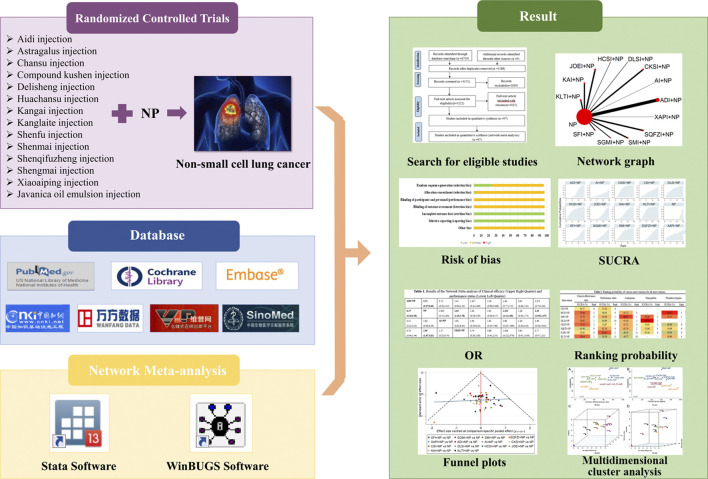
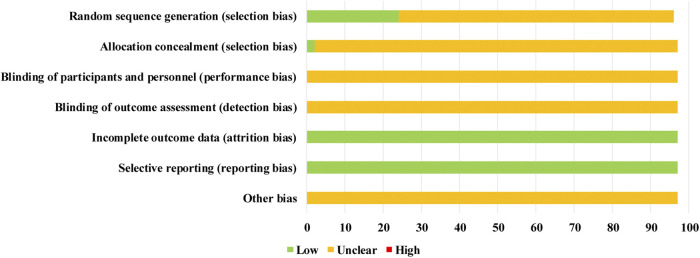
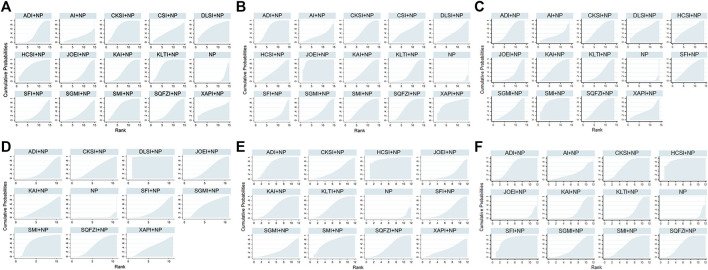
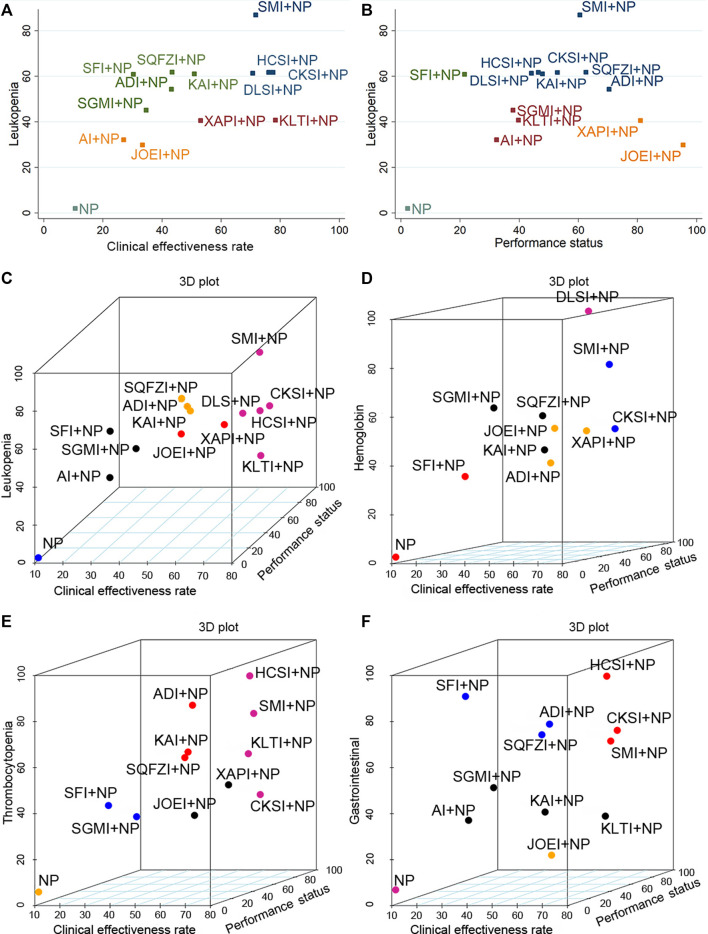
As non-small cell lung cancer (NSCLC) seriously threatens human health, several clinical studies have reported that Chinese herbal injections (CHIs) combined with vinorelbine and cisplatin (NP) are beneficial. This multidimensional network meta-analysis was performed to explore the preferable options among different CHIs for treating NSCLC. A literature search was performed in several databases to identify randomized controlled trials (RCTs) of CHIs in the treatment of NSCLC from inception to January 31, 2019. Final included studies met the eligibility criteria and methodological quality recommendations. Data analysis was performed using Stata 13.0 and WinBUGS 14.0 software. Each outcome was presented as an odds ratio and the surface under the cumulative ranking curve value (SCURA). The "scatterplot3d" package in R 3.6.1 software was used to perform multidimensional cluster analysis. Ultimately, 97 eligible RCTs involving 7,440 patients and 14 CHIs were included in this network meta-analysis. Combined with NP chemotherapy, Kanglaite injection plus NP exhibited a better impact on the clinical effectiveness rate (SCURA probability: 78.34%), and Javanica oil emulsion injection plus NP was better in the performance status (95.44%). Huachansu injection plus NP was dominant in reducing thrombocytopenia (92.67%) and gastrointestinal reactions (92.52%). As to multidimensional cluster analysis, Shenmai injection plus NP was superior considering improving the clinical effectiveness rate, performance status and relieving leukopenia. The combination of CHIs and NP has a better impact on patients with NSCLC than NP alone. Among them, Shenmai injection plus NP, Kanglaite injection plus NP and Javanica oil emulsion injection plus NP were notable. Nevertheless, more multicenter and better designed RCTs are needed to validate our findings.
由于非小细胞肺癌(NSCLC)严重威胁人类健康,多项临床研究报告称,中药注射剂(CHIs)联合长春瑞滨和顺铂(NP)具有益处。进行这项多维度网络荟萃分析以探索不同CHIs治疗NSCLC的更优选择。在多个数据库中进行文献检索,以识别从起始到2019年1月31日CHIs治疗NSCLC的随机对照试验(RCTs)。最终纳入的研究符合纳入标准和方法学质量建议。使用Stata 13.0和WinBUGS 14.0软件进行数据分析。每个结局以比值比和累积排序曲线下面积值(SCURA)表示。使用R 3.6.1软件中的“scatterplot3d”包进行多维度聚类分析。最终,这项网络荟萃分析纳入了97项符合条件的RCTs,涉及7440例患者和14种CHIs。与NP化疗联合使用时,康莱特注射液联合NP对临床有效率的影响更好(SCURA概率:78.34%),鸦胆子油乳注射液联合NP在体能状态方面表现更好(95.44%)。华蟾素注射液联合NP在减少血小板减少症(92.67%)和胃肠道反应(92.52%)方面占优势。至于多维度聚类分析,参麦注射液联合NP在提高临床有效率、体能状态和缓解白细胞减少方面更具优势。CHIs与NP联合使用对NSCLC患者的影响优于单独使用NP。其中,参麦注射液联合NP、康莱特注射液联合NP和鸦胆子油乳注射液联合NP值得关注。然而,需要更多多中心且设计更好的RCTs来验证我们的研究结果。