Nord Camilla L
MRC Cognition and Brain Sciences Unit, University of Cambridge, 15 Chaucer Road, Cambridge, CB2 7EF UK.
Curr Behav Neurosci Rep. 2021;8(1):11-19. doi: 10.1007/s40473-021-00226-9. Epub 2021 Feb 15.
Clinical response to brain stimulation treatments for depression is highly variable. A major challenge for the field is predicting an individual patient's likelihood of response. This review synthesises recent developments in neural predictors of response to targeted brain stimulation in depression. It then proposes a framework to evaluate the clinical potential of putative 'biomarkers'.
Largely, developments in identifying putative predictors emerge from two approaches: data-driven, including machine learning algorithms applied to resting state or structural neuroimaging data, and theory-driven, including task-based neuroimaging. Theory-driven approaches can also yield mechanistic insight into the cognitive processes altered by the intervention.
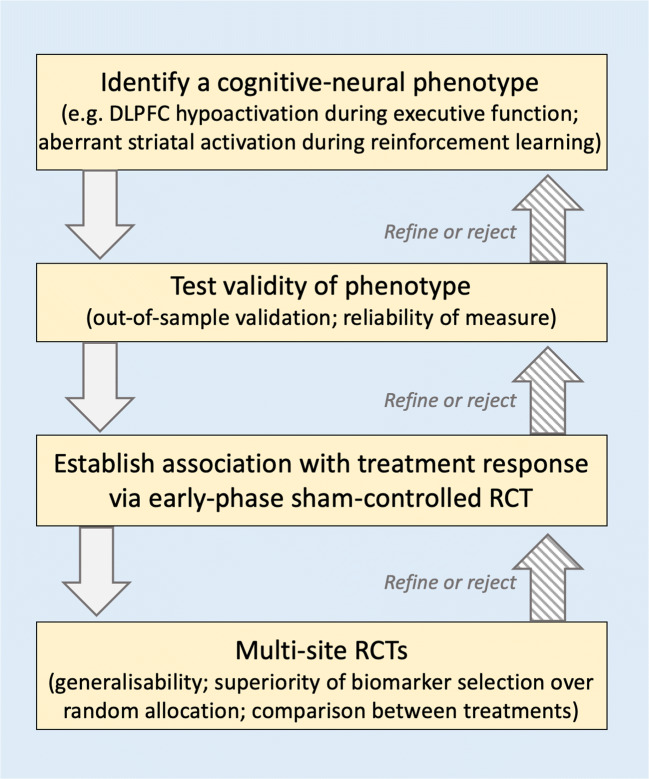
A pragmatic framework for discovery and testing of biomarkers of brain stimulation response in depression is proposed, involving (1) identification of a cognitive-neural phenotype; (2) confirming its validity as putative biomarker, including out-of-sample replicability and within-subject reliability; (3) establishing the association between this phenotype and treatment response and/or its modifiability with particular brain stimulation interventions via an early-phase randomised controlled trial RCT; and (4) multi-site RCTs of one or more treatment types measuring the generalisability of the biomarker and confirming the superiority of biomarker-selected patients over randomly allocated groups.
抑郁症脑刺激治疗的临床反应差异很大。该领域面临的一个主要挑战是预测个体患者的反应可能性。本综述总结了抑郁症靶向脑刺激反应的神经预测指标的最新进展。然后提出了一个框架来评估假定“生物标志物”的临床潜力。
在很大程度上,确定假定预测指标的进展来自两种方法:数据驱动,包括应用于静息态或结构神经影像数据的机器学习算法;理论驱动,包括基于任务的神经影像。理论驱动的方法还可以对干预改变的认知过程产生机制性见解。
提出了一个用于发现和测试抑郁症脑刺激反应生物标志物的实用框架,包括:(1)识别认知神经表型;(2)确认其作为假定生物标志物的有效性,包括样本外可重复性和受试者内可靠性;(3)通过早期随机对照试验(RCT)建立这种表型与治疗反应之间的关联和/或其对特定脑刺激干预的可修饰性;(4)对一种或多种治疗类型进行多中心RCT,测量生物标志物的普遍性,并确认生物标志物选择的患者优于随机分配组。