Department of Psychiatry and Behavioral Sciences, Stanford University School of Medicine, 401 Quarry Road, Stanford, CA, 94304, USA.
Mental Illness Research, Education and Clinical Center, VA Palo Alto Health Care System, 3801 Miranda Ave, Palo Alto, CA, 94304, USA.
BMC Psychiatry. 2021 Jan 13;21(1):35. doi: 10.1186/s12888-020-03030-z.
Although repetitive transcranial magnetic stimulation ('TMS') is becoming a gold standard treatment for pharmacoresistant depression, we lack neural target biomarkers for identifying who is most likely to respond to TMS and why. To address this gap in knowledge we evaluate neural targets defined by activation and functional connectivity of the dorsolateral prefrontal cortex-anchored cognitive control circuit, regions of the default mode network and attention circuit, and interactions with the subgenual anterior cingulate. We evaluate whether these targets and interactions between them change in a dose-dependent manner, whether changes in these neural targets correspond to changes in cognitive behavioral performance, and whether baseline and early change in neural target and cognitive behavioral performance predict subsequent symptom severity, suicidality, and quality of life outcomes. This study is designed as a pragmatic, mechanistic trial partnering with the National Clinical TMS Program of the Veteran's Health Administration.
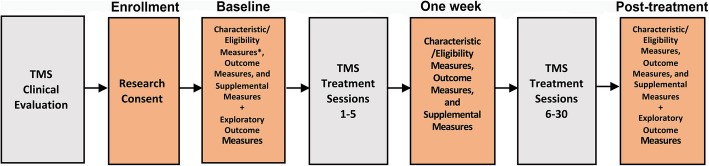
Target enrollment consists of 100 veterans with pharmacoresistant Major Depressive Disorder (MDD). All veterans will receive a clinical course of TMS and will be assessed at 'baseline' pre-TMS commencement, 'first week' after initiation of TMS (targeting five sessions) and 'post-treatment' at the completion of TMS (targeting 30 sessions). Veterans will be assessed using functional magnetic resonance imaging (fMRI), a cognitive behavioral performance battery, and established questionnaires. Multivariate linear mixed models will be used to assess whether neural targets change with TMS as a function of dose (Aim 1), whether extent and change of neural target relates to and predicts extent of behavioral performance (Aim 3), and whether extent of neural target change predicts improvement in symptom severity, suicidality, and quality of life (Aim 3). For all three aims, we will also assess the contribution of baseline moderators such as biological sex and age.
To our knowledge, our study will be the first pragmatic, mechanistic observational trial to use fMRI imaging and cognitive-behavioral performance as biomarkers of TMS treatment response in pharmacoresistant MDD. The results of this trial will allow providers to select suitable candidates for TMS treatment and better predict treatment response by assessing circuit connectivity and cognitive-behavioral performance at baseline and during early treatment.
ClinicalTrials.gov NCT04663481 , December 5th, 2020, retrospectively registered. The first veteran was enrolled October 30th, 2020.
尽管重复经颅磁刺激(rTMS)正在成为治疗耐药性抑郁症的金标准治疗方法,但我们缺乏识别哪些患者最有可能对 rTMS 有反应以及原因的神经靶标生物标志物。为了弥补这一知识空白,我们评估了以背外侧前额叶皮层为锚定的认知控制回路的激活和功能连接、默认模式网络和注意力回路的区域以及与前扣带回亚区的相互作用所定义的神经靶标。我们评估这些靶标以及它们之间的相互作用是否以剂量依赖性的方式发生变化,这些神经靶标是否与认知行为表现的变化相对应,以及神经靶标和认知行为表现的基线和早期变化是否预测随后的症状严重程度、自杀意念和生活质量结果。这项研究旨在与退伍军人事务部国家临床 TMS 计划合作进行一项实用的、机制性的试验。
目标入组包括 100 名患有耐药性重度抑郁症(MDD)的退伍军人。所有退伍军人将接受 rTMS 的临床疗程,并在 rTMS 开始前的“基线”、启动后第一周(针对五节 rTMS)和 rTMS 结束后的“治疗后”进行评估(针对 30 节 rTMS)。退伍军人将接受功能磁共振成像(fMRI)、认知行为表现测试和已建立的问卷评估。多变量线性混合模型将用于评估神经靶标是否随着 TMS 的剂量而发生变化(目标 1),神经靶标的程度和变化是否与行为表现的程度相关并预测行为表现的程度(目标 3),以及神经靶标变化的程度是否预测症状严重程度、自杀意念和生活质量的改善(目标 3)。对于所有三个目标,我们还将评估生物性别和年龄等基线调节因素的贡献。
据我们所知,我们的研究将是第一项使用 fMRI 成像和认知行为表现作为 rTMS 治疗耐药性 MDD 反应生物标志物的实用、机制性观察性试验。该试验的结果将使提供者能够通过在基线和早期治疗期间评估回路连通性和认知行为表现,选择合适的 rTMS 治疗候选者,并更好地预测治疗反应。
ClinicalTrials.gov NCT04663481,2020 年 12 月 5 日,回顾性注册。第一位退伍军人于 2020 年 10 月 30 日入组。