Mass Elvira, Gentek Rebecca
Developmental Biology of the Immune System, Life & Medical Sciences (LIMES) Institute, University of Bonn, Bonn, Germany.
Centre for Inflammation Research & Centre for Reproductive Health, The Queen's Medical Research Institute, University of Edinburgh, Edinburgh, United Kingdom.
Front Cell Dev Biol. 2021 Feb 23;9:648313. doi: 10.3389/fcell.2021.648313. eCollection 2021.
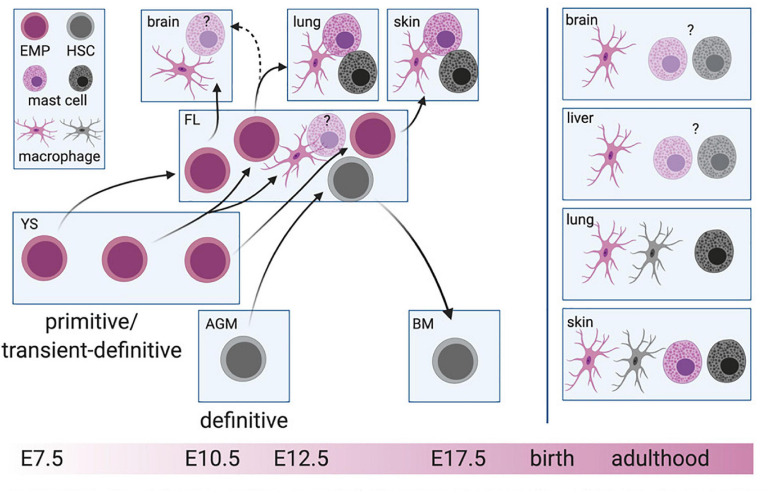
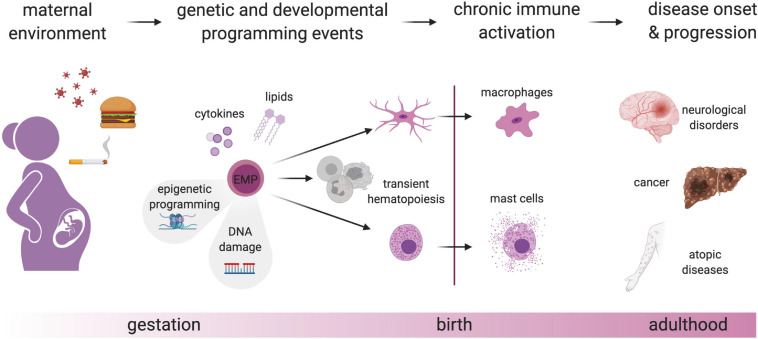
Tissue-resident innate immune cells exert a wide range of functions in both adult homeostasis and pathology. Our understanding of when and how these cellular networks are established has dramatically changed with the recognition that many lineages originate at least in part from fetal sources and self-maintain independently from hematopoietic stem cells. Indeed, fetal-derived immune cells are found in most organs and serous cavities of our body, where they reside throughout the entire lifespan. At the same time, there is a growing appreciation that pathologies manifesting in adulthood may be caused by adverse early life events, a concept known as "developmental origins of health and disease" (DOHaD). Yet, whether fetal-derived immune cells are mechanistically involved in DOHaD remains elusive. In this review, we summarize our knowledge of fetal hematopoiesis and its contribution to adult immune compartments, which results in a "layered immune system." Based on their ontogeny, we argue that fetal-derived immune cells are prime transmitters of long-term consequences of prenatal adversities. In addition to increasing disease susceptibility, these may also directly cause inflammatory, degenerative, and metabolic disorders. We explore this notion for cells generated from erythro-myeloid progenitors (EMP) produced in the extra-embryonic yolk sac. Focusing on macrophages and mast cells, we present emerging evidence implicating them in lifelong disease by either somatic mutations or developmental programming events resulting from maternal and early environmental perturbations.
组织驻留固有免疫细胞在成人稳态和病理过程中发挥着广泛的功能。随着认识到许多细胞谱系至少部分起源于胎儿来源并独立于造血干细胞进行自我维持,我们对这些细胞网络何时以及如何建立的理解发生了巨大变化。事实上,胎儿来源的免疫细胞存在于我们身体的大多数器官和浆膜腔中,并在整个生命周期中驻留。与此同时,人们越来越认识到成年期出现的病理状况可能由早期不良生活事件引起,这一概念被称为“健康与疾病的发育起源”(DOHaD)。然而,胎儿来源的免疫细胞是否在机制上参与DOHaD仍然不清楚。在这篇综述中,我们总结了我们对胎儿造血及其对成人免疫区室的贡献的认识,这导致了一个“分层免疫系统”。基于它们的个体发生,我们认为胎儿来源的免疫细胞是产前逆境长期后果的主要传递者。除了增加疾病易感性外,这些细胞还可能直接导致炎症、退行性和代谢紊乱。我们探讨了由胚外卵黄囊中产生的红髓系祖细胞(EMP)产生的细胞的这一概念。聚焦于巨噬细胞和肥大细胞,我们展示了新出现的证据,表明它们通过体细胞突变或由母体和早期环境扰动导致的发育编程事件而与终身疾病有关。