Dong Gang, Huang Xiao-Quan, Zhu Yu-Li, Ding Hong, Li Feng, Chen Shi-Yao
Department of Gastroenterology and Hepatology, Zhongshan Hospital, Fudan University, Shanghai, China.
Department of Ultrasound, Zhongshan Hospital, Fudan University, Shanghai, China.
Ann Transl Med. 2021 Feb;9(4):289. doi: 10.21037/atm-20-4912.
Cirrhotic patients with portal vein thrombosis (PVT) may have a high risk of hepatic decompensation and increased mortality. This study aimed to investigate if increased portal vein diameter is associated with PVT development.
A total of 174 cirrhotic patients were enrolled between February 1 and August 31, 2017. All participants were divided into PVT (n=62) and non-PVT (n=112) groups based on the thrombus that was detected by ultrasonography and confirmed by computed tomography angiography (CTA).
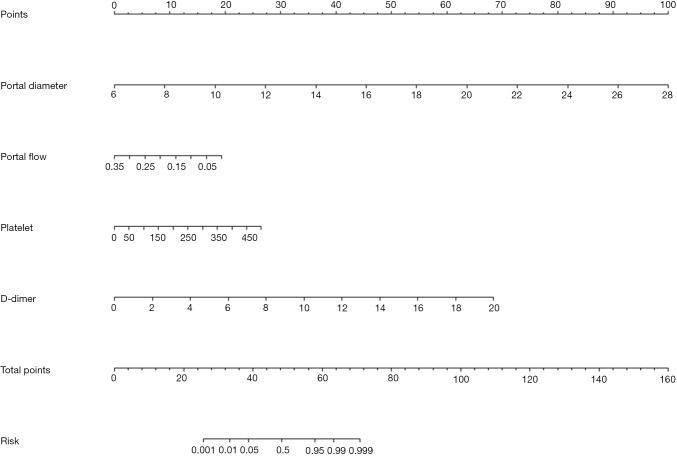
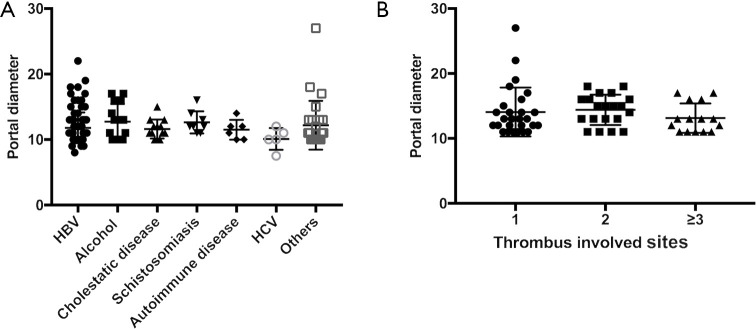
The study participants, aged 54.7±10.5 years (PVT) and 55.8±11.6 years (non-PVT), were included in this analysis. The Child-Pugh score of PVT or non-PVT was 6.6±1.3 and 5.8±0.9, respectively. Hepatitis B virus (HBV) is the primary etiological agent of cirrhosis. Logistic regression, receiver operating characteristic (ROC), and nomograph analysis designated portal diameter as the strongest independent risk factor for predicting PVT development [odds ratio (OR): 3.96, area under the ROC curve (AUC): 0.88; P<0.01], and the cutoff with predictive value for PVT development was >12.5 mm. No differences were observed in the overall survival (OS) in cirrhosis with or without PVT or stratifying on portal diameter based on the cutoff value.
Increased portal diameter is associated with an increased risk of PVT development. Patients with cirrhosis and increased portal diameter are a high-risk subgroup that may need thromboprophylaxis.
门静脉血栓形成(PVT)的肝硬化患者可能有肝失代偿风险增加和死亡率升高的情况。本研究旨在调查门静脉直径增加是否与PVT的发生有关。
2017年2月1日至8月31日共纳入174例肝硬化患者。所有参与者根据超声检查发现并经计算机断层血管造影(CTA)证实的血栓分为PVT组(n = 62)和非PVT组(n = 112)。
本分析纳入了年龄为54.7±10.5岁(PVT组)和55.8±11.6岁(非PVT组)的研究参与者。PVT组和非PVT组的Child-Pugh评分分别为6.6±1.3和5.8±0.9。乙型肝炎病毒(HBV)是肝硬化的主要病因。逻辑回归、受试者工作特征(ROC)和列线图分析将门静脉直径确定为预测PVT发生的最强独立危险因素[比值比(OR):3.96,ROC曲线下面积(AUC):0.88;P<0.01],预测PVT发生的临界值为>12.5 mm。无论有无PVT的肝硬化患者,或根据临界值按门静脉直径分层,总体生存率(OS)均未观察到差异。
门静脉直径增加与PVT发生风险增加有关。肝硬化且门静脉直径增加的患者是一个可能需要进行血栓预防的高危亚组。