Felix Susanne E A, Oerlemans Martinus I F, Ramjankhan Faiz Z, Muller Steven A, Kirkels Hans H, van Laake Linda W, Suyker Willem J L, Asselbergs Folkert W, de Jonge Nicolaas
Department of Cardiology, University Medical Center of Utrecht, Heidelberglaan 100, Utrecht, 3584 CX, The Netherlands.
Department of Cardiothoracic Surgery, University Medical Center of Utrecht, Utrecht, The Netherlands.
ESC Heart Fail. 2021 Jun;8(3):1796-1805. doi: 10.1002/ehf2.13234. Epub 2021 Mar 12.
Mechanical circulatory support (MCS) results in substantial improvement of prognosis and functional capacity. Currently, duration of MCS as a bridge to transplantation (BTT) is often prolonged due to shortage of donor hearts. Because long-term results of exercise capacity after MCS are largely unknown, we studied serial cardiopulmonary exercise tests (CPETs) during the first year after MCS implantation.
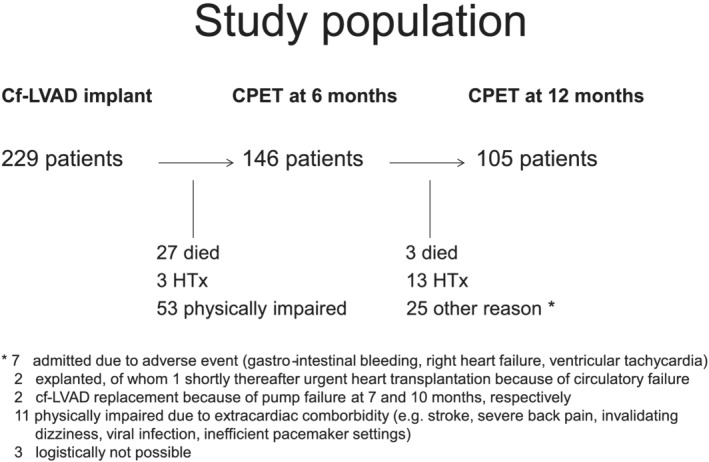
Cardiopulmonary exercise tests at 6 and 12 months after MCS implantation in BTT patients were retrospectively analysed, including clinical factors related to exercise capacity. A total of 105 MCS patients (67% male, 50 ± 12 years) underwent serial CPET at 6 and 12 months after implantation. Power (105 ± 35 to 114 ± 40 W; P ≤ 0.001) and peak VO2 per kilogram (pVO2/kg) improved significantly (16.5 ± 5.0 to 17.2 ± 5.5 mL/kg/min (P = 0.008)). Improvement in pVO2 between 6 and 12 months after LVAD implantation was not related to heart failure aetiology or haemodynamic severity prior to MCS. We identified maximal heart rate at exercise as an important factor for pVO2. Younger age and lower BMI were related to further improvement. At 12 months, 25 (24%) patients had a normal exercise capacity (Weber classification A, pVO2 > 20 mL/kg/min).
Exercise capacity (power and pVO2) increased significantly between 6 and 12 months after MCS independent of Interagency Registry for Mechanically Assisted Circulatory Support (INTERMACS) profile or heart failure aetiology. Heart rate at exercise importantly relates to exercise capacity. This long-term improvement in exercise capacity is important information for the growing group of long-term MCS patients as this is critical for the quality of life of patients.
机械循环支持(MCS)可显著改善预后和功能能力。目前,由于供体心脏短缺,作为移植桥梁(BTT)的MCS持续时间常常延长。由于MCS后运动能力的长期结果很大程度上未知,我们研究了MCS植入后第一年的系列心肺运动试验(CPET)。
对BTT患者MCS植入后6个月和12个月时的心肺运动试验进行回顾性分析,包括与运动能力相关的临床因素。共有105例MCS患者(67%为男性,年龄50±12岁)在植入后6个月和12个月接受了系列CPET。功率(从105±35瓦提高到114±40瓦;P≤0.001)和每千克峰值摄氧量(pVO2/kg)显著改善(从16.5±5.0毫升/千克/分钟提高到17.2±5.5毫升/千克/分钟,P=0.008)。左心室辅助装置(LVAD)植入后6至12个月pVO2的改善与心力衰竭病因或MCS前的血流动力学严重程度无关。我们确定运动时的最大心率是pVO2的一个重要因素。年龄较小和体重指数较低与进一步改善有关。在12个月时,25例(24%)患者具有正常运动能力(韦伯分类A,pVO2>20毫升/千克/分钟)。
MCS后6至12个月,运动能力(功率和pVO2)显著提高,与机械辅助循环支持机构间注册中心(INTERMACS)概况或心力衰竭病因无关。运动时的心率与运动能力密切相关。运动能力的这种长期改善对于越来越多的长期MCS患者来说是重要信息,因为这对患者的生活质量至关重要。