Division of Cardiac Surgery, Department of Surgery, Northwestern University, Chicago, Illinois.
Department of Surgery, University of Alabama at Birmingham, Birmingham, Alabama.
J Heart Lung Transplant. 2014 Apr;33(4):412-21. doi: 10.1016/j.healun.2013.10.017. Epub 2013 Oct 23.
The severity of pre-implantation heart failure may affect post-implantation health-related quality of life (HRQOL). The purpose of our study was to examine differences in HRQOL from before mechanical circulatory support (MCS) through 1 year after surgery by Interagency Registry for Mechanically Assisted Circulatory Support (INTERMACS) patient profiles.
Data from 1,559 adults with advanced heart failure who received primary continuous-flow pumps between June 23, 2006, and March 31, 2010, and were enrolled in INTERMACS were analyzed. HRQOL data were collected using the EQ-5D-3L survey before implantation and at 3, 6, and 12 months after implantation. Statistical analyses included chi-square and t-tests, using all available data for each time period. Paired t-tests and sensitivity analyses were also conducted.
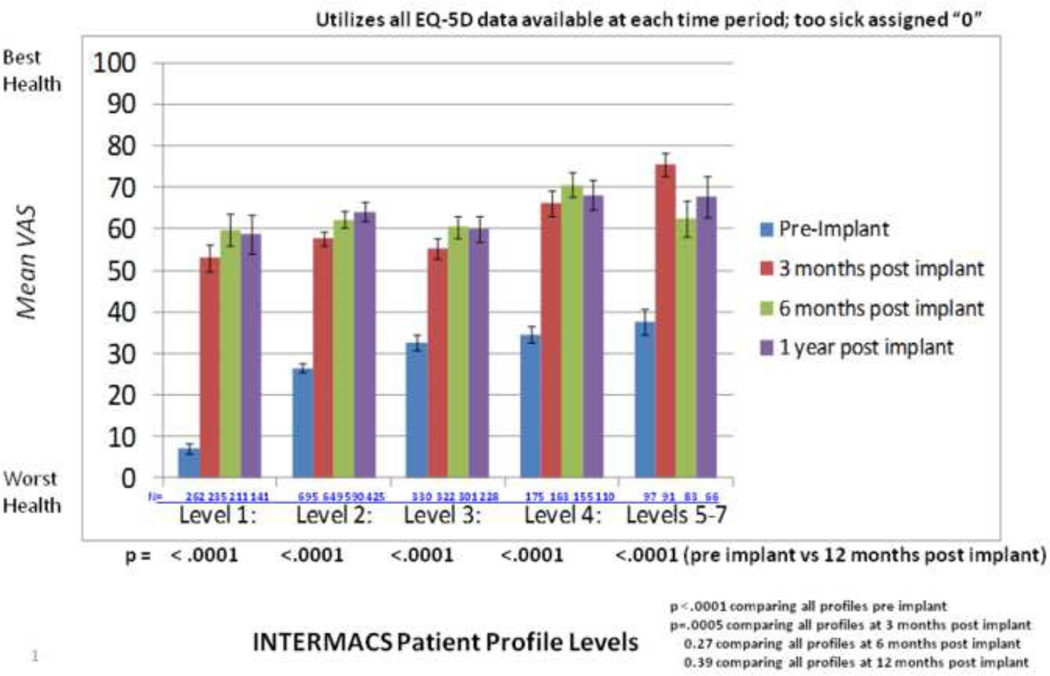
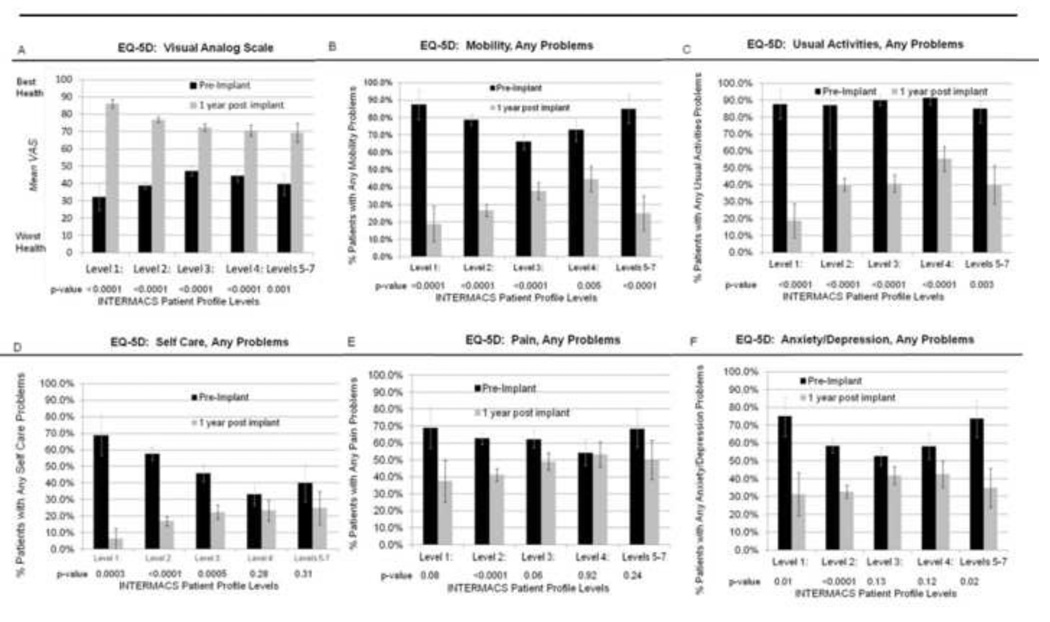
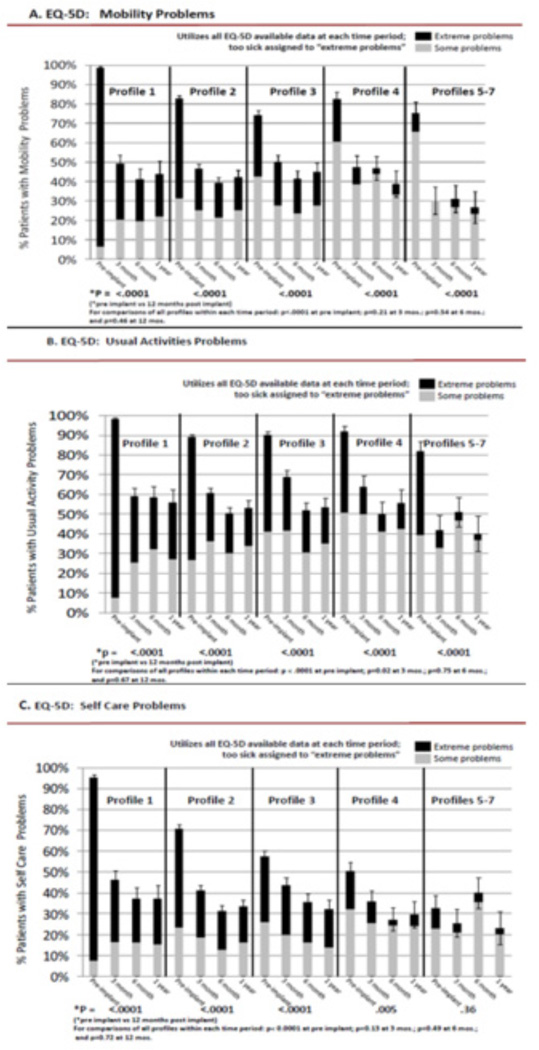
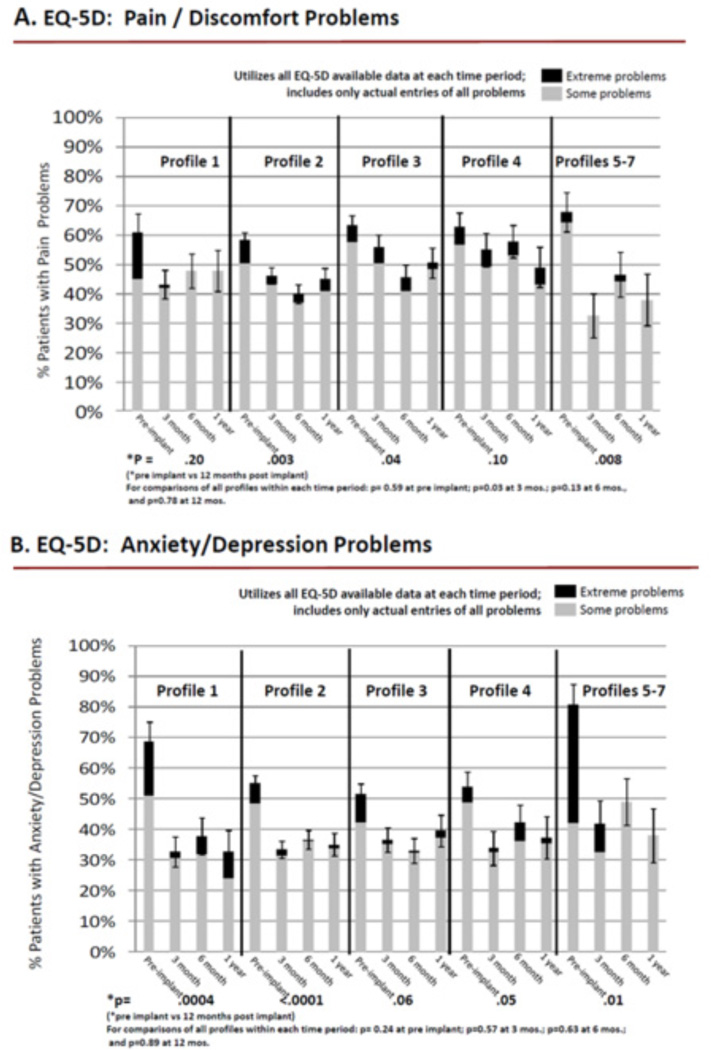
HRQOL was poor before MCS implantation among patients with INTERMACS profiles 1 to 7 and significantly improved after MCS implantation for all profiles. Stratified by INTERMACS profile, problems within each of the 5 dimensions of HRQOL (i.e., mobility, self-care, usual activities, pain, and anxiety/depression) generally decreased from before to after implantation. By 6 months after implantation, patients with all INTERMACS profiles reported similar frequencies of problems for all HRQOL dimensions. Paired t-tests and sensitivity analyses supported almost all of our findings.
HRQOL is poor among advanced heart failure patients with INTERMACS profiles 1 to 7 before MCS implantation and improves to similar levels for patients who remained on MCS 1 year after surgery. Patients have problems in HRQOL dimensions before and after MCS; however, the frequency of reporting problems decreases for all dimensions within most profiles across time.
植入前心力衰竭的严重程度可能会影响植入后的健康相关生活质量(HRQOL)。我们的研究目的是通过 INTERMACS 患者档案检查接受机械循环支持(MCS)前后 1 年的 HRQOL 差异。
分析了 2006 年 6 月 23 日至 2010 年 3 月 31 日期间接受原发性连续流泵治疗的 1559 名晚期心力衰竭成人患者的数据,这些患者均参与了 INTERMACS。在植入前和植入后 3、6 和 12 个月使用 EQ-5D-3L 调查收集 HRQOL 数据。统计分析包括卡方检验和 t 检验,使用每个时间段的所有可用数据。还进行了配对 t 检验和敏感性分析。
在 MCS 植入前,INTERMACS 1 至 7 型患者的 HRQOL 较差,而在 MCS 植入后,所有类型的 HRQOL 均显著改善。根据 INTERMACS 类型分层,HRQOL 的五个维度(即移动性、自我护理、日常活动、疼痛和焦虑/抑郁)内的问题通常从植入前到植入后减少。在植入后 6 个月,所有 INTERMACS 类型的患者在所有 HRQOL 维度上报告的问题频率相似。配对 t 检验和敏感性分析支持了我们的大部分发现。
在 MCS 植入前,INTERMACS 1 至 7 型晚期心力衰竭患者的 HRQOL 较差,而在手术后 1 年继续使用 MCS 的患者 HRQOL 则改善到相似水平。患者在 MCS 前后在 HRQOL 维度上存在问题;然而,在大多数类型中,随着时间的推移,所有维度报告问题的频率都会降低。