Clinic for Gastroenterology, Hepatology and Infectious Diseases, University Hospital Düsseldorf, Medical Faculty of Heinrich Heine University Düsseldorf, Düsseldorf, Germany.
Department of Hepatology and Gastroenterology, Charité University Medicine Berlin, Berlin, Germany.
PLoS One. 2021 Mar 12;16(3):e0247917. doi: 10.1371/journal.pone.0247917. eCollection 2021.
Early detection of hepatocellular carcinoma (HCC), the most common primary liver malignancy, is crucial to offer patients a potentially curative treatment strategy such as surgical resection or liver transplantation (LT). However, easily accessible biomarkers facilitating an early diagnosis of HCC as well as a reliable risk prediction are currently missing. The microRNA(miR)-107 has recently been described as a driver of HCC in both murine and human HCC but data on circulating miR-107 in HCC patients are scarce. In the present study, we evaluated a potential diagnostic and/or prognostic role of circulating miR-107 in patients undergoing tumor resection or LT for early-stage HCC.
The Kmplot bioinformatic tool was used to query publicly available databases (including TCGA, GEO and EGA) in order to analyse the prognostic value of tumoral miR-107 expression in HCC patients (n = 372). Serum levels of miR-107 were measured by qPCR in n = 45 HCC patients undergoing surgical tumor resection (n = 37) or LT (n = 8) as well as n = 18 healthy control samples. Results were correlated with clinical data.
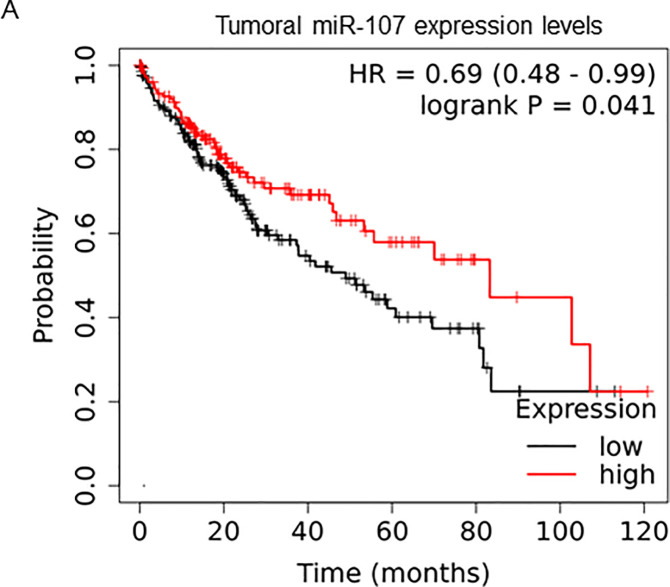
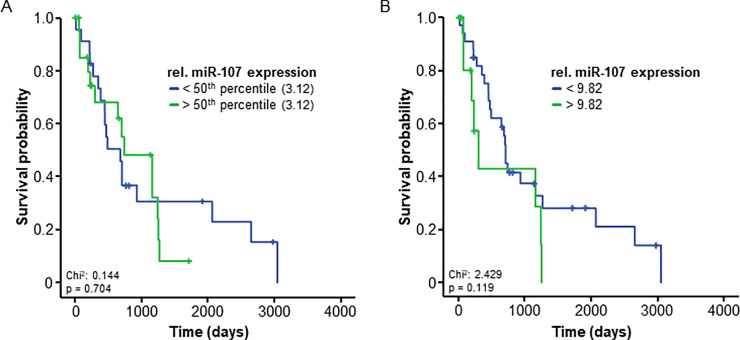
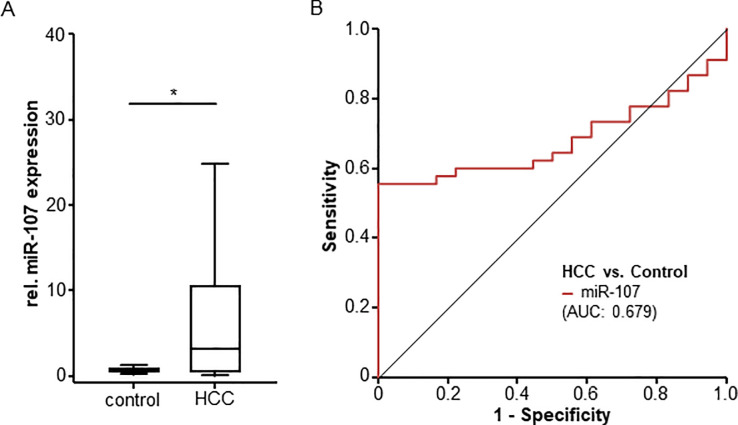
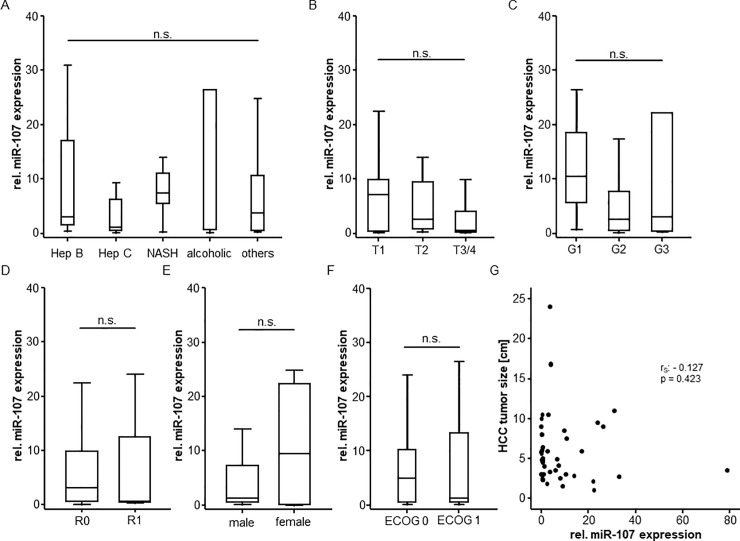
A high tumoral expression of miR-107 was associated with a significantly better overall survival compared to patients with low miR-107 expression levels (HR 0.69, 95% CI 0.48-0.99, p = 0.041). In addition, serum levels of miR-107 were significantly higher in HCC patients when compared to healthy controls. However, miR-107 serum levels in HCC patients were independent of different disease etiology, tumor stage or tumor grading. HCC patients with baseline miR-107 expression levels above a calculated ideal prognostic cut-off value (9.82) showed a clear trend towards an impaired overall survival (p = 0.119).
Tumoral miR-107 expression levels are a potential prognostic marker in early stage HCC. Furthermore, we describe a potential role of circulating miR-107 levels as a diagnostic biomarker in patients with early-stage HCC.
肝细胞癌(HCC)是最常见的原发性肝脏恶性肿瘤,早期检测对于为患者提供潜在的治愈性治疗策略(如手术切除或肝移植(LT))至关重要。然而,目前缺乏便于早期诊断 HCC 以及可靠风险预测的易于获取的生物标志物。miR-107 最近被描述为在鼠和人 HCC 中 HCC 的驱动因素,但关于 HCC 患者循环 miR-107 的数据很少。在本研究中,我们评估了循环 miR-107 在接受手术切除或 LT 治疗早期 HCC 的患者中的潜在诊断和/或预后作用。
使用 Kmplot 生物信息学工具查询公开可用的数据库(包括 TCGA、GEO 和 EGA),以分析 HCC 患者肿瘤 miR-107 表达的预后价值(n = 372)。通过 qPCR 测量 n = 45 例接受手术肿瘤切除(n = 37)或 LT(n = 8)的 HCC 患者以及 n = 18 例健康对照样本中的 miR-107 血清水平。结果与临床数据相关。
与 miR-107 低表达水平的患者相比,高肿瘤 miR-107 表达与总生存率显著提高相关(HR 0.69,95%CI 0.48-0.99,p = 0.041)。此外,与健康对照组相比,HCC 患者的 miR-107 血清水平明显更高。然而,HCC 患者的 miR-107 血清水平与不同的疾病病因、肿瘤分期或肿瘤分级无关。基线 miR-107 表达水平高于计算出的理想预后截止值(9.82)的 HCC 患者的总生存明显呈下降趋势(p = 0.119)。
肿瘤 miR-107 表达水平是早期 HCC 的潜在预后标志物。此外,我们描述了循环 miR-107 水平作为早期 HCC 患者诊断生物标志物的潜在作用。