Xiangya School of Public Health, Central South University, Changsha, China.
Center for Information Statistics, Health Commission of Hunan Province, Changsha, China.
PLoS One. 2021 Mar 12;16(3):e0248157. doi: 10.1371/journal.pone.0248157. eCollection 2021.
Shortening the length of stay (LOS) is a potential and sustainable way to relieve the pressure that type 2 diabetes mellitus (T2DM) patients placed on the public health system.
Multi-stage random sampling was used to obtain qualified hospitals and electronic medical records for patients discharged with T2DM in 2018. A box-cox transformation was adopted to normalize LOS. Multilevel model was used to verify hospital cluster effect on LOS variations and screen potential factors for LOS variations from both individual and hospital levels.
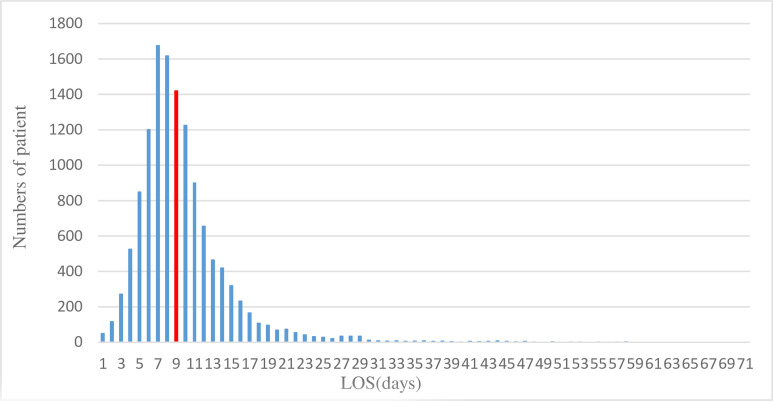
50 hospitals and a total of 12,888 T2DM patients were included. Significant differences in LOS variations between hospitals, and a hospital cluster effect on LOS variations (t = 92.188, P<0.001) was detected. The results showed that female patients, patients with new rural cooperative' medical insurance, hospitals with more beds, and hospitals with faster bed turnovers had shorter LOS. Conversely, elderly patients, patients with urban workers' medical insurance, patients requiring surgery, patients with the International Classification of Diseases coded complication types E11.1, E11.2, E11.4, E11.5, and other complications cardiovascular diseases, grade III hospitals, hospitals with a lower doctor-to-nurse ratio, and hospitals with more daily visits per doctor had longer LOS.
The evidence proved that hospital cluster effect on LOS variation did exist. Complications and patients features at individual level, as well as organization and resource characteristics at hospital level, had impacted LOS variations to varying degrees. To shorten LOS and better meet the medical demand for T2DM patients, limited health resources must be allocated and utilized rationally at hospital level, and the patients with the characteristics of longer LOS risk must be identified in time. More influencing factors on LOS variations at different levels are still worth of comprehensive exploration in the future.
缩短住院时间(LOS)是缓解 2 型糖尿病(T2DM)患者对公共卫生系统压力的一种潜在且可持续的方法。
采用多阶段随机抽样方法,获取 2018 年 T2DM 出院患者合格医院和电子病历。采用 Box-Cox 变换对 LOS 进行正态化。采用多水平模型验证 LOS 变化的医院聚类效应,并从个体和医院水平筛选 LOS 变化的潜在因素。
纳入 50 家医院共 12888 例 T2DM 患者。检测到医院间 LOS 变化存在显著差异,存在 LOS 变化的医院聚类效应(t=92.188,P<0.001)。结果显示,女性患者、新型农村合作医疗保险患者、床位较多的医院、床位周转率较快的医院 LOS 较短。相反,老年患者、城镇职工医疗保险患者、需要手术的患者、国际疾病分类编码并发症类型 E11.1、E11.2、E11.4、E11.5 及其他心血管疾病并发症、三级医院、医生与护士比例较低的医院和每位医生的每日就诊次数较多的医院 LOS 较长。
证据证明 LOS 变化存在医院聚类效应。个体层面的并发症和患者特征,以及医院层面的组织和资源特征,都在不同程度上影响了 LOS 的变化。为了缩短 LOS 并更好地满足 T2DM 患者的医疗需求,必须在医院层面合理分配和利用有限的卫生资源,及时识别 LOS 风险较高的患者。未来仍值得综合探讨不同层面 LOS 变化的更多影响因素。