Yang Can, Hu Chongze, Xiang Congying, Nie Hongbo, Gu Xinfu, Xie Lin, He Jiaqing, Zhang Wenqing, Yu Zhiyang, Luo Jian
State Key Laboratory of Photocatalysis on Energy and Environment, College of Chemistry, Fuzhou University, Fuzhou, Fujian 350002, P. R. China.
Department of NanoEngineering, Program of Materials Science and Engineering, University of California San Diego, La Jolla, CA 92093, USA.
Sci Adv. 2021 Mar 12;7(11). doi: 10.1126/sciadv.abf6667. Print 2021 Mar.
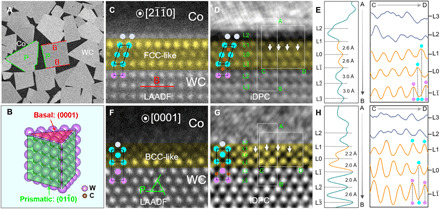
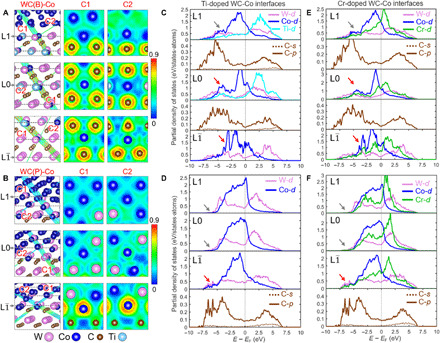
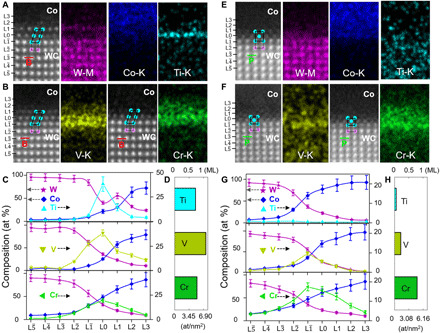
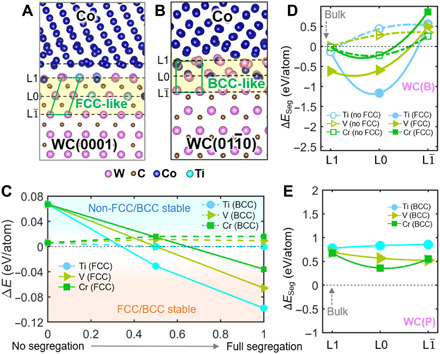
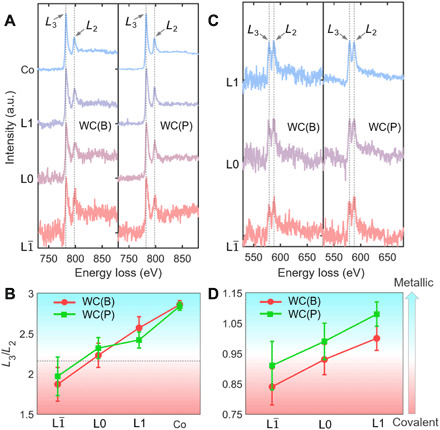
Metal-ceramic interfaces are scientifically interesting and technologically important. However, the transition of chemical bonding character from a metal to a nonoxide ceramic is not well understood. The effects of solute segregation and interfacial structural transitions are even more elusive. In this study, aberration-corrected electron microscopy is combined with atomic-resolution energy-dispersive x-ray and electron energy loss spectroscopy to investigate Ti-, V-, and Cr-segregated WC-Co interfaces as model systems. The experiments reveal the general anisotropic formation of reconstructed trilayer-like superstructures with segregant-specific compositional profiles that facilitate the transition from covalent to metallic electronic structures. Density functional theory calculations confirm the gradual increasing metallicity from WC to Co in the interfacial trilayers via increasing metallic solute concentration. This study uncovers unprecedented details of the sophisticated interfacial superstructures at metal-ceramic interfaces. It sheds light on how a metal transits to a ceramic at a "general" interface with strong segregation.
金属-陶瓷界面在科学上具有趣味性,在技术上具有重要性。然而,化学键性质从金属向非氧化物陶瓷的转变尚未得到很好的理解。溶质偏析和界面结构转变的影响更是难以捉摸。在本研究中,将像差校正电子显微镜与原子分辨率能量色散X射线和电子能量损失谱相结合,以研究Ti、V和Cr偏析的WC-Co界面作为模型体系。实验揭示了具有偏析剂特异性成分分布的重构三层状超结构的一般各向异性形成,这有助于从共价电子结构向金属电子结构的转变。密度泛函理论计算证实,通过增加金属溶质浓度,界面三层中从WC到Co的金属性逐渐增强。这项研究揭示了金属-陶瓷界面处复杂界面超结构前所未有的细节。它阐明了金属在具有强烈偏析的“一般”界面处如何转变为陶瓷。