Department of Zoology, University of Oxford, Oxford, UK.
School of Public Health, Tel Aviv University, Tel Aviv, Israel.
Sci Rep. 2021 Mar 12;11(1):5825. doi: 10.1038/s41598-021-84672-1.
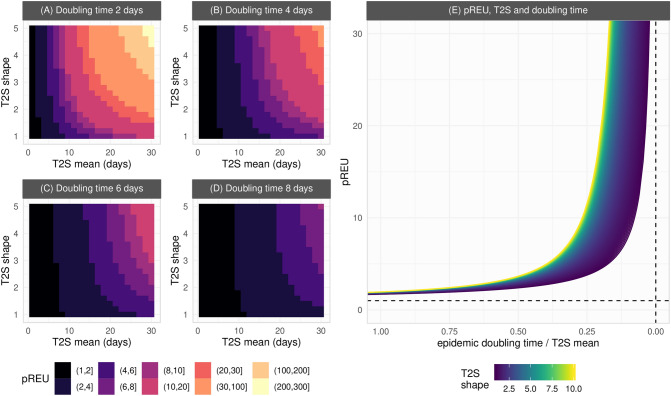
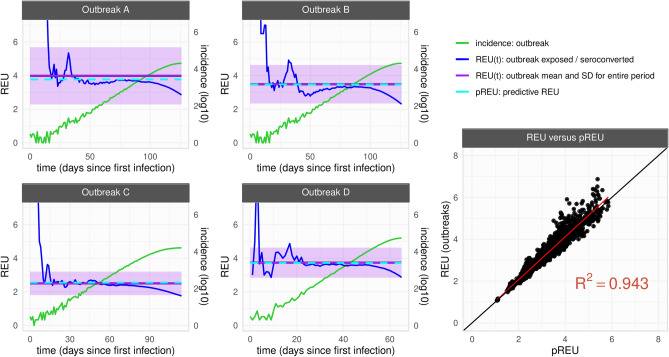
For endemic pathogens, seroprevalence mimics overall exposure and is minimally influenced by the time that recent infections take to seroconvert. Simulating spatially-explicit and stochastic outbreaks, we set out to explore how, for emerging pathogens, the mix of exponential growth in infection events and a constant rate for seroconversion events could lead to real-time significant differences in the total numbers of exposed versus seropositive. We find that real-time seroprevalence of an emerging pathogen can underestimate exposure depending on measurement time, epidemic doubling time, duration and natural variation in the time to seroconversion among hosts. We formalise mathematically how underestimation increases non-linearly as the host's time to seroconversion is ever longer than the pathogen's doubling time, and how more variable time to seroconversion among hosts results in lower underestimation. In practice, assuming that real-time seroprevalence reflects the true exposure to emerging pathogens risks overestimating measures of public health importance (e.g. infection fatality ratio) as well as the epidemic size of future waves. These results contribute to a better understanding and interpretation of real-time serological data collected during the emergence of pathogens in infection-naive host populations.
对于地方性病原体,血清流行率模拟了总体暴露情况,并且很少受到近期感染到血清转化所需时间的影响。通过模拟空间明确和随机爆发,我们旨在探索新兴病原体的感染事件呈指数增长与血清转化率呈常数率的混合情况如何导致暴露人数与血清阳性人数之间的实时显著差异。我们发现,新兴病原体的实时血清流行率可能会根据测量时间、流行倍增时间、宿主血清转化率的持续时间和自然变化而低估暴露情况。我们从数学上形式化了这种低估如何随着宿主血清转化率比病原体倍增时间长得多时呈非线性增加,以及宿主血清转化率的变化越大导致的低估越低。在实践中,假设实时血清流行率反映了对新兴病原体的真实暴露情况,可能会高估与公共卫生重要性(例如感染病死率)以及未来波次的流行规模相关的措施。这些结果有助于更好地理解和解释在感染新宿主群体中出现病原体时收集的实时血清学数据。