Fundacion Ecuatoriana Para Investigación en Salud, Quinindé, Ecuador.
Institute of Health Sciences, Federal University of Bahia, Salvador, Bahia, Brazil.
Parasit Vectors. 2021 Feb 5;14(1):95. doi: 10.1186/s13071-020-04575-4.
Although Toxocara spp. infection has a worldwide distribution, to our knowledge, no data from birth cohorts have been reported in published studies on the potential for congenital transmission and determinants of infection in early childhood.
We followed 290 mother-infant pairs from birth to 5 years of age through periodic collection of data and samples at birth, 7 and 13 months and 2, 3 and 5 years of age. Data on potential risk factors and confounders were collected by maternal questionnaire. Blood for plasma was collected from the mother at time of birth and periodically from the child for detection of anti-Toxocara spp. immunoglobulin G (IgG) antibodies using a Toxocara canis larval excretory-secretory antigen-based enzyme-linked immunosorbent assay. Stool samples were collected from the mother around the time of birth and periodically from the child for microscopic detection of soil-transmitted helminths (STH). Associations between potential risk factors and Toxocara spp. seroprevalence and seroconversion were estimated using multivariable logistic regression and generalized estimating equations.
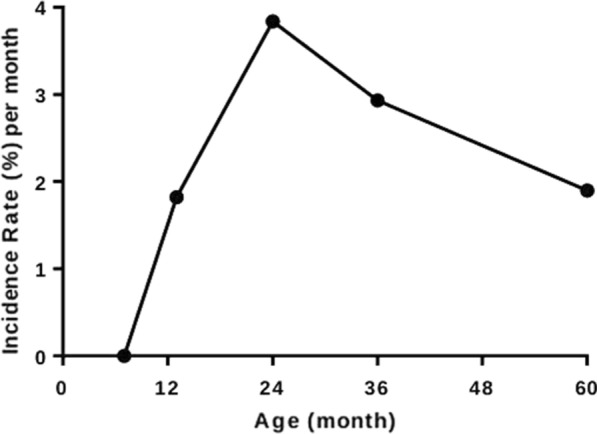
Toxocara spp. seroprevalence was 80.7% in mothers and in children was 0%, 9.3%, 48.4%, 64.9%, and 80.9% at 7 months, 13 months, 2, 3 and 5 years, respectively. Risk factors significantly associated with increases in seroprevalence over the first 5 years of life in multivariable analyses were age [Odds ratio (OR) 2.06, 95% confidence interval (CI) 1.39-2.27, P < 0001], male sex (female vs. male: OR 0.66, 95% CI 0.48-0.89, P = 0.006), maternal ethnicity (non-Afro vs. Afro-Ecuadorian: OR 0.65, 95% CI 0.47-0.91, P = 0.011), lower maternal educational and socioeconomic level, and childhood STH (OR 2.29, 95% CI 1.51-3.47, P < 0.001). Seroconversion rates for infection were greatest at 2 years of age (3.8%/month). Factors associated significantly with seroconversion at 2, 3 or 5 years were childhood STH infection, male sex, and more frequent domestic cat exposure.
Our data, from an area of high Toxocara spp. endemicity, indicate no congenital transmission but high rates of seroconversion after 13 months of age reaching maternal levels of seroprevalence by 5 years of age. Factors associated with seroprevalence and seroconversion included STH infections, domestic cats, maternal ethnicity, male sex, STH infections, and markers of greater poverty.
虽然旋毛虫属感染在世界范围内分布广泛,但据我们所知,在关于先天性传播潜力和幼儿感染决定因素的已发表研究中,尚无来自出生队列的数据。
我们通过定期收集数据和样本,从出生到 5 岁时跟踪了 290 对母婴对,在出生时、7 个月和 13 个月以及 2 岁、3 岁和 5 岁时进行了定期收集。通过母亲问卷收集了潜在危险因素和混杂因素的数据。在出生时从母亲身上采集血浆血样,并定期从孩子身上采集血液,以使用旋毛虫幼虫排泄分泌抗原为基础的酶联免疫吸附试验检测抗旋毛虫属 IgG 抗体。在母亲分娩前后和孩子定期采集粪便样本,以显微镜检查土壤传播性蠕虫(STH)。使用多变量逻辑回归和广义估计方程估计潜在危险因素与旋毛虫属血清阳性率和血清转化率之间的关系。
母亲的旋毛虫属血清阳性率为 80.7%,儿童的血清阳性率分别为 0%、9.3%、48.4%、64.9%和 80.9%,在 7 个月、13 个月、2 岁、3 岁和 5 岁时。多变量分析中,与生命前 5 年血清阳性率增加相关的危险因素包括年龄[优势比(OR)2.06,95%置信区间(CI)1.39-2.27,P<0.0001]、男性(女性与男性:OR 0.66,95%CI 0.48-0.89,P=0.006)、母亲种族(非非洲裔与非洲裔厄瓜多尔人:OR 0.65,95%CI 0.47-0.91,P=0.011)、较低的母亲教育和社会经济水平以及儿童 STH(OR 2.29,95%CI 1.51-3.47,P<0.001)。感染的血清转化率在 2 岁时最高(3.8%/月)。与 2、3 或 5 岁时血清转化率显著相关的因素包括儿童 STH 感染、男性和更频繁地接触家猫。
我们的数据来自旋毛虫属高流行地区,表明没有先天性传播,但在 13 个月后血清转化率很高,到 5 岁时达到了母亲的血清阳性率。与血清阳性率和血清转化率相关的因素包括 STH 感染、家猫、母亲种族、男性、STH 感染和更多贫困的标志。