Department of Surgery and Science, Graduate School of Medical Sciences, Kyushu University, Fukuoka, 812-8582, Japan.
Department of Clinical Radiology, Graduate School of Medical Sciences, Kyushu University, Fukuoka, 812-8582, Japan.
Sci Rep. 2021 Mar 12;11(1):5845. doi: 10.1038/s41598-021-85186-6.
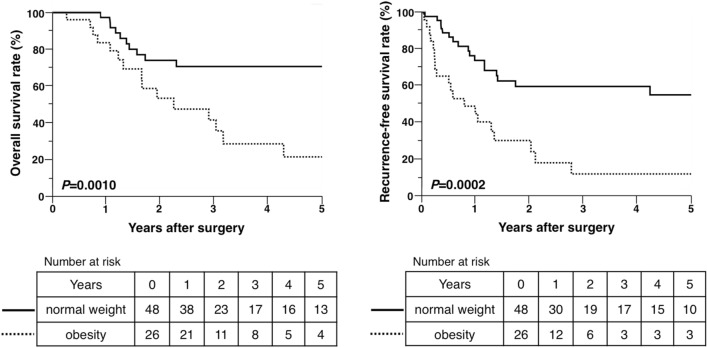
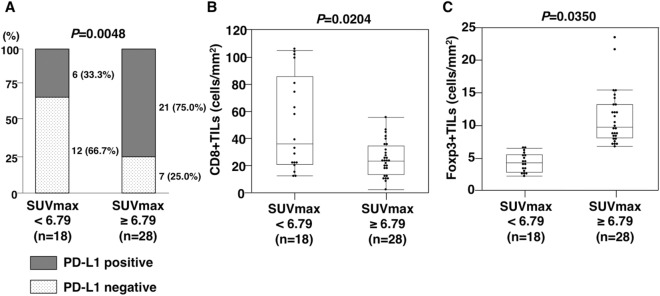
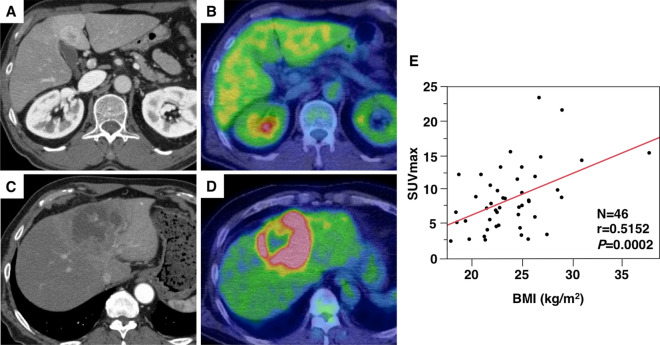
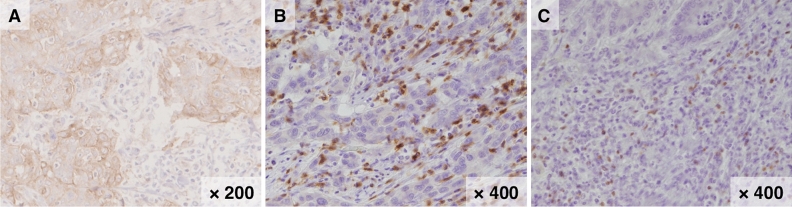
Body mass index (BMI) is well known to be associated with poor prognosis in several cancers. The relationship between BMI and the long-term outcomes of patients with intrahepatic cholangiocarcinoma (ICC) is incompletely understood. This study investigated the relationships of BMI with clinicopathological characteristics and patient outcomes, focusing on metabolic activity and immune status. The relationship between BMI and the maximum standardized uptake value (SUVmax) on fluorine-18 fluorodeoxyglucose (F-FDG) positron emission tomography/computed tomography (PET/CT) was analyzed. In addition, immunohistochemistry was performed for programmed cell death-ligand 1 (PD-L1), cluster of differentiation 8 (CD8), and forkhead box protein P3 (Foxp3). Seventy-four patients with ICC were classified into normal weight (BMI < 25.0 kg/m, n = 48) and obesity groups (BMI ≥ 25.0 kg/m, n = 26), respectively. Serum carbohydrate antigen 19-9 levels were higher in the obesity group than in the normal weight group. Tumor size and the intrahepatic metastasis rate were significantly larger in the obesity group. Patients in the obesity group had significantly worse prognoses than those in the normal weight group. Moreover, BMI displayed a positive correlation with SUVmax on F-FDG PET/CT (n = 46, r = 0.5152). Patients with high F-FDG uptake had a significantly higher rate of PD-L1 expression, lower CD8 + tumor-infiltrating lymphocyte (TIL) counts, and higher Foxp3 + TIL counts. The elevated BMI might predict the outcomes of patients with ICC. Obesity might be associated with ICC progression, possibly through alterations in metabolic activity and the immune status.
体重指数(BMI)与多种癌症的不良预后密切相关。BMI 与肝内胆管癌(ICC)患者长期结局的关系尚未完全阐明。本研究旨在探讨 BMI 与临床病理特征及患者预后的关系,重点关注代谢活性和免疫状态。分析了 BMI 与氟-18 氟代脱氧葡萄糖(F-FDG)正电子发射断层扫描/计算机断层扫描(PET/CT)上最大标准化摄取值(SUVmax)之间的关系。此外,还进行了程序性死亡配体 1(PD-L1)、CD8 和叉头框蛋白 P3(Foxp3)的免疫组织化学检测。将 74 例 ICC 患者分别归入正常体重组(BMI<25.0 kg/m2,n=48)和肥胖组(BMI≥25.0 kg/m2,n=26)。肥胖组患者的血清碳水化合物抗原 19-9 水平高于正常体重组。肥胖组的肿瘤大小和肝内转移率显著大于正常体重组。肥胖组患者的预后明显差于正常体重组。此外,BMI 与 F-FDG PET/CT 上的 SUVmax 呈正相关(n=46,r=0.5152)。高 F-FDG 摄取患者的 PD-L1 表达率显著升高,CD8+肿瘤浸润淋巴细胞(TIL)计数显著降低,Foxp3+TIL 计数显著升高。较高的 BMI 可能预示 ICC 患者的预后。肥胖可能与 ICC 的进展有关,可能是通过改变代谢活性和免疫状态。