MRC/CSO Social & Public Health Sciences Unit, University of Glasgow, UK.
Understanding Society, Institute for Social and Economic Research, University of Essex, UK.
Brain Behav Immun. 2021 May;94:41-50. doi: 10.1016/j.bbi.2021.03.008. Epub 2021 Mar 11.
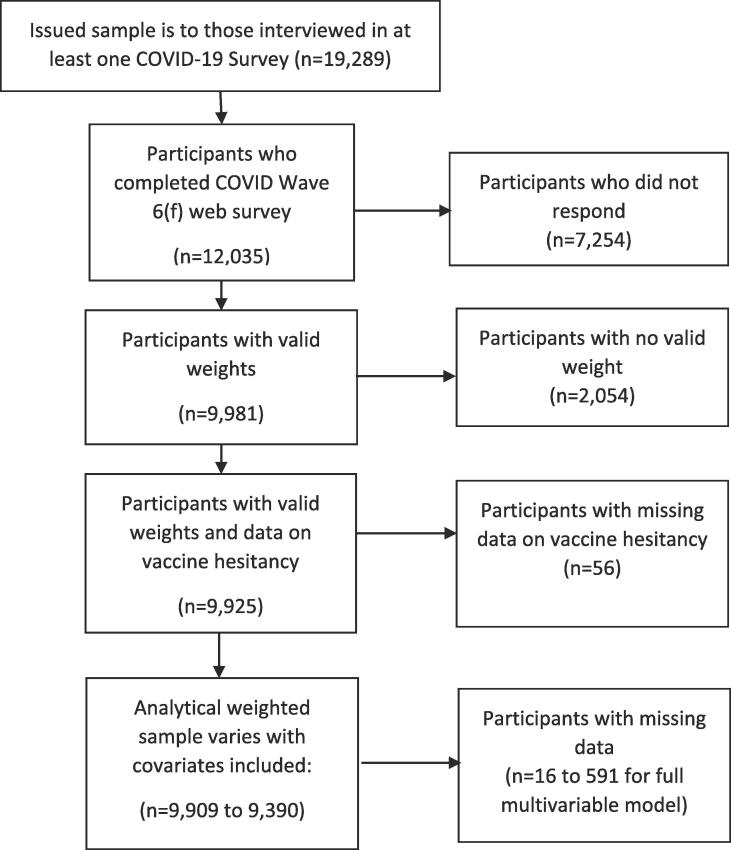
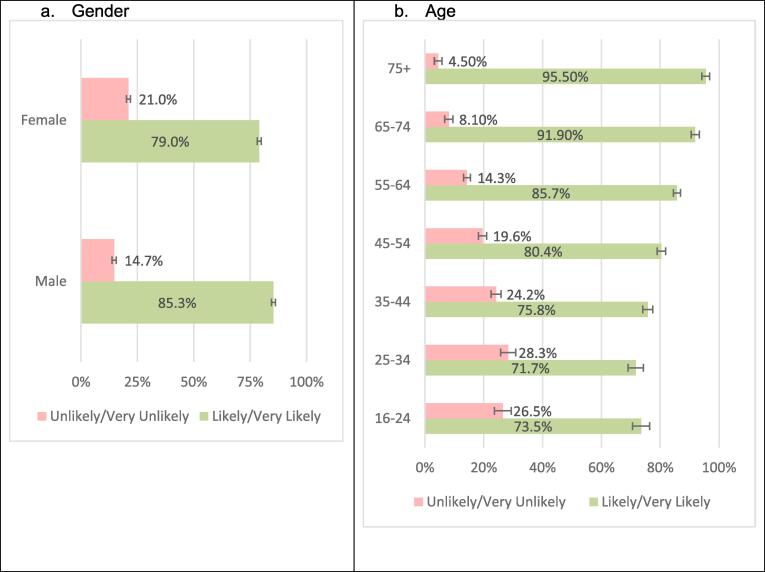
Vaccine hesitancy could undermine efforts to control COVID-19. We investigated the prevalence of COVID-19 vaccine hesitancy in the UK and identified vaccine hesitant subgroups. The 'Understanding Society' COVID-19 survey asked participants (n = 12,035) their likelihood of vaccine uptake and reason for hesitancy. Cross-sectional analysis assessed vaccine hesitancy prevalence and logistic regression calculated odds ratios. Overall vaccine hesitancy was low (18% unlikely/very unlikely). Vaccine hesitancy was higher in women (21.0% vs 14.7%), younger age groups (26.5% in 16-24 year olds vs 4.5% in 75 + ) and those with lower education levels (18.6% no qualifications vs 13.2% degree qualified). Vaccine hesitancy was high in Black (71.8%) and Pakistani/Bangladeshi (42.3%) ethnic groups. Odds ratios for vaccine hesitancy were 13.42 (95% CI:6.86, 26.24) in Black and 2.54 (95% CI:1.19, 5.44) in Pakistani/Bangladeshi groups (compared to White British/Irish) and 3.54 (95% CI:2.06, 6.09) for people with no qualifications versus degree. Urgent action to address hesitancy is needed for some but not all ethnic minority groups.
疫苗犹豫可能会破坏控制 COVID-19 的努力。我们调查了英国 COVID-19 疫苗犹豫的流行情况,并确定了疫苗犹豫的亚组。“社会认知”COVID-19 调查询问了参与者(n=12035)他们接种疫苗的可能性和犹豫的原因。横断面分析评估了疫苗犹豫的流行率,逻辑回归计算了优势比。总体而言,疫苗犹豫率较低(18%不太可能/非常不可能)。女性(21.0%比 14.7%)、年龄较小的人群(26.5%在 16-24 岁的人群中,而 4.5%在 75 岁及以上的人群中)和教育程度较低的人群(18.6%没有资格证书,而 13.2%有学位)疫苗犹豫率较高。黑人(71.8%)和巴基斯坦/孟加拉(42.3%)族裔群体的疫苗犹豫率较高。与白种英国人/爱尔兰人相比,黑人组的疫苗犹豫率为 13.42(95%可信区间:6.86,26.24),巴基斯坦/孟加拉组为 2.54(95%可信区间:1.19,5.44),无资格证书的人群为 3.54(95%可信区间:2.06,6.09)。对于某些但不是所有少数族裔群体,需要采取紧急行动来解决犹豫问题。