Department of Dermatology, Sapporo Medical University School of Medicine, Sapporo, Japan.
Dermatology Division, Shizuoka Cancer Center Hospital, Shizuoka, Japan.
J Dermatol. 2021 May;48(5):592-599. doi: 10.1111/1346-8138.15804. Epub 2021 Mar 14.
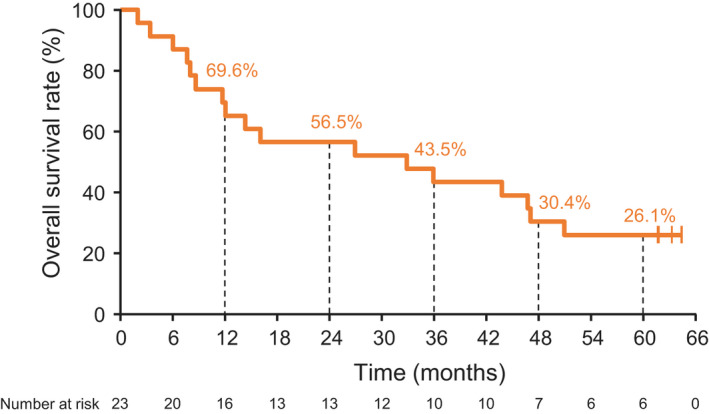
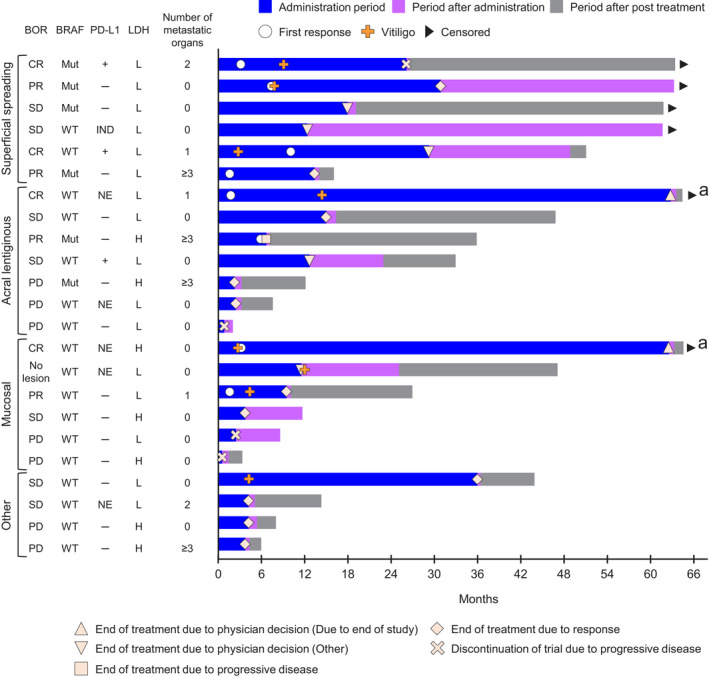
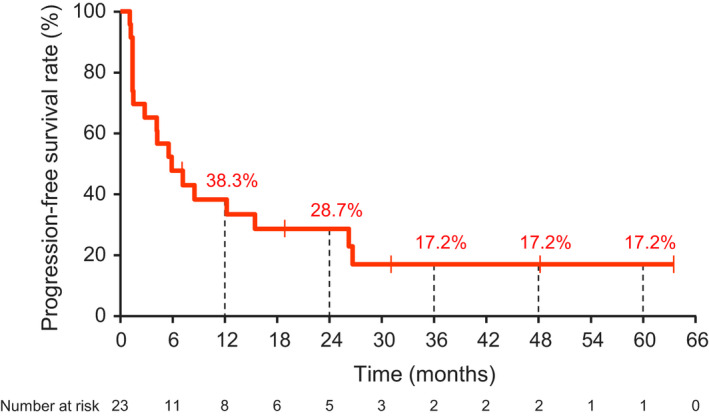
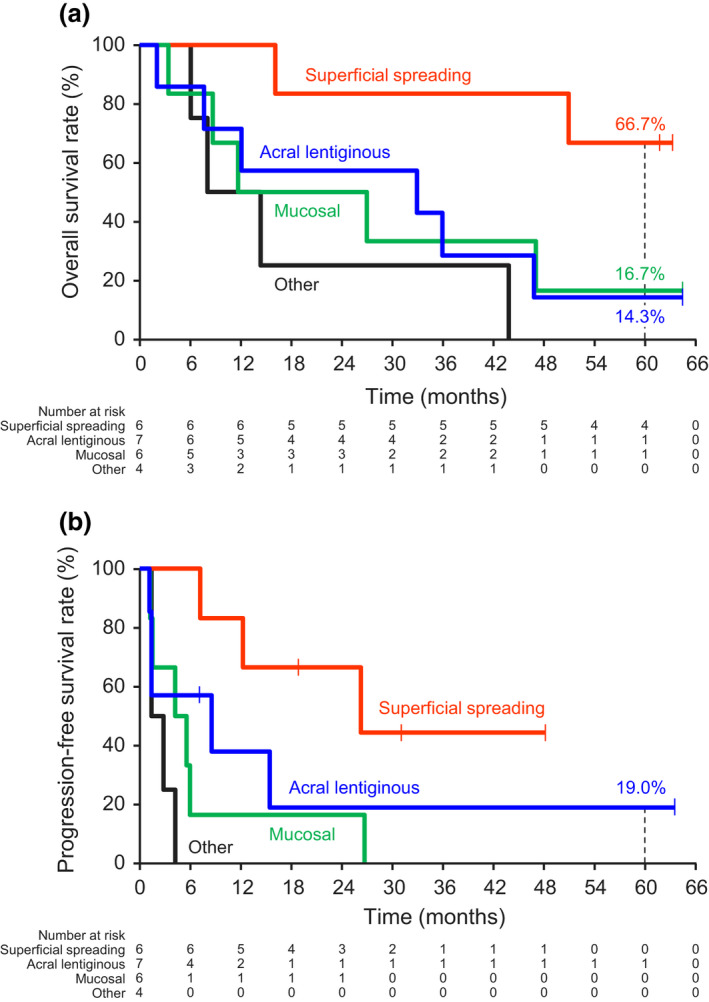
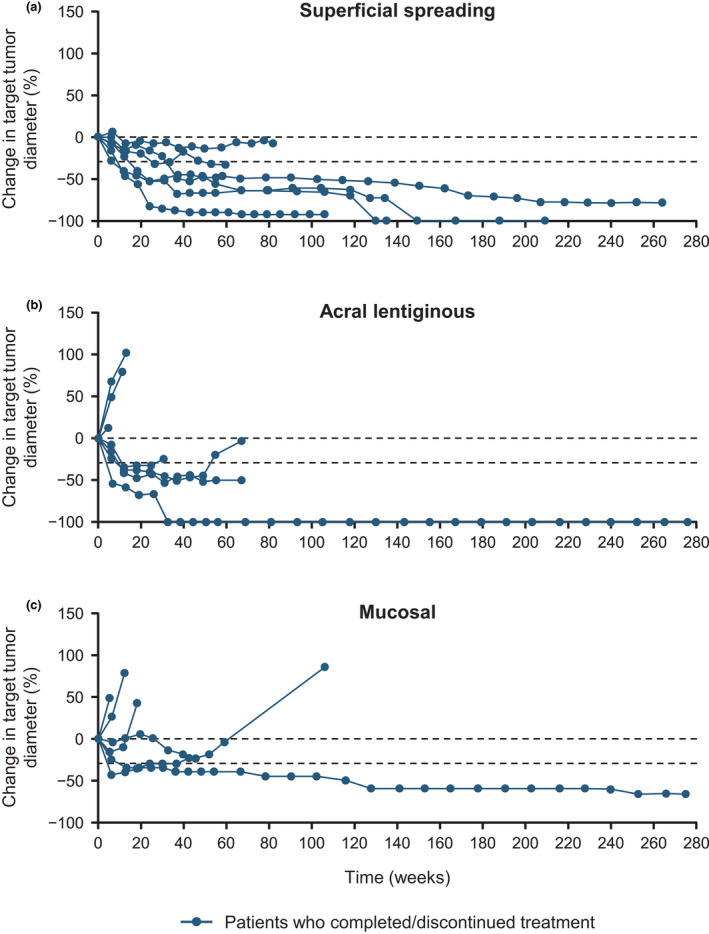
We report the 5-year follow-up results from a single-arm, open-label, multicenter phase II study (ONO-4538-08) conducted in Japan. Twenty-four patients with treatment-naïve, recurrent, or unresectable stage III/IV malignant melanoma received 3 mg/kg nivolumab every 2 weeks until progressive disease or unacceptable toxicity occurred. The 5-year overall survival (OS) rate was 26.1%. Five years after the start of nivolumab treatment, there were six survivors. The 5-year OS rate was 66.7% for patients with a superficial spreading type, 14.3% for acral lentiginous type, and 16.7% for mucosal type. The 5-year progression-free survival rate was 17.2%. No new cases of partial response or complete response were observed after 3 years, and overall response and disease control rates were similar to those reported at 3 years. The treatment-related adverse events reported between the 3- and 5-year follow-up periods were anemia (grade 2), white blood cell count decrease (grade 2), and psoriasiform dermatitis (grade 2) in one patient each. No new grade 3 or higher treatment-related adverse events occurred in this period. In conclusion, first-line treatment with nivolumab in Japanese patients with unresectable or metastatic melanoma resulted in confirmed long-term survival. No new safety signals were reported in the studied population.
我们报告了一项在日本进行的单臂、开放标签、多中心 II 期研究(ONO-4538-08)的 5 年随访结果。24 例未经治疗、复发或不可切除的 III/IV 期恶性黑色素瘤患者接受 3mg/kg 纳武利尤单抗每 2 周一次,直到出现疾病进展或不可接受的毒性。5 年总生存率(OS)为 26.1%。纳武利尤单抗治疗开始后 5 年,有 6 名幸存者。有 6 名患者为浅表扩散型,5 年 OS 率为 66.7%;2 名患者为肢端雀斑样痣型,5 年 OS 率为 14.3%;2 名患者为黏膜型,5 年 OS 率为 16.7%。5 年无进展生存率为 17.2%。3 年后未观察到新的部分缓解或完全缓解病例,总缓解率和疾病控制率与 3 年时相似。在 3 年至 5 年随访期间报告了 3 例新的治疗相关不良事件,包括 1 例贫血(2 级)、1 例白细胞计数减少(2 级)和 1 例银屑病样皮炎(2 级)。在此期间未发生新的 3 级或更高的治疗相关不良事件。总之,纳武利尤单抗作为不可切除或转移性黑色素瘤患者的一线治疗,证实了长期生存。在研究人群中未报告新的安全性信号。