Center for Health System Research, National Institute of Public Health, Avenida Universidad #655, 62100, Cuernavaca, Morelos, Mexico.
National School of Nursing and Obstetrics, National Autonomous University of Mexico, Mexico City, Mexico.
Bull World Health Organ. 2021 Mar 1;99(3):190-200. doi: 10.2471/BLT.20.252544. Epub 2020 Nov 30.
To describe the temporal and geographical patterns of the continuum of maternal health care in Mexico, as well as the sociodemographic characteristics that affect the likelihood of receiving this care.
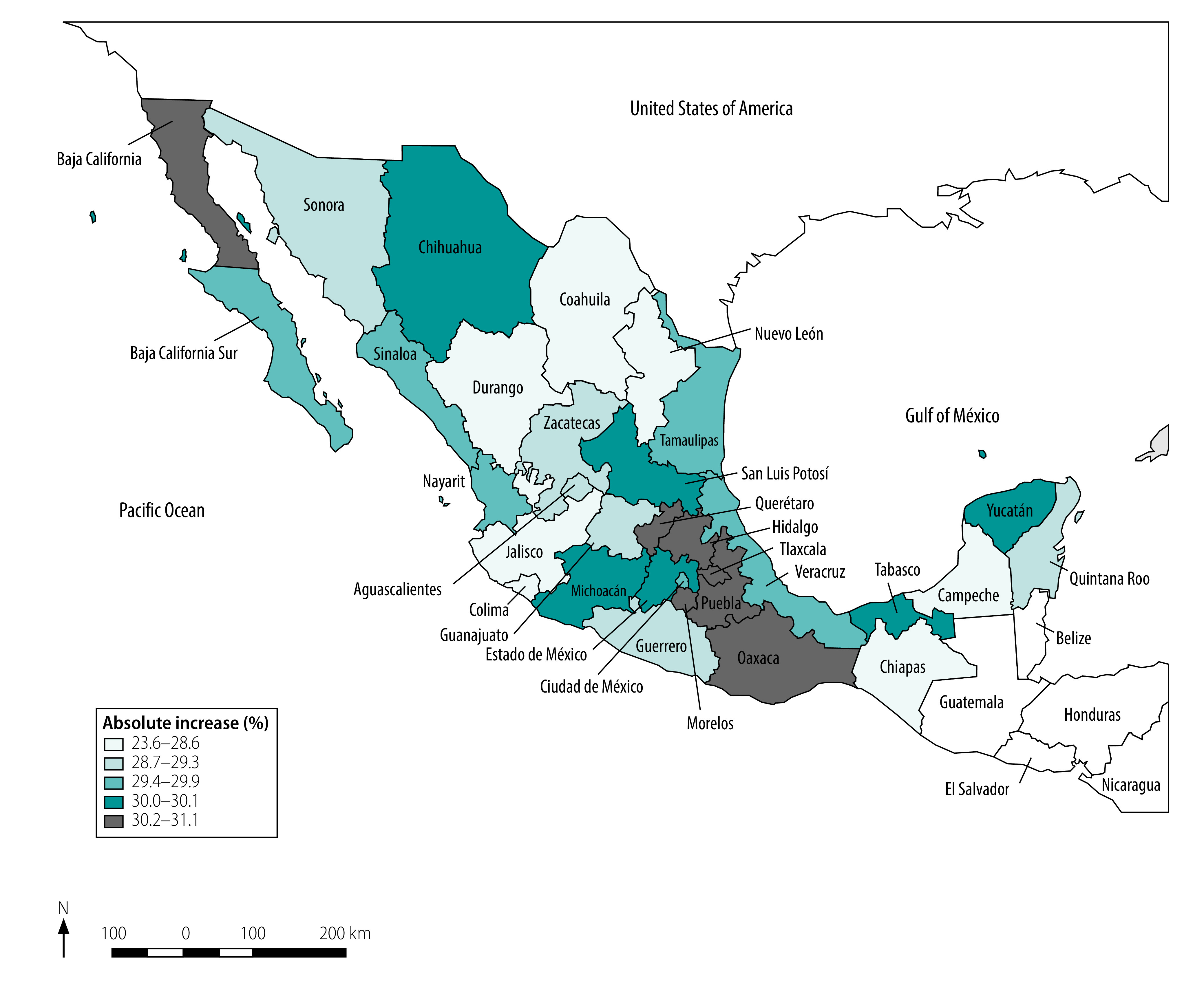
We conducted a pooled cross-sectional analysis using the 1997, 2009, 2014 and 2018 waves of the National Survey of Demographic Dynamics, collating sociodemographic and obstetric characteristics of 93 745 women aged 12-54 years at last delivery. We defined eight variables along the antenatal-postnatal continuum, both independently and conditionally. We used a pooled fixed-effects multivariable logistic model to determine the likelihood of receiving the continuum of care for various properties. We also mapped the quintiles of adjusted state-level absolute change in continuum of care coverage during 1994-2018.
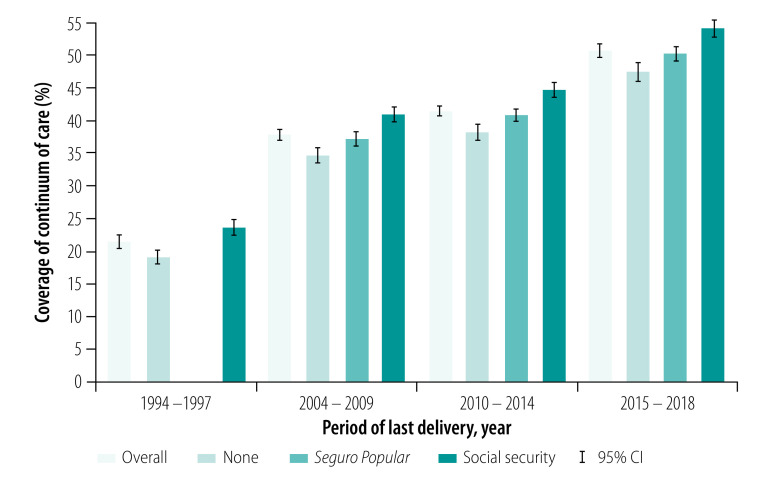
We observed large absolute increases in the proportion of women receiving timely antenatal and postnatal care (from 48.9% to 88.2% and from 39.1% to 68.7%, respectively). In our conditional analysis, we found that the proportion of women receiving adequate antenatal care doubled over this period. We showed that having social security and a higher level of education is positively associated with receiving the continuum of care. We observed the largest relative increases in continuum of care coverage in Chiapas (181.5%) and Durango (160.6%), assigned human development index categories of low and medium, respectively.
Despite significant progress in coverage of the continuum of maternal health care, disparities remain. While ensuring progress towards achievement of the health-related sustainable development goal, government intervention must also target underserved populations.
描述墨西哥母婴保健连续服务的时间和地域模式,以及影响获得这种服务可能性的社会人口特征。
我们使用 1997 年、2009 年、2014 年和 2018 年全国人口动态调查的四次横断面数据进行了汇总分析,收集了 93745 名最近分娩时年龄在 12-54 岁的妇女的社会人口学和产科特征。我们沿着产前-产后连续服务定义了八个变量,分别独立和条件地进行了定义。我们使用汇总固定效应多变量逻辑模型来确定各种属性获得连续服务的可能性。我们还绘制了 1994-2018 年期间连续服务覆盖范围的调整州级绝对变化的五分位数图。
我们观察到及时接受产前和产后护理的妇女比例有较大的绝对增加(分别从 48.9%增加到 88.2%和从 39.1%增加到 68.7%)。在我们的条件分析中,我们发现在此期间,接受足够产前护理的妇女比例增加了一倍。我们发现,有社会保障和较高教育水平与接受连续服务呈正相关。我们观察到,恰帕斯州(181.5%)和杜兰戈州(160.6%)的连续服务覆盖范围的相对增幅最大,这两个州分别属于人类发展指数低和中等类别。
尽管母婴保健连续服务的覆盖范围取得了重大进展,但仍存在差距。在确保朝着实现与健康相关的可持续发展目标取得进展的同时,政府干预还必须针对服务不足的人群。