Bravo-Rivera Hector, Rubio Arzola Patricia, Caban-Murillo Albit, Vélez-Avilés Adriana N, Ayala-Rosario Shantée N, Quirk Gregory J
Department of Psychiatry, University of Puerto Rico School of Medicine, San Juan, Puerto Rico.
Department of Anatomy & Neurobiology, University of Puerto Rico School of Medicine, San Juan, Puerto Rico.
Front Neurosci. 2021 Feb 25;15:608922. doi: 10.3389/fnins.2021.608922. eCollection 2021.
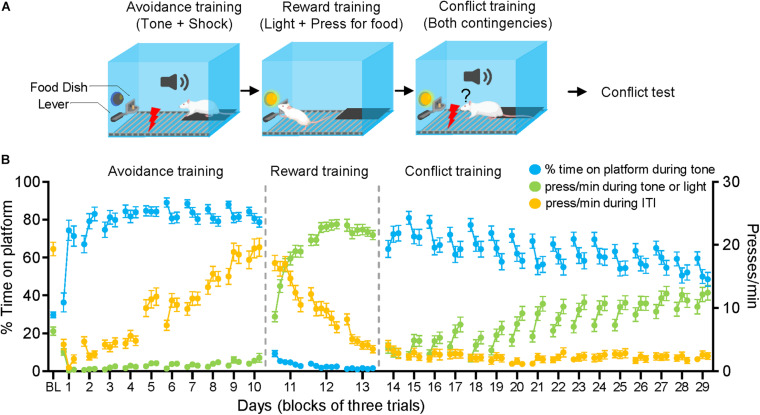
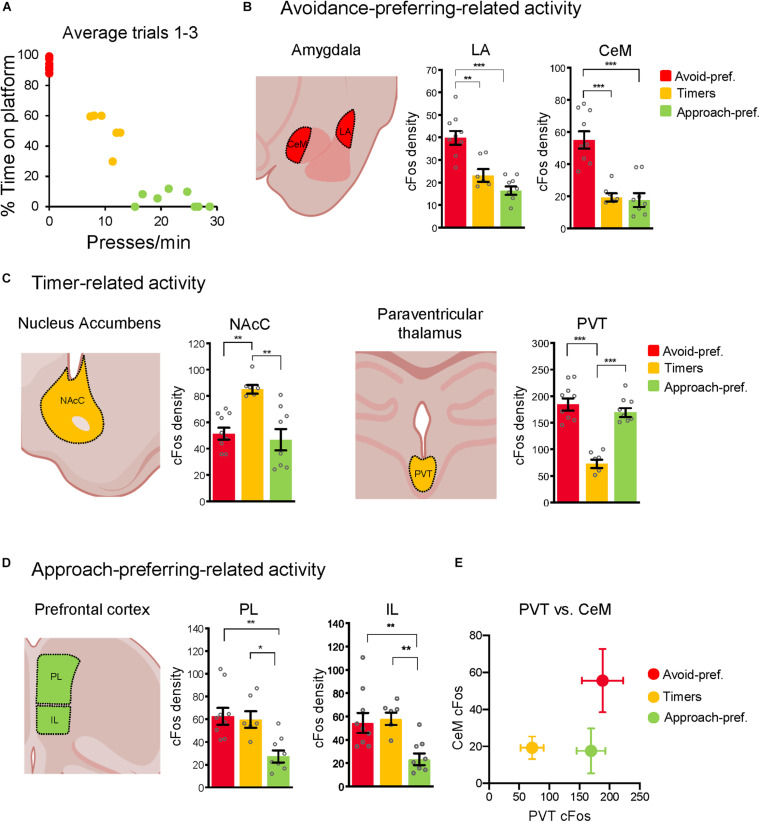
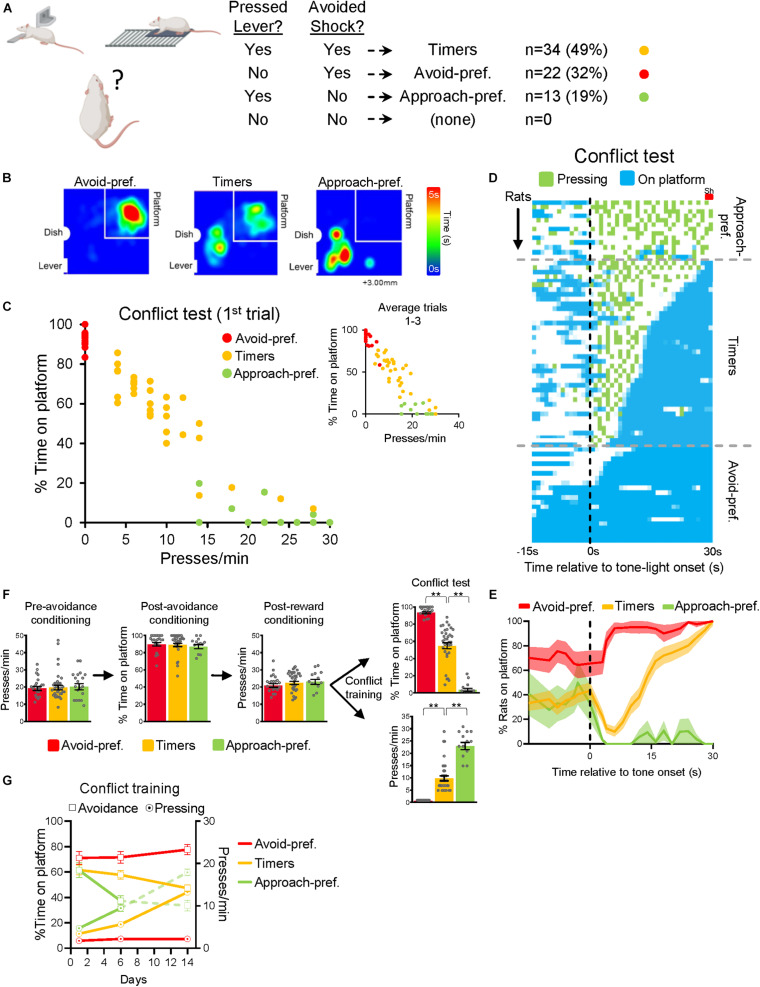
The ability of animals to maximize benefits and minimize costs during approach-avoidance conflicts is an important evolutionary tool, but little is known about the emergence of specific strategies for conflict resolution. Accordingly, we developed a simple approach-avoidance conflict task in rats that pits the motivation to press a lever for sucrose against the motivation to step onto a distant platform to avoid a footshock delivered at the end of a 30 s tone (sucrose is available only during the tone). Rats received conflict training for 16 days to give them a chance to optimize their strategy by learning to properly time the expression of both behaviors across the tone. Rats unexpectedly separated into three distinct subgroups: those pressing early in the tone and avoiding later (Timers, 49%); those avoiding throughout the tone (Avoidance-preferring, 32%); and those pressing throughout the tone (Approach-preferring, 19%). The immediate early gene cFos revealed that Timers showed increased activity in the ventral striatum and midline thalamus relative to the other two subgroups, Avoidance-preferring rats showed increased activity in the amygdala, and Approach-preferring rats showed decreased activity in the prefrontal cortex. This pattern is consistent with low fear and high behavioral flexibility in Timers, suggesting the potential of this task to reveal the neural mechanisms of conflict resolution.
动物在趋避冲突中最大化收益和最小化成本的能力是一种重要的进化工具,但对于解决冲突的特定策略的出现却知之甚少。因此,我们在大鼠中开发了一种简单的趋避冲突任务,该任务使大鼠按压杠杆获取蔗糖的动机与踏上远处平台以避免在30秒音调结束时遭受足部电击的动机相互竞争(蔗糖仅在音调期间可用)。大鼠接受了16天的冲突训练,以便它们有机会通过学习在整个音调期间正确安排两种行为的表达来优化其策略。大鼠意外地分为三个不同的亚组:那些在音调早期按压并在后期避免的(定时者,49%);那些在整个音调期间都避免的(偏好回避者,32%);以及那些在整个音调期间都按压的(偏好趋近者,19%)。即时早期基因cFos显示,与其他两个亚组相比,定时者在腹侧纹状体和中线丘脑的活动增加,偏好回避的大鼠在杏仁核的活动增加,而偏好趋近的大鼠在前额叶皮质的活动减少。这种模式与定时者低恐惧和高行为灵活性一致,表明该任务有可能揭示冲突解决的神经机制。