Perrett David I, Talamas Sean N, Cairns Patrick, Henderson Audrey J
School of Psychology and Neuroscience, Faculty of Science, University of St Andrews, St Andrews, United Kingdom.
Front Psychol. 2020 Mar 11;11:392. doi: 10.3389/fpsyg.2020.00392. eCollection 2020.
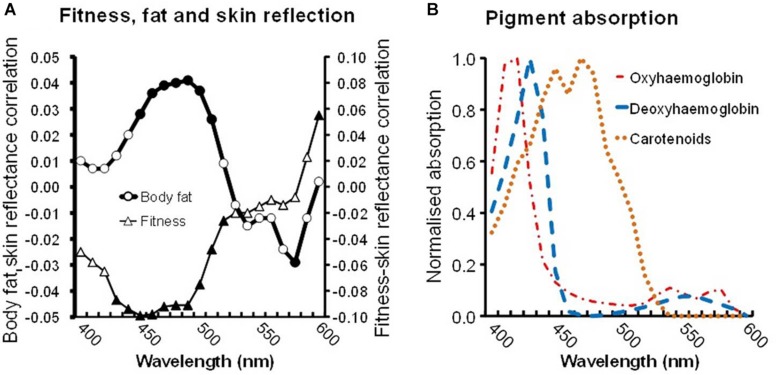
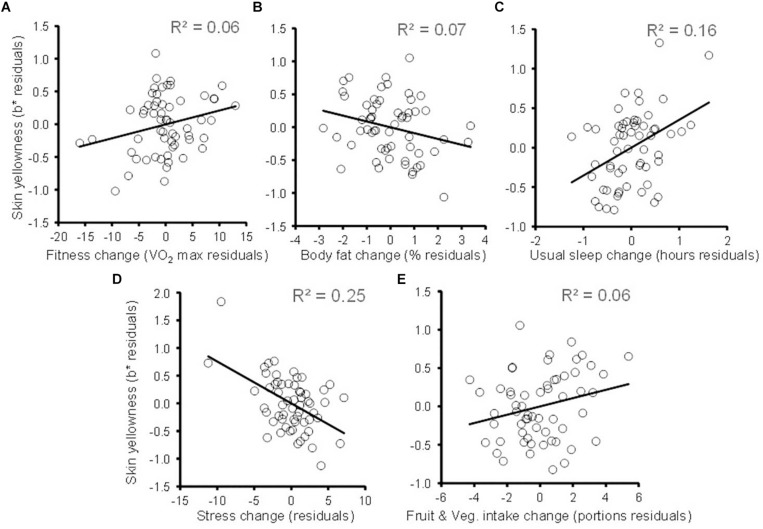
Colorful carotenoid ornaments are sexually selected signals of health in many species. In humans too, carotenoids could provide a perceptible cue to health as they impart an attractive yellow-orange color to skin. Increasing carotenoid pigmentation and skin yellowness is associated with increased fruit and vegetable intake, but whether other aspects of human health benefit skin color is unknown. Carotenoids, as antioxidants, help maintain oxidative balance but are expended in this role. Therefore, any health factor affecting oxidative balance could alter the quantity of carotenoids available to color skin. Exercise increases endogenous antioxidant capacity and consequently may decrease expenditure of carotenoids. Fitness could also raise skin carotenoids by lowering body fat (a source of oxidative stress). Here we investigate the relationship between skin color (measured spectrophotometrically), aerobic fitness (measured by estimating the maximum volume of oxygen that a person can use per unit of time, VO max), and body fat. In a cross-sectional design, we find that both higher aerobic fitness and lower body fat are predictors of skin yellowness, independent of each other and dietary fruit and vegetable intake. In a longitudinal design over 8 weeks, we found that increase in fitness and decrease in body fat were independently associated with an increase in skin yellowness. Change in self-reported stress and sleep were further predictors of skin yellowness indicating a more general relation between health and skin tone. Simulations of the skin color associated with higher fitness were found to appear healthier. Hence, our results suggest that increasing cardiovascular fitness and decreasing fat levels produce a healthier skin color. Such findings have repercussions for public health because improved attractiveness can provide an incentive for a healthier lifestyle, including exercise and weight regulation.
在许多物种中,色彩斑斓的类胡萝卜素装饰是健康状况的性选择信号。在人类中,类胡萝卜素也可能为健康提供一种可察觉的线索,因为它们会使皮肤呈现出诱人的黄橙色。类胡萝卜素色素沉着增加和皮肤变黄与水果和蔬菜摄入量增加有关,但人类健康的其他方面是否有益于肤色尚不清楚。类胡萝卜素作为抗氧化剂,有助于维持氧化平衡,但会在这一过程中消耗。因此,任何影响氧化平衡的健康因素都可能改变用于使皮肤着色的类胡萝卜素数量。运动可提高内源性抗氧化能力,因此可能会减少类胡萝卜素的消耗。健康状况良好还可能通过降低体脂(氧化应激的一个来源)来提高皮肤中的类胡萝卜素含量。在这里,我们研究了肤色(通过分光光度法测量)、有氧适能(通过估计一个人单位时间内可以使用的最大氧气量,即最大摄氧量来测量)和体脂之间的关系。在一项横断面设计中,我们发现较高的有氧适能和较低的体脂都是皮肤变黄的预测因素,它们相互独立,且与饮食中水果和蔬菜的摄入量无关。在一项为期8周的纵向设计中,我们发现适能的提高和体脂的降低都与皮肤变黄的增加独立相关。自我报告的压力和睡眠变化是皮肤变黄的进一步预测因素,这表明健康与肤色之间存在更普遍的关系。研究发现,模拟与更高健康水平相关的肤色看起来更健康。因此,我们的结果表明,提高心血管适能和降低脂肪水平会产生更健康的肤色。这些发现对公共卫生有影响,因为吸引力的提升可以为包括运动和体重调节在内的更健康生活方式提供动力。