Santini Francesco, Deligianni Xeni, Paoletti Matteo, Solazzo Francesca, Weigel Matthias, de Sousa Paulo Loureiro, Bieri Oliver, Monforte Mauro, Ricci Enzo, Tasca Giorgio, Pichiecchio Anna, Bergsland Niels
Division of Radiological Physics, Department of Radiology, University Hospital of Basel, Basel, Switzerland.
Department of Biomedical Engineering, University of Basel, Allschwil, Switzerland.
Front Neurol. 2021 Feb 26;12:630387. doi: 10.3389/fneur.2021.630387. eCollection 2021.
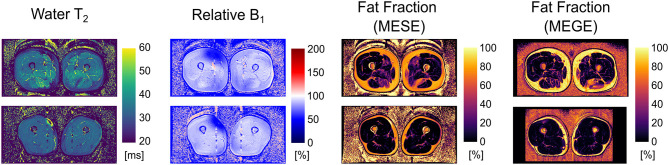
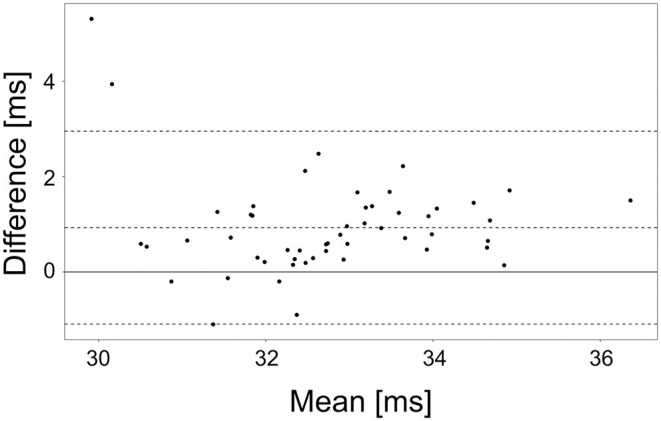
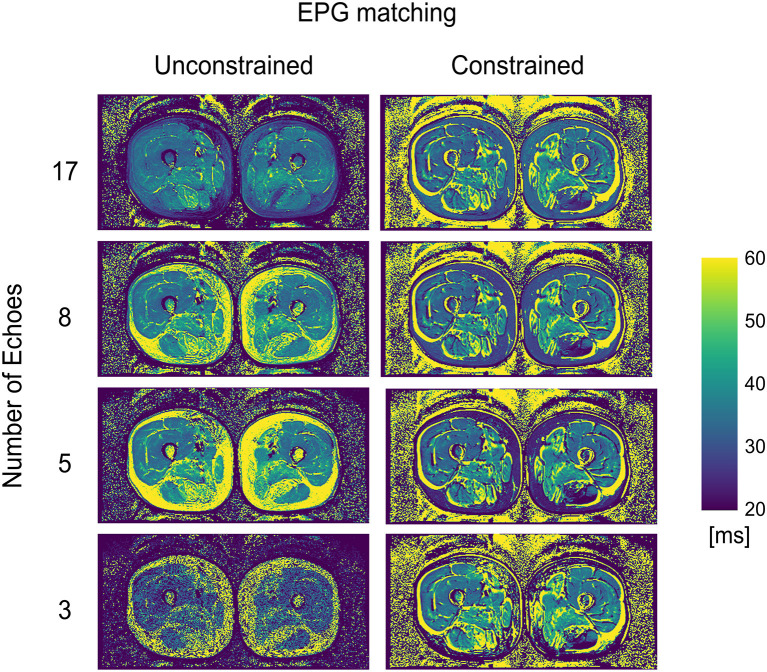
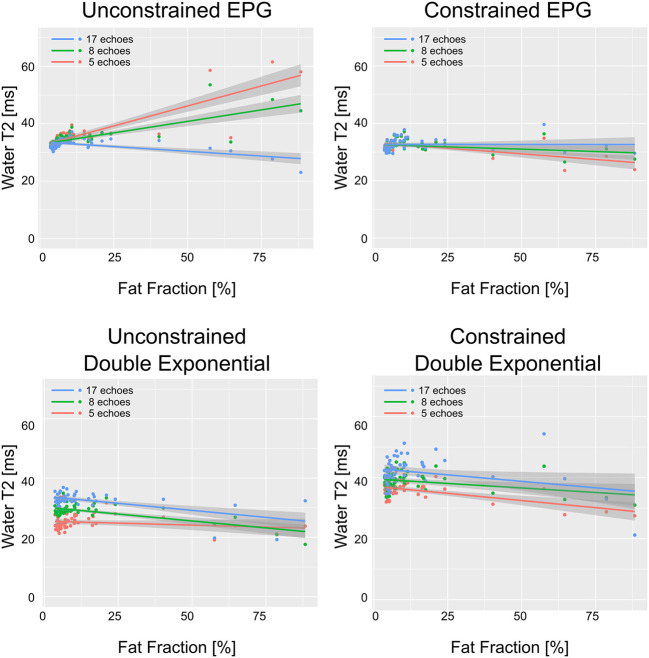
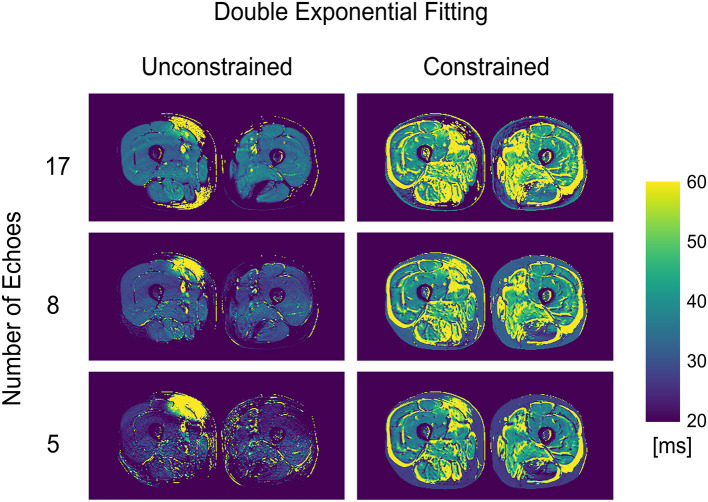
Imaging has become a valuable tool in the assessment of neuromuscular diseases, and, specifically, quantitative MR imaging provides robust biomarkers for the monitoring of disease progression. Quantitative evaluation of fat infiltration and quantification of the T2 values of the muscular tissue's water component (wT2) are two of the most essential indicators currently used. As each voxel of the image can contain both water and fat, a two-component model for the estimation of wT2 must be used. In this work, we present a fast method for reconstructing wT2 maps obtained from conventional multi-echo spin-echo (MESE) acquisitions and released as Free Open Source Software. The proposed software is capable of fast reconstruction thanks to extended phase graphs (EPG) simulations and dictionary matching implemented on a general-purpose graphic processing unit. The program can also perform more conventional biexponential least-squares fitting of the data and incorporate information from an external water-fat acquisition to increase the accuracy of the results. The method was applied to the scans of four healthy volunteers and five subjects suffering from facioscapulohumeral muscular dystrophy (FSHD). Conventional multi-slice MESE acquisitions were performed with 17 echoes, and additionally, a 6-echo multi-echo gradient-echo (MEGE) sequence was used for an independent fat fraction calculation. The proposed reconstruction software was applied on the full datasets, and additionally to reduced number of echoes, respectively, to 8, 5, and 3, using EPG and biexponential least-squares fitting, with and without incorporating information from the MEGE acquisition. The incorporation of external fat fraction maps increased the robustness of the fitting with a reduced number of echoes per datasets, whereas with unconstrained fitting, the total of 17 echoes was necessary to retain an independence of wT2 from the level of fat infiltration. In conclusion, the proposed software can successfully be used to calculate wT2 maps from conventional MESE acquisition, allowing the usage of an optimized protocol with similar precision and accuracy as a 17-echo acquisition. As it is freely released to the community, it can be used as a reference for more extensive cohort studies.
成像已成为评估神经肌肉疾病的重要工具,特别是定量磁共振成像为监测疾病进展提供了可靠的生物标志物。脂肪浸润的定量评估和肌肉组织水成分(wT2)的T2值量化是目前使用的两个最重要指标。由于图像的每个体素都可能同时包含水和脂肪,因此必须使用用于估计wT2的双成分模型。在这项工作中,我们提出了一种快速方法,用于重建从传统多回波自旋回波(MESE)采集中获得的wT2图,并作为免费开源软件发布。由于在通用图形处理单元上实现了扩展相位图(EPG)模拟和字典匹配,所提出的软件能够进行快速重建。该程序还可以对数据执行更传统的双指数最小二乘拟合,并结合来自外部水脂采集的信息以提高结果的准确性。该方法应用于四名健康志愿者和五名面肩肱型肌营养不良症(FSHD)患者的扫描。使用17个回波进行传统的多层MESE采集,此外,还使用6回波多回波梯度回波(MEGE)序列进行独立的脂肪分数计算。所提出的重建软件分别应用于完整数据集以及减少回波数量后的数据集,回波数量分别减少到8、5和3,使用EPG和双指数最小二乘拟合,同时考虑是否结合MEGE采集的信息。纳入外部脂肪分数图提高了在每个数据集中减少回波数量时拟合的稳健性,而在无约束拟合中,总共需要17个回波才能使wT2不受脂肪浸润水平的影响。总之,所提出的软件可以成功地用于从传统MESE采集中计算wT2图,允许使用具有与17回波采集相似精度和准确性的优化协议。由于它已免费向社区发布,因此可作为更广泛队列研究的参考。