Department of Diagnostic and Interventional Radiology, Klinikum rechts der Isar, Technical University of Munich, Munich, Germany.
Institute for Nutritional Medicine, Klinikum rechts der Isar, Technical University of Munich, Munich, Germany.
J Magn Reson Imaging. 2019 Aug;50(2):424-434. doi: 10.1002/jmri.26661. Epub 2019 Jan 25.
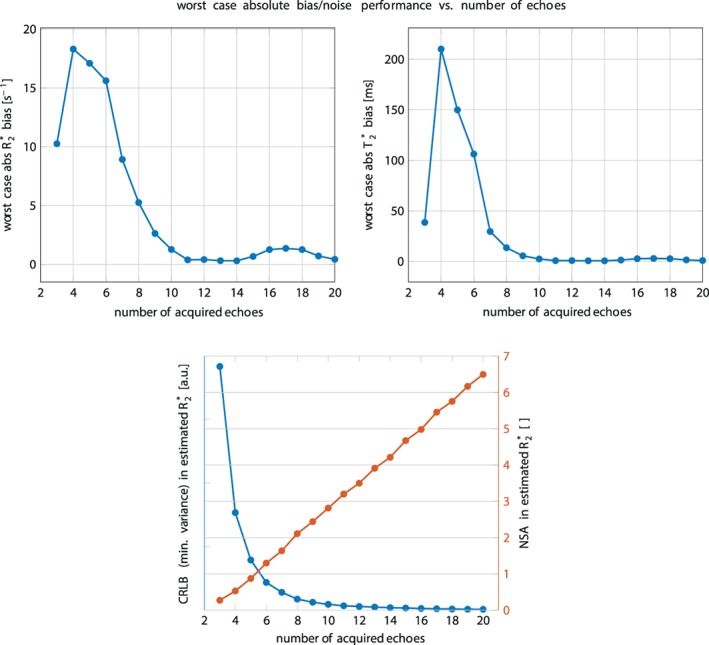
Adipose tissue (AT) can be classified into white and brown/beige subtypes. Chemical shift encoding-based water-fat MRI-techniques allowing simultaneous mapping of proton density fat fraction (PDFF) and T * result in a lower PDFF and a shorter T * in brown compared with white AT. However, AT T * values vary widely in the literature and are primarily based on 6-echo data. Increasing the number of echoes in a multiecho gradient-echo acquisition is expected to increase the precision of AT T * mapping.
Prospective.
Twenty-one healthy subjects.
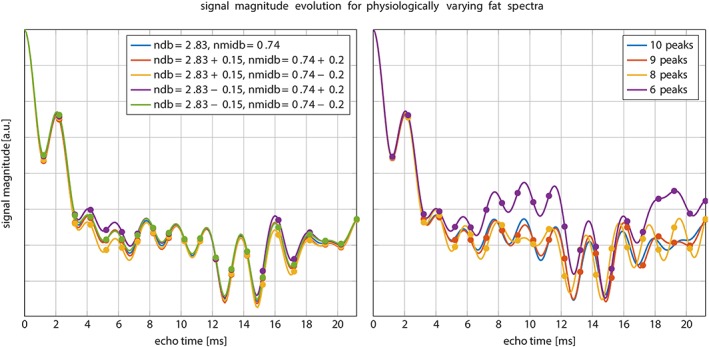
FIELD STRENGTH/SEQUENCE ASSESSMENT: First, a ground truth signal evolution was simulated from a single-T * water-fat model. Second, a time-interleaved 20-echo gradient-echo sequence with monopolar gradients of neck and abdomen/pelvis at 3 T was performed in vivo to determine supraclavicular and gluteal PDFF and T *. Complex-based water-fat separation was performed for the first 6 echoes and the full 20 echoes. AT depots were segmented.
Mann-Whitney test, Wilcoxon signed-rank test and simple linear regression analysis.
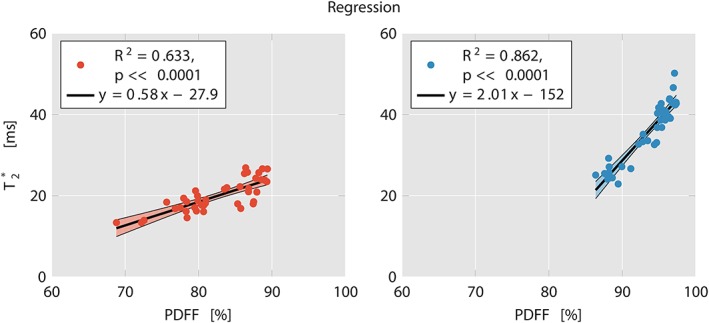
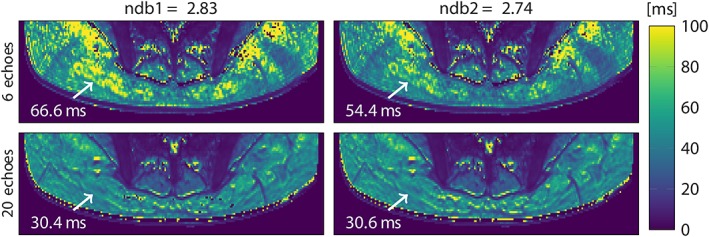
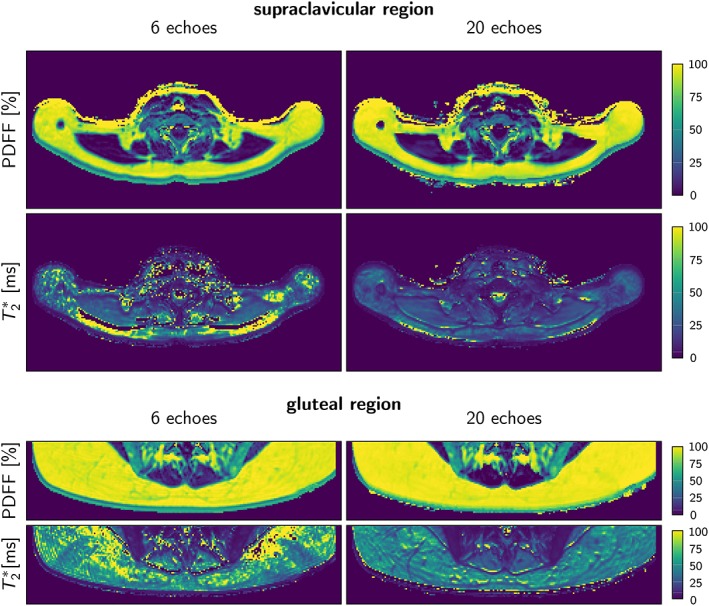
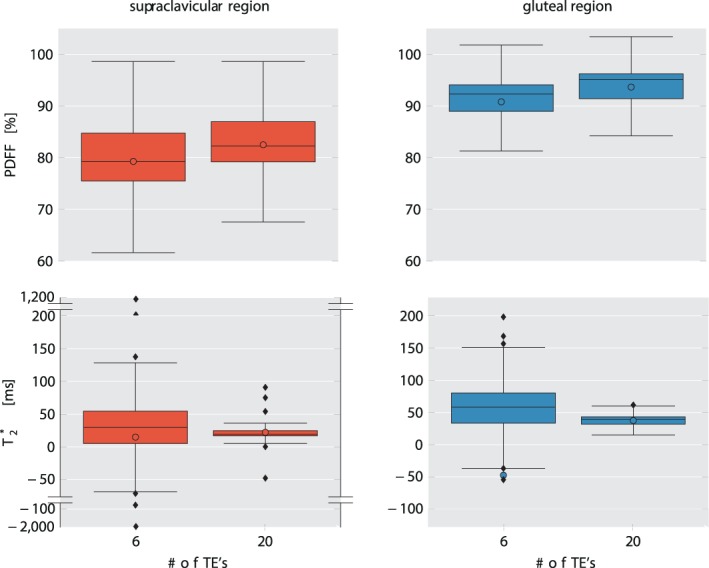
Both PDFF and T * differed significantly between supraclavicular and gluteal AT with 6 and 20 echoes (PDFF: P < 0.0001 each, T *: P = 0.03 / P < 0.0001 for 6/20 echoes). 6-echo T * demonstrated higher standard deviations and broader ranges than 20-echo T *. Regression analyses revealed a strong relationship between PDFF and T * values per AT compartment (R = 0.63 supraclavicular, R = 0.86 gluteal, P < 0.0001 each).
The present findings suggest that an increase in the number of sampled echoes beyond 6 does not affect AT PDFF quantification, whereas AT T * is considerably affected. Thus, a 20-echo gradient-echo acquisition enables a multiparametric analysis of both AT PDFF and T * and may therefore improve MR-based differentiation between white and brown fat.
2 Technical Efficacy: Stage 2 J. Magn. Reson. Imaging 2019;50:424-434.
脂肪组织(AT)可分为白色和棕色/米色亚型。基于化学位移编码的水脂 MRI 技术可同时对质子密度脂肪分数(PDFF)和 T进行映射,结果显示棕色 AT 的 PDFF 较低,T较短。然而,AT T* 值在文献中差异很大,主要基于 6 回波数据。在多回波梯度回波采集过程中增加回波数量有望提高 AT T* 映射的精度。
1)通过实验设计减轻当前 T测量技术的问题,2)使用 20 回波梯度回波采集来研究臀上部和锁骨上 AT 的 T和 PDFF 及其关系。
前瞻性。
21 名健康受试者。
磁场强度/序列评估:首先,从单 T水脂模型模拟真实信号演变。其次,在 3T 时进行了具有颈部和腹部/骨盆单极梯度的时间交错 20 回波梯度回波序列,以确定锁骨上和臀上部的 PDFF 和 T。对前 6 个回波和完整的 20 个回波进行基于复数的水脂分离。AT 隔室进行了分割。
Mann-Whitney 检验、Wilcoxon 符号秩检验和简单线性回归分析。
锁骨上和臀上部 AT 的 PDFF 和 T* 均有显著差异(PDFF:均 P<0.0001,T*:6 回波 P=0.03/20 回波 P<0.0001)。6 回波 T* 的标准偏差和范围均高于 20 回波 T*。回归分析显示,每个 AT 隔室的 PDFF 和 T* 值之间存在很强的相关性(锁骨上 R=0.63,臀上部 R=0.86,均 P<0.0001)。
本研究结果表明,增加采样回波数量超过 6 不会影响 AT PDFF 定量,而 AT T* 则受到较大影响。因此,20 回波梯度回波采集可对 AT PDFF 和 T* 进行多参数分析,从而提高基于 MRI 的白色和棕色脂肪的区分。
2 技术功效:2 级。J. Magn. Reson. Imaging 2019;50:424-434.