Department of Internal Medicine, MedStar Clinical Research Center, MedStar Health Research Institute (MHRI), Washington, DC, United States.
Section of Endocrinology, MedStar Washington Hospital Center, Washington, DC, United States.
Front Endocrinol (Lausanne). 2021 Feb 25;12:623182. doi: 10.3389/fendo.2021.623182. eCollection 2021.
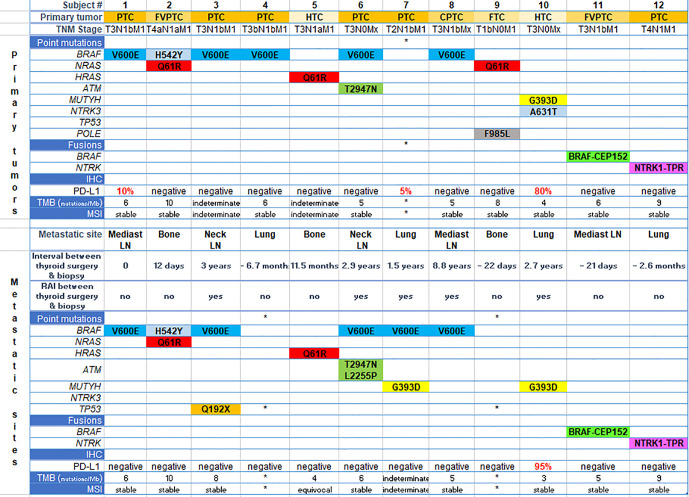
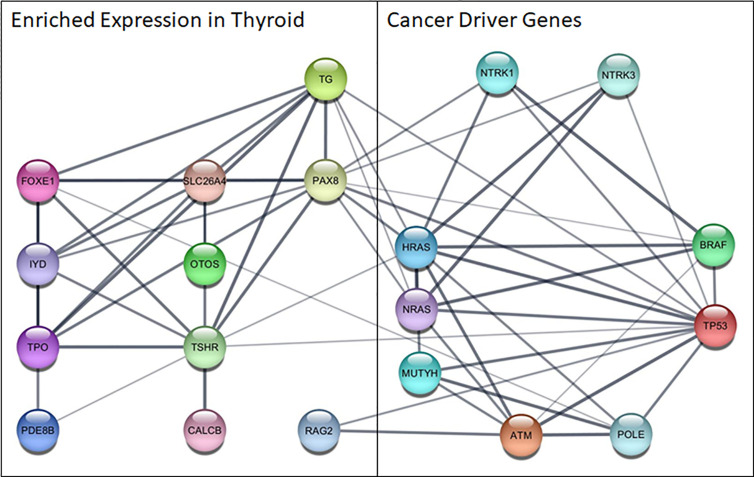
Management of metastatic radioiodine refractory differentiated thyroid cancer (DTC) can be a therapeutic challenge. Generally, little is known about the paired molecular profile of the primary tumor and the metastases and whether they harbor the same genetic abnormalities. The present study compared the molecular profile of paired tumor specimens (primary tumor/metastatic sites) from patients with radioiodine refractory DTC in order to gain insight into a possible basis for resistance to radioiodine. Twelve patients with radioiodine refractory metastases were studied; median age at diagnosis of 61 years (range, 25-82). Nine patients had papillary TC (PTC), one had follicular TC (FTC), and two had Hürthle cell TC (HTC). Distant metastases were present in the lungs (n = 10), bones (n = 4), and liver (n = 1). The molecular profiling of paired tumors was performed with a panel of 592 genes for Next Generation Sequencing, RNA-sequencing, and immunohistochemistry. Digital microfluidic PCR was used to investigate promoter mutations. The genetic landscape of all paired sites comprised , , , , , , , and genes, including and fusions. V600E was the most common point mutation in the paired specimens (5/12). promoter mutation C228T was detected in one case. PD-L1 expression at metastatic sites was highly positive (95%) for one patient with HTC. All specimens were stable for microsatellite instability testing, and the tumor mutation burden was low to intermediate. Therefore, the molecular profile of DTC primary and metastatic lesions can show heterogeneity, which may help explain some altered responses to therapeutic intervention.
转移性碘难治性分化型甲状腺癌 (DTC) 的治疗具有一定挑战性。一般来说,人们对原发肿瘤和转移灶的配对分子特征知之甚少,也不清楚它们是否存在相同的遗传异常。本研究比较了碘难治性 DTC 患者配对肿瘤标本(原发灶/转移灶)的分子特征,以期深入了解对碘治疗产生耐药性的可能基础。研究纳入 12 例碘难治性转移的患者;诊断时的中位年龄为 61 岁(范围,25-82 岁)。9 例为乳头状甲状腺癌 (PTC),1 例为滤泡状甲状腺癌 (FTC),2 例为 Hurthle 细胞甲状腺癌 (HTC)。远处转移发生在肺部(n = 10)、骨骼(n = 4)和肝脏(n = 1)。对配对肿瘤进行了 592 个基因的下一代测序、RNA 测序和免疫组织化学分析。数字微流控 PCR 用于检测启动子突变。所有配对部位的遗传特征包括 、 、 、 、 、 和 基因,包括 和 融合。V600E 是配对标本中最常见的点突变(5/12)。在一例 HTC 患者的转移部位检测到 启动子突变 C228T。一例患者的转移性部位 PD-L1 表达高度阳性(95%)。所有标本均稳定,适合进行微卫星不稳定性检测,肿瘤突变负担为低至中等。因此,DTC 原发和转移病灶的分子特征可能存在异质性,这有助于解释一些治疗干预反应的改变。