Chen Bo-Chen, Ding Zhi-Shan, Dai Jian-Sheng, Chen Ni-Pi, Gong Xing-Wen, Ma Lie-Feng, Qian Chao-Dong
College of Life Science, Institute of Molecular Medicine, Zhejiang Chinese Medical University, Hangzhou, China.
College of Medical Technology, Zhejiang Chinese Medical University, Hangzhou, China.
Front Microbiol. 2021 Feb 25;12:647289. doi: 10.3389/fmicb.2021.647289. eCollection 2021.
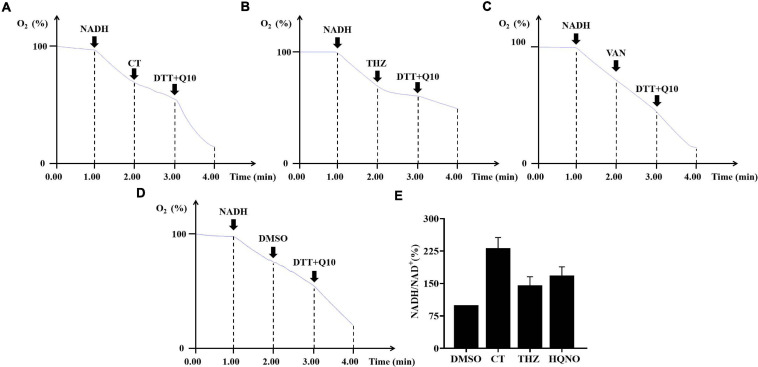
The rapid rise of antibiotic resistance causes an urgent need for new antimicrobial agents with unique and different mechanisms of action. The respiratory chain is one such target involved in the redox balance and energy metabolism. As a natural quinone compound isolated from the root of Bunge, cryptotanshinone (CT) has been previously demonstrated against a wide range of Gram-positive bacteria including multidrug-resistant pathogens. Although superoxide radicals induced by CT are proposed to play an important role in the antibacterial effect of this agent, its mechanism of action is still unclear. In this study, we have shown that CT is a bacteriostatic agent rather than a bactericidal agent. Metabolome analysis suggested that CT might act as an antibacterial agent targeting the cell membrane. CT did not cause severe damage to the bacterial membrane but rapidly dissipated membrane potential, implying that this compound could be a respiratory chain inhibitor. Oxygen consumption analysis in staphylococcal membrane vesicles implied that CT acted as respiratory chain inhibitor probably by targeting type II NADH:quinone dehydrogenase (NDH-2). Molecular docking study suggested that the compound would competitively inhibit the binding of quinone to NDH-2. Consistent with the hypothesis, the antimicrobial activity of CT was blocked by menaquinone, and the combination of CT with thioridazine but not 2-n-heptyl-4-hydroxyquinoline--oxide exerted synergistic activity against . Additionally, combinations of CT with other inhibitors targeting different components of the bacterial respiratory chain exhibit potent synergistic activities against , suggesting a promising role in combination therapies.
抗生素耐药性的迅速上升迫切需要具有独特且不同作用机制的新型抗菌剂。呼吸链就是参与氧化还原平衡和能量代谢的这样一个靶点。隐丹参酮(CT)作为从丹参根中分离出的一种天然醌类化合物,此前已被证明对包括多重耐药病原体在内的多种革兰氏阳性菌具有抗菌活性。尽管有人提出CT诱导产生的超氧自由基在该药物的抗菌作用中起重要作用,但其作用机制仍不清楚。在本研究中,我们发现CT是一种抑菌剂而非杀菌剂。代谢组学分析表明,CT可能作为一种靶向细胞膜的抗菌剂发挥作用。CT不会对细菌膜造成严重损伤,但会迅速耗散膜电位,这意味着该化合物可能是一种呼吸链抑制剂。对葡萄球菌膜囊泡的氧气消耗分析表明,CT可能通过靶向II型NADH:醌脱氢酶(NDH-2)作为呼吸链抑制剂发挥作用。分子对接研究表明,该化合物会竞争性抑制醌与NDH-2的结合。与该假设一致,甲萘醌可阻断CT的抗菌活性,且CT与硫利达嗪而非2-正庚基-4-羟基喹啉-N-氧化物的组合对……具有协同活性。此外,CT与其他靶向细菌呼吸链不同组分的抑制剂的组合对……表现出强大的协同活性,表明其在联合治疗中具有广阔前景。