Ostolin Thatiane Lopes Valentim Di Paschoale, Gonze Bárbara de Barros, de Oliveira Vieira Wesley, de Oliveira André Luiz Silva, Nascimento Matheus Bibian, Arantes Rodolfo Leite, Romiti Marcello, Sperandio Evandro Fornias, Dourado Victor Zuniga
Laboratory of Epidemiology and Human Movement, Federal University of São Paulo, Santos, Brazil.
Institute of Cardiovascular Medicine Angiocorpore, Santos, Brazil.
SAGE Open Med. 2021 Feb 27;9:2050312121993294. doi: 10.1177/2050312121993294. eCollection 2021.
The handgrip strength is a practical, valid, reliable, low-cost tool that presents strong correlations with several health conditions. However, handgrip strength may be inaccurate to prospectively predict the variability of muscular function since the decrease in muscular strength over the years varies according to a muscular group or between upper and lower limbs. Our hypothesis is that the handgrip strength cannot explain the variance of muscle function prospectively.
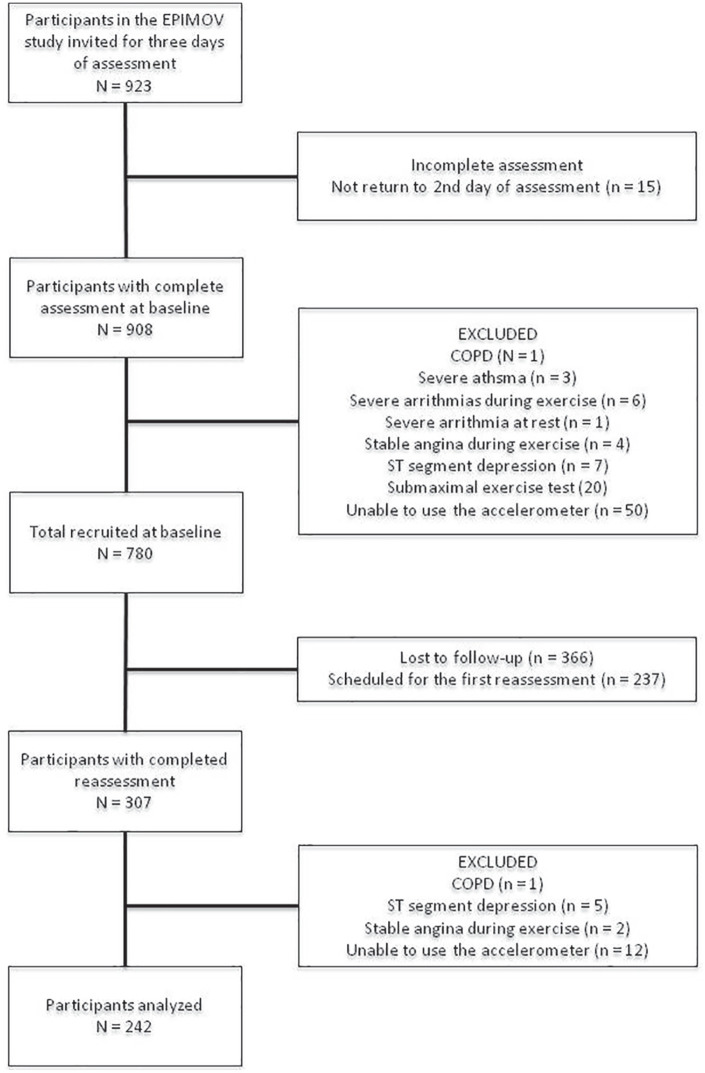
The aim of this study was to evaluate the cross-sectional and prospective association between handgrip strength and isokinetic muscle function of the knee and elbow in 780 asymptomatic adults.
In a sample of 780 adults, we obtained handgrip strength and elbow and knee muscle function (for both flexion and extension at 60°/s and 300°/s) using, respectively, a hydraulic dynamometer and an isokinetic dynamometer. In a cross-sectional analysis, we analyzed the data obtained from baseline assessment. Then, we calculated the absolute change as a result of the variation data between the baseline and the 1-year follow-up assessment of each participant. The correlations were analyzed using Pearson or Spearman coefficients. We used multivariate models to investigate the association between handgrip strength and isokinetic muscle function.
The cross-sectional correlations were significantly moderate-to-strong ( = 0.41-0.71, < 0.01), but became weak-to-moderate ( = 0.26-0.34, < 0.01) prospectively. In the cross-sectional analysis, the handgrip strength was selected as a strong predictor for isokinetic variables (∆ = 0.171-0.583, < 0.05) as expected. Although handgrip strength was also selected as a significant predictor in prospective analysis, it explained only a little variance in isokinetic muscle function of the knee (∆ = 0.7-0.117, < 0.05). Regarding the predictive models for the elbow, handgrip strength was not selected prospectively.
The 1-year absolute change of the handgrip strength cannot explain the variance of the isokinetic muscle function. Thus, specific measures are required for assessing muscle function in epidemiological studies.
握力是一种实用、有效、可靠且低成本的工具,与多种健康状况密切相关。然而,握力可能无法准确地前瞻性预测肌肉功能的变化,因为多年来肌肉力量的下降因肌肉群或上下肢而异。我们的假设是握力无法前瞻性地解释肌肉功能的差异。
本研究旨在评估780名无症状成年人的握力与膝关节和肘关节等速肌肉功能之间的横断面和前瞻性关联。
在780名成年人的样本中,我们分别使用液压测力计和等速测力计获得了握力以及肘关节和膝关节的肌肉功能(60°/秒和300°/秒时的屈伸)。在横断面分析中,我们分析了基线评估获得的数据。然后,我们计算了每位参与者基线与1年随访评估之间数据变化导致的绝对变化。使用Pearson或Spearman系数分析相关性。我们使用多变量模型研究握力与等速肌肉功能之间的关联。
横断面相关性显著为中度至高度(r = 0.41 - 0.71,P < 0.01),但前瞻性来看变为低度至中度(r = 0.26 - 0.34,P < 0.01)。在横断面分析中,如预期的那样,握力被选为等速变量的强预测指标(ΔR² = 0.171 - 0.583,P < 0.05)。虽然握力在前瞻性分析中也被选为显著预测指标,但它仅解释了膝关节等速肌肉功能的少量差异(ΔR² = 0.07 - 0.117,P < 0.05)。关于肘关节的预测模型,握力在前瞻性分析中未被选中。
握力的1年绝对变化无法解释等速肌肉功能的差异。因此,在流行病学研究中评估肌肉功能需要采取特定措施。