PĂtru Adrian, Şurlin Valeriu, MĂrgĂritescu Claudiu, CiucĂ Eduard, MĂrgĂritescu Otilia Clara, Camen Adrian
Department of Oral and Maxillofacial Surgery, University of Medicine and Pharmacy of Craiova, Romania.
Department of Surgery, University of Medicine and Pharmacy of Craiova, Romania.
Curr Health Sci J. 2020 Oct-Dec;46(4):358-370. doi: 10.12865/CHSJ.46.04.06. Epub 2020 Dec 31.
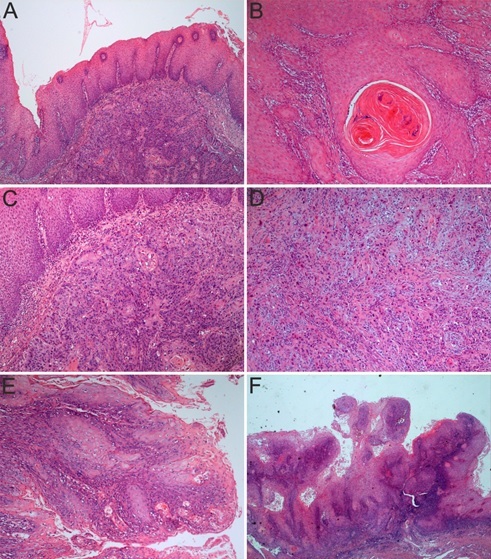
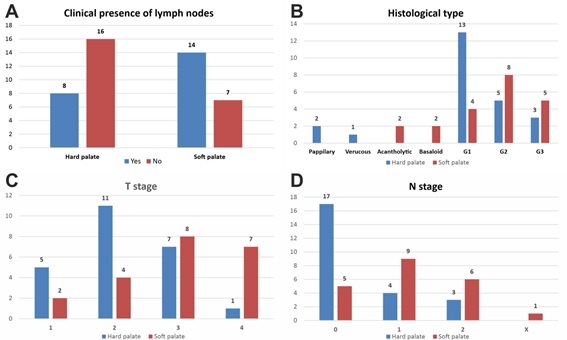
The literature date estimated that about 5% of all oral cavity cancers are hard palate cancers while soft palate cancers account for about 5-12% of oropharyngeal cancers. Although rare, usually these tumors had a more aggressively behavior than other oral cancer sites. That is why our study aimed to investigate comparatively the epidemiological, clinical and histopathological peculiarities of the two palatal sites of oral squamous cell carcinomas. We conducted a retrospective study limited to a period of 10 years in a single medical institution to investigate the morphoclinical profile of such tumors. We found that patients with hard palate SCCs had an average age slightly larger compared to those who developed soft palate tumors. Also, those with hard palate tumors are mostly diagnosed in less advanced stages compared to those at the level of the soft palate, and implicitly the former had a longer survival time. Histopathologically the most encountered hard palate SCC were the conventional well-differentiated tumor, and from the peculiar SCC variant the papillary and verrucous forms while for the soft palate SCC prevailed the moderate and poor differentiated conventional SCC and from the peculiar SCC variant the basaloid and acantholytic forms. In conclusion hard palate tumors differ in many aspects from those of the soft palate, and thus specification of the origin tumor site become important for the assessment of prognosis, treatment and survival outcome of such patients.
文献数据估计,所有口腔癌中约5%为硬腭癌,而软腭癌约占口咽癌的5 - 12%。尽管罕见,但通常这些肿瘤的行为比其他口腔癌部位更具侵袭性。这就是为什么我们的研究旨在比较口腔鳞状细胞癌两个腭部部位的流行病学、临床和组织病理学特征。我们在一家单一医疗机构进行了一项为期10年的回顾性研究,以调查此类肿瘤的形态临床特征。我们发现,硬腭鳞状细胞癌患者的平均年龄比发生软腭肿瘤的患者略大。此外,与软腭肿瘤患者相比,硬腭肿瘤患者大多在较早期阶段被诊断出来,因此前者的生存时间更长。组织病理学上,硬腭最常见的鳞状细胞癌是传统的高分化肿瘤,在特殊的鳞状细胞癌变体中,乳头状和疣状形式居多;而软腭鳞状细胞癌中,中度和低分化的传统鳞状细胞癌占主导,在特殊的鳞状细胞癌变体中,基底样和棘层松解形式居多。总之,硬腭肿瘤在许多方面与软腭肿瘤不同,因此明确肿瘤起源部位对于评估此类患者的预后、治疗和生存结果非常重要。