Gergen Anna K, White Allana M, Mitchell John D, Meguid Robert A, Fullerton David A, Scott Christopher D, Weyant Michael J
Division of Cardiothoracic Surgery, Department of Surgery, University of Colorado, Aurora, CO, USA.
Adult and Child Consortium for Health Outcomes Research (ACCORDS), University of Colorado, Aurora, CO, USA.
J Thorac Dis. 2021 Feb;13(2):762-767. doi: 10.21037/jtd-20-2249.
Pulmonary segmentectomy provides an anatomic lung resection while avoiding removal of excess normal lung tissue. This may be beneficial in patients with minimal pulmonary reserve who present with early-stage non-small cell lung cancer (NSCLC). However, the operative performance of a segmentectomy using a video-assisted thoracoscopic approach can be technically challenging. We hypothesized that introduction of the robotic surgical system would facilitate the performance of a segmentectomy as measured by an increase in the proportion of segmentectomies being pursued.
We completed a retrospective analysis of thoracoscopic and robotic anatomic lung resections, including lobectomies and segmentectomies, performed in patients with primary lung cancer from the time of initiation of the robotic thoracic surgery program in November 2017 to November 2019. We compared the proportion of thoracoscopic and robotic segmentectomies performed during the first year compared to the second year of the data collection period.
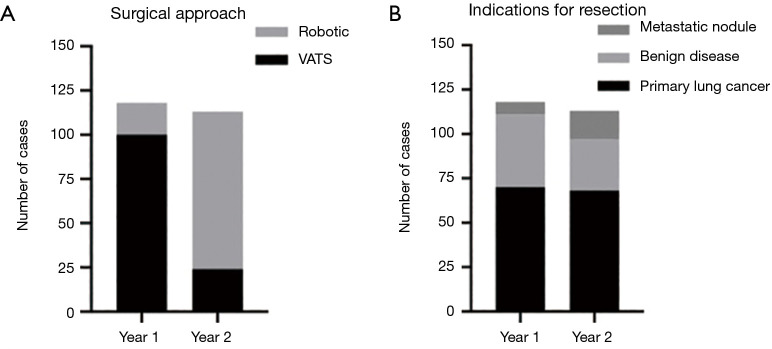
A total of 138 thoracoscopic and robotic anatomic lung resections were performed for primary lung cancer. Types of lung cancer resected (adenocarcinoma, squamous cell carcinoma, or other), tumor size based on clinical T staging (T1-T4), and tumor location were not significantly different between years (P=0.44, P=0.98, and P=0.26, respectively). The proportion of segmentectomies increased from 8.6% during the first year to 25.0% during the second year (P=0.01). One out of 6 (16.7%) segmentectomies were performed using the robot during the first year versus 15 out of 17 (88.2%) during the second year (P=0.003).
Use of the robot led to a significant increase in the number of segmentectomies performed in patients undergoing anatomic lung resection. With increasing lung cancer awareness and widely available screening, a greater number of small, early-stage tumors suitable for segmentectomy will likely be detected. We conclude that robotic-assisted surgery may facilitate the challenges of performing a minimally invasive segmentectomy.
肺段切除术可实现肺的解剖性切除,同时避免切除过多正常肺组织。这对于肺储备功能有限且患有早期非小细胞肺癌(NSCLC)的患者可能有益。然而,采用电视辅助胸腔镜方法进行肺段切除术的手术操作在技术上可能具有挑战性。我们假设引入机器人手术系统将有助于肺段切除术的实施,衡量标准是实施的肺段切除术比例增加。
我们对2017年11月机器人胸外科手术项目启动至2019年11月期间,对原发性肺癌患者进行的胸腔镜和机器人解剖性肺切除术(包括肺叶切除术和肺段切除术)进行了回顾性分析。我们比较了数据收集期第一年与第二年进行的胸腔镜和机器人肺段切除术的比例。
共对原发性肺癌进行了138例胸腔镜和机器人解剖性肺切除术。各年份间切除的肺癌类型(腺癌、鳞状细胞癌或其他)、基于临床T分期的肿瘤大小(T1 - T4)以及肿瘤位置均无显著差异(分别为P = 0.44、P = 0.98和P = 0.26)。肺段切除术的比例从第一年的8.6%增加到第二年的25.0%(P = 0.01)。第一年6例肺段切除术中1例(16.7%)使用机器人进行,而第二年17例中有15例(88.2%)使用机器人进行(P = 0.003)。
使用机器人导致接受解剖性肺切除术患者的肺段切除术数量显著增加。随着肺癌意识的提高和广泛可用的筛查,可能会发现更多适合肺段切除术的小的早期肿瘤。我们得出结论,机器人辅助手术可能有助于应对微创肺段切除术的挑战。