Hu Wenbin, Zhang Kang, Han Xiaoliang, Zhao Jiaming, Wang Guzong, Yuan Shunda, He Binjun
Department of Cardiothoracic Surgery, Affiliated Hospital of Shaoxing University (The Shaoxing Municipal Hospital), Shaoxing, China.
Department of Thoracosurgery, Shaoxing People's Hospital, Zhejiang University School of Medicine, Shaoxing, China.
J Thorac Dis. 2021 Feb;13(2):1187-1195. doi: 10.21037/jtd-21-16.
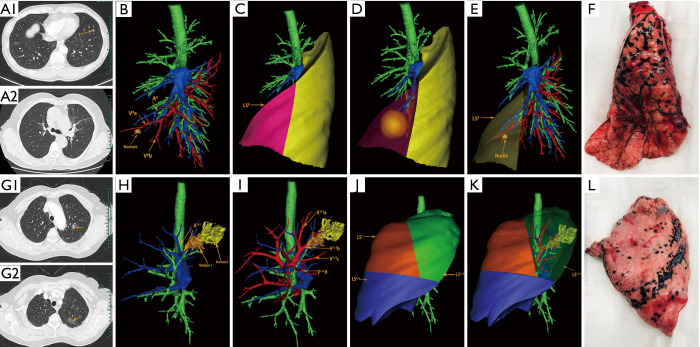
Compared with lobectomy, the anatomical structure of the lung segment is relatively complex and easy to occur variation, thus it increases the difficulty and risk of precise segmentectomy. The application of three-dimensional computed tomography bronchography and angiography (3D-CTBA) combined with a three-dimensional printing (3D printing) model can ensure the safety of operation and simplify the surgical procedure to a certain extent. We aimed to estimate the value of 3D-CTBA and 3D printing in thoracoscopic precise pulmonary segmentectomy.
We retrospectively reviewed the clinical data of 65 patients who underwent anatomical segmentectomy at the Affiliated Hospital of Shaoxing University from January 2019 to August 2020. The patients were divided into two groups: a 3D-CTBA combined with 3D printing group (30 patients) and a general group (35 patients). The perioperative data of the two groups were compared.
Compared with the general segmentectomy group at the same period in our center, the surgery time of the group guided by 3D-CTBA and 3D printing was significantly shorter. Intraoperative blood loss in the 3D-CTBA and 3D printing group was also apparently lower than in the general group. Hospital stay and postoperative chest tube duration showed no significant differences between the two groups, and neither did postoperative complications such as pneumonia, hemoptysis, arrhythmia, and pulmonary air leakage.
3D-CTBA combined with 3D printing clearly identifies the precise pulmonary segmental structures, avoids intraoperative accidental injury, reduces intraoperative blood loss, shortens the operation time and improves the safety of thoracoscopic pulmonary segmentectomy in stage IA non-small cell lung cancer (NSCLC).
与肺叶切除术相比,肺段的解剖结构相对复杂且容易发生变异,这增加了精确肺段切除术的难度和风险。三维计算机断层扫描支气管造影和血管造影(3D-CTBA)联合三维打印(3D打印)模型的应用可在一定程度上确保手术安全并简化手术过程。我们旨在评估3D-CTBA和3D打印在胸腔镜精确肺段切除术中的价值。
我们回顾性分析了2019年1月至2020年8月在绍兴大学附属医院接受解剖性肺段切除术的65例患者的临床资料。将患者分为两组:3D-CTBA联合3D打印组(30例患者)和常规组(35例患者)。比较两组的围手术期数据。
与本中心同期的常规肺段切除术组相比,3D-CTBA和3D打印引导组的手术时间明显更短。3D-CTBA和3D打印组的术中出血量也明显低于常规组。两组的住院时间和术后胸管留置时间无显著差异,术后肺炎、咯血、心律失常和肺漏气等并发症也无显著差异。
3D-CTBA联合3D打印能清晰识别精确的肺段结构,避免术中意外损伤,减少术中出血,缩短手术时间,提高IA期非小细胞肺癌(NSCLC)胸腔镜肺段切除术的安全性。