Li Zhenhao, Zhang Xiaohui, Liao Jie, Fan Xiaohui, Cheng Yiyu
Pharmaceutical Informatics Institute, College of Pharmaceutical Sciences, Zhejiang University, Hangzhou, 310058, China.
J Pharm Anal. 2021 Feb;11(1):88-95. doi: 10.1016/j.jpha.2020.01.003. Epub 2020 Jan 16.
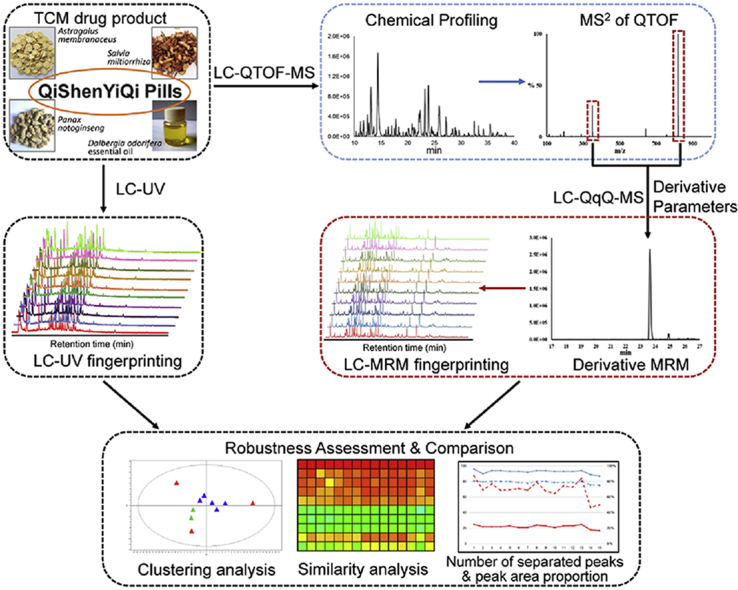
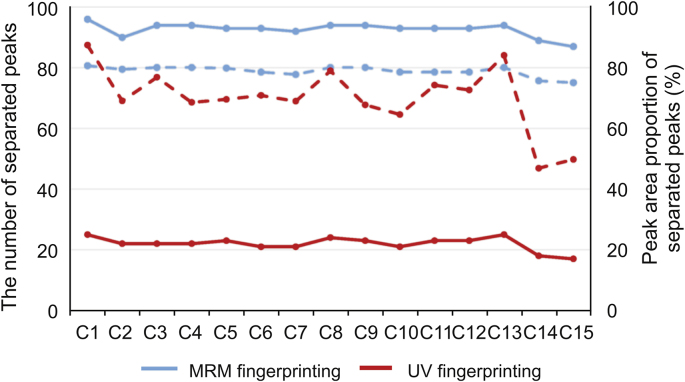
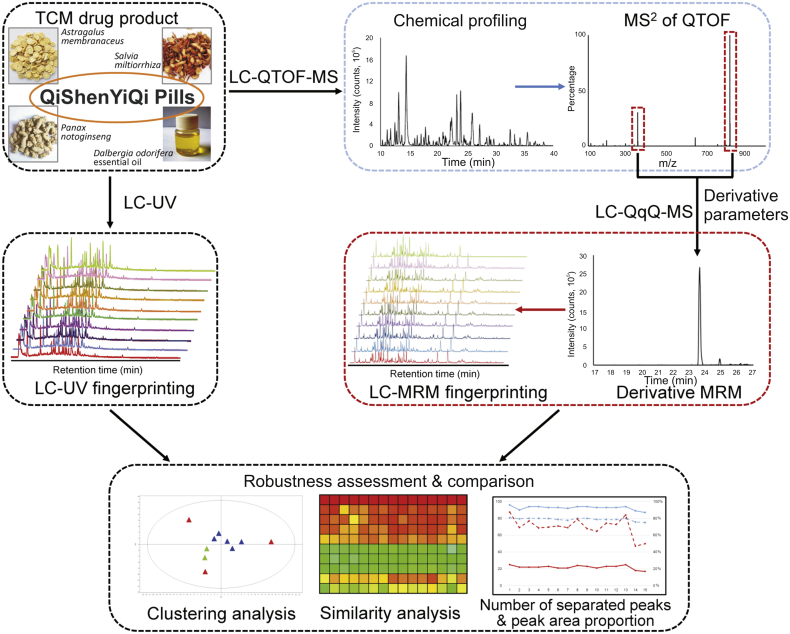
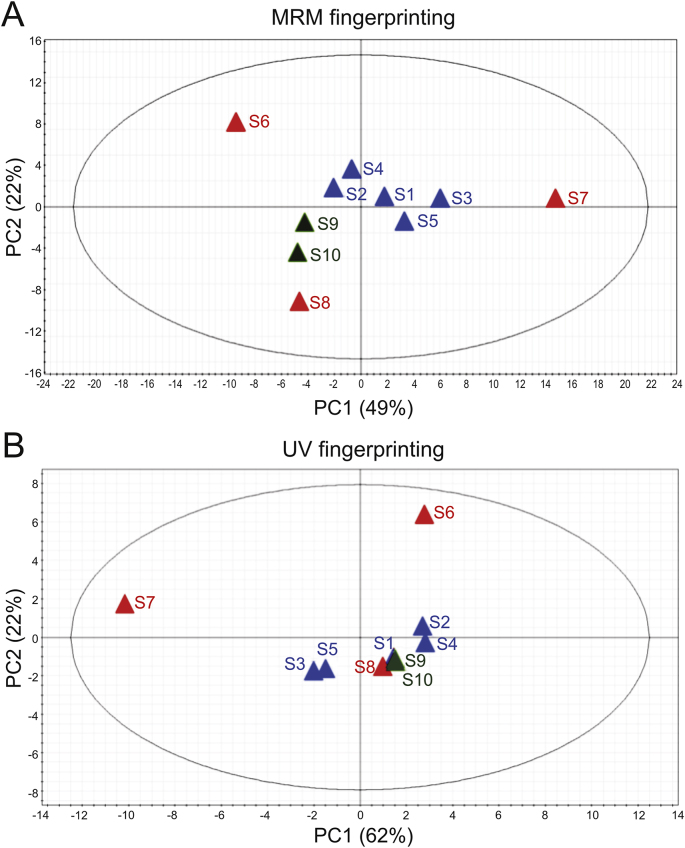
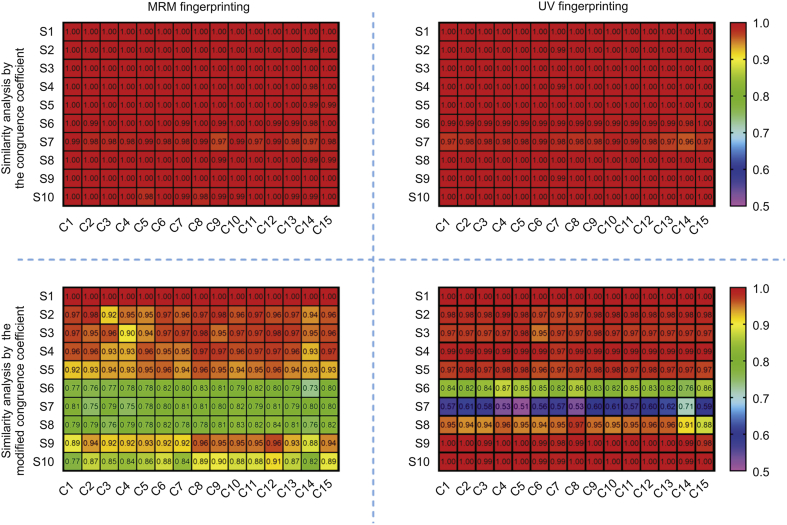
Chromatographic fingerprinting has been perceived as an essential tool for assessing quality and chemical equivalence of traditional Chinese medicine. However, this pattern-oriented approach still has some weak points in terms of chemical coverage and robustness. In this work, we proposed a multiple reaction monitoring (MRM)-based fingerprinting method in which approximately 100 constituents were simultaneously detected for quality assessment. The derivative MRM approach was employed to rapidly design MRM transitions independent of chemical standards, based on which the large-scale fingerprinting method was efficiently established. This approach was exemplified on QiShenYiQi Pill (QSYQ), a traditional Chinese medicine-derived drug product, and its robustness was systematically evaluated by four indices: clustering analysis by principal component analysis, similarity analysis by the congruence coefficient, the number of separated peaks, and the peak area proportion of separated peaks. Compared with conventional ultraviolet-based fingerprints, the MRM fingerprints provided not only better discriminatory capacity for the tested normal/abnormal QSYQ samples, but also higher robustness under different chromatographic conditions (i.e., flow rate, apparent pH, column temperature, and column). The result also showed for such large-scale fingerprints including a large number of peaks, the angle cosine measure after min-max normalization was more suitable for setting a decision criterion than the unnormalized algorithm. This proof-of-concept application gives evidence that combining MRM technique with proper similarity analysis metrices can provide a highly sensitive, robust and comprehensive analytical approach for quality assessment of traditional Chinese medicine.
色谱指纹图谱已被视为评估中药质量和化学等效性的重要工具。然而,这种基于图谱的方法在化学覆盖范围和稳健性方面仍存在一些弱点。在本研究中,我们提出了一种基于多反应监测(MRM)的指纹图谱方法,可同时检测约100种成分用于质量评估。采用衍生MRM方法,独立于化学标准快速设计MRM跃迁,在此基础上高效建立了大规模指纹图谱方法。以中药衍生药品芪参益气滴丸(QSYQ)为例,通过主成分分析聚类分析、相似度系数相似性分析、分离峰数量和分离峰面积比例四个指标系统评估了该方法的稳健性。与传统的基于紫外的指纹图谱相比,MRM指纹图谱不仅对测试的正常/异常QSYQ样品具有更好的鉴别能力,而且在不同色谱条件(即流速、表观pH值、柱温、色谱柱)下具有更高的稳健性。结果还表明,对于包含大量峰的此类大规模指纹图谱,最小-最大归一化后的夹角余弦度量比未归一化算法更适合设定决策标准。这一概念验证应用证明,将MRM技术与适当的相似性分析指标相结合,可以为中药质量评估提供一种高度灵敏、稳健且全面的分析方法。