Bugert Christina L, Kwiat Victoria, Valera Isela C, Bugert Joachim J, Parvatiyar Michelle S
College of Life and Environmental Sciences, University of Exeter, Exeter, South West UK.
Department of Nutrition, Food and Exercise Sciences, Florida State University, Tallahassee, FL USA.
Curr Clin Microbiol Rep. 2021;8(3):167-177. doi: 10.1007/s40588-021-00160-0. Epub 2021 Mar 5.
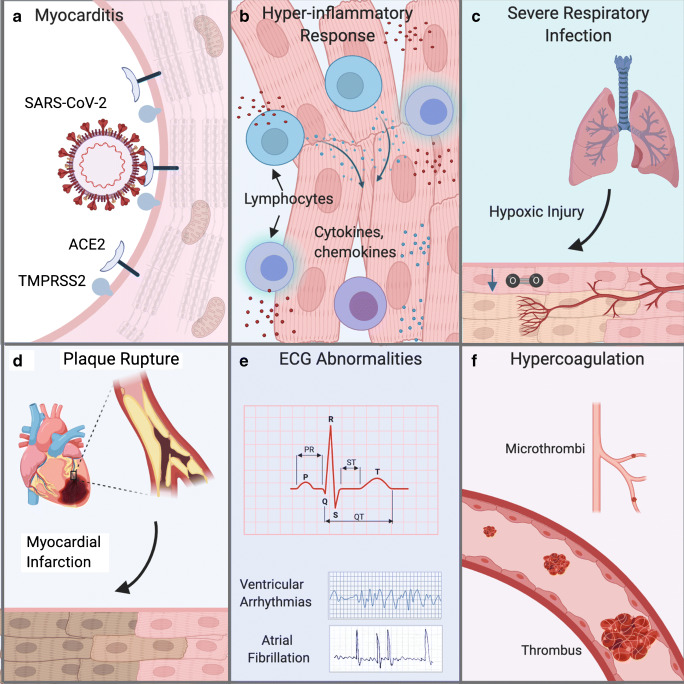
The world is currently facing the largest global health crisis since the early 1900s due to a novel . While SARS-CoV-2 infection causes predictable symptoms in COVID-19 patients, including upper respiratory distress and fever, the heterogeneity of manifestations is surprising. This review focuses on direct and indirect causes of myocardial injury in COVID-19 patients and highlights current knowledge, treatment strategies, and outstanding questions in the field.
Data are emerging that highlight the extent of cardiovascular involvement in COVID-19 patients, including evidence that SARS-CoV-2 causes myocarditis and increases cardiac risk. The incidence of cardiac injury is much greater in patients with severe disease presentation and those in intensive care.
During the past year, COVID-19 patient mortality rates have improved due to tailored pharmacological treatments and patient management strategies that address the unique presentation of symptoms, which will hopefully also reduce the incidence of cardiac injury.
由于一种新型病毒,全球目前正面临自20世纪初以来最大的全球健康危机。虽然严重急性呼吸综合征冠状病毒2(SARS-CoV-2)感染在冠状病毒病(COVID-19)患者中会引发可预测的症状,包括上呼吸道窘迫和发热,但临床表现的异质性令人惊讶。本综述聚焦于COVID-19患者心肌损伤的直接和间接原因,并突出该领域的现有知识、治疗策略及悬而未决的问题。
越来越多的数据凸显了COVID-19患者心血管受累的程度,包括有证据表明SARS-CoV-2可导致心肌炎并增加心脏风险。重症患者和重症监护患者中心脏损伤的发生率要高得多。
在过去一年中,由于针对症状独特表现的定制化药物治疗和患者管理策略,COVID-19患者的死亡率有所改善,这有望也降低心脏损伤的发生率。