Chen Yanbo, Xu Hui, Liu Chong, Gu Meng, Zhan Ming, Chen Qi, Wang Zhong
Department of Urology, Shanghai Ninth People's Hospital Affiliated to Shanghai Jiao Tong University School of Medicine, Shanghai, China.
Department of Emergency, Shanghai Ninth People's Hospital Affiliated to Shanghai Jiao Tong University School of Medicine, Shanghai, China.
Transl Androl Urol. 2021 Feb;10(2):643-653. doi: 10.21037/tau-20-1169.
The etiopathogenesis of benign prostatic hyperplasia (BPH) is extremely complicated which involving epithelial-mesenchymal transition (EMT) of epithelial cells and growth of stromal cells. Long non-coding RNAs (lncRNAs) belong to a group of noncoding RNAs which has been widely studied in other diseases but rarely in BPH. Here, we intend to investigate the roles of a lncRNA DIO3 opposite strand (DIO3OS) in BPH progression.
BPH-1 cells were used to study EMT and WPMY-1 cells were applied to study proliferation induced by TGF-β1, resveratrol, DIO3OS and miRNAs.
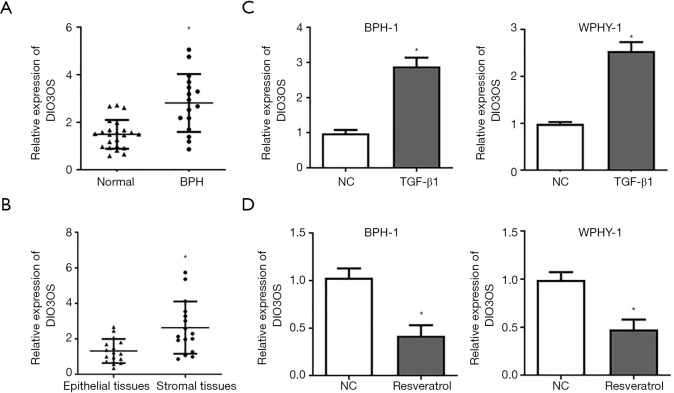
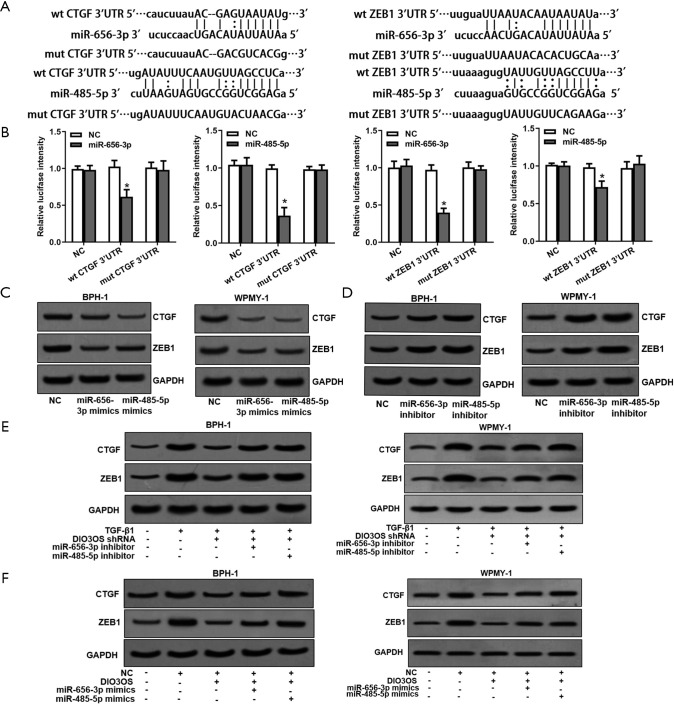
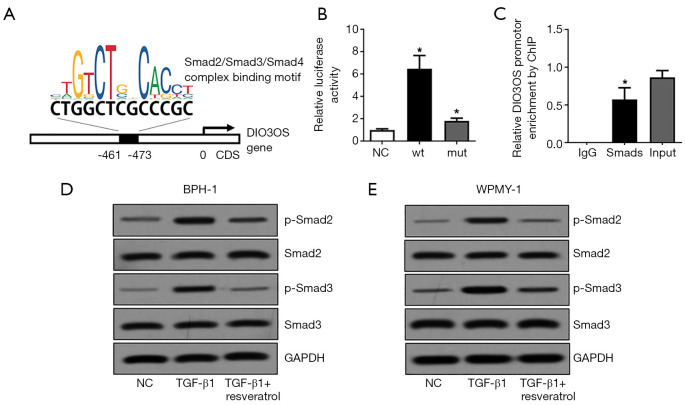
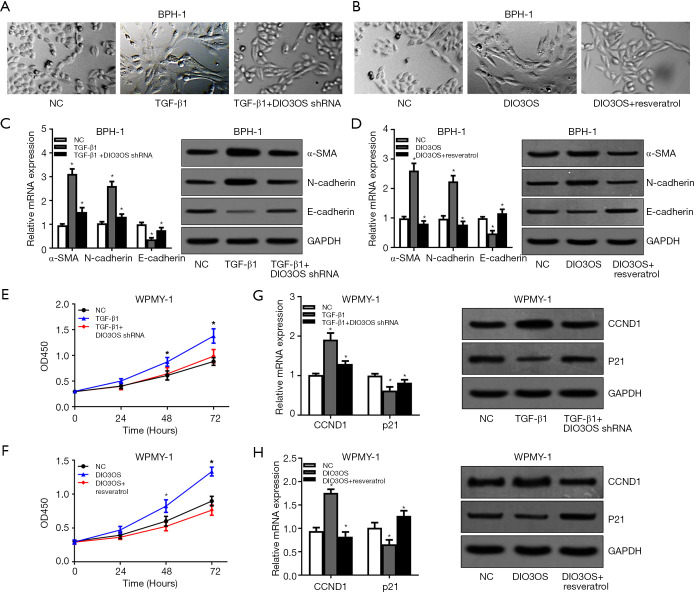
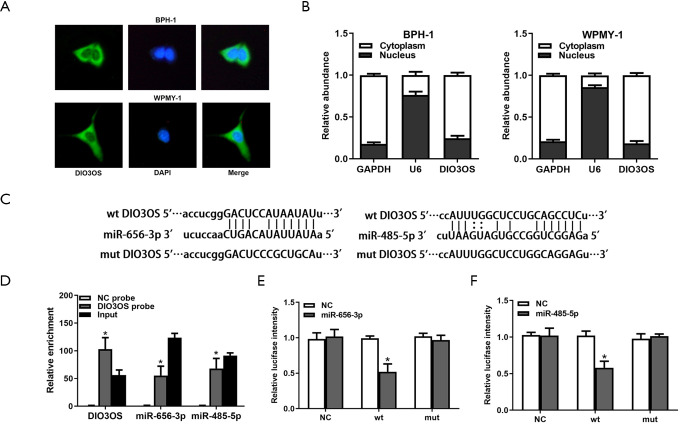
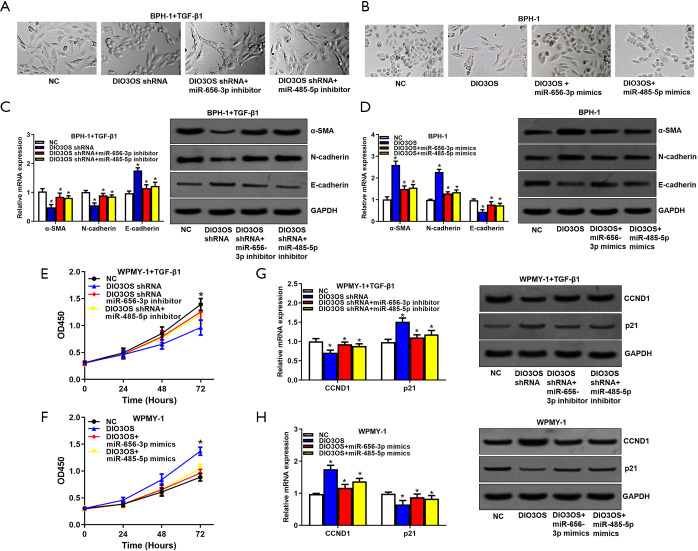
DIO3OS was over-expressed in BPH tissues and could be upregulated by Transforming growth factor beta 1 (TGF-β1) and downregulated by resveratrol. Smad2/Smad3/Smad4 complex could bind to the DIO3OS promotor region and thereby enhanced its transcription which was responsible for the regulation of TGF-β1 and resveratrol on DIO3OS expression. TGF-β1 promoted BPH-1 cells EMT and WPMY-1 cells proliferation via DIO3OS and this effect could be blocked by resveratrol. MiR-656-3p and miR-485-5p were targets of DIO3OS and DIO3OS promoted BPH-1 cells EMT and WPMY-1 cells proliferation via miR-656-3p and miR-485-5p. Connective tissue growth factor (CTGF) and zinc finger e-box binding homeobox 1 (ZEB1) were confirmed to be targets of both miR-656-3p and miR-485-5p and could be modulated by TGF-β1, resveratrol, DIO3OS, miR-656-3p and miR-485-5p.
DIO3OS is highly expressed in BPH tissues and regulated by TGF-β1 as well as resveratrol in a Smads dependent manner. DIO3OS facilitates BPH-1 cells EMT and WPMY-1 cells proliferation by upregulating CTGF and ZEB1 via miR-656-3p and miR-485-5p.
良性前列腺增生(BPH)的发病机制极其复杂,涉及上皮细胞的上皮-间质转化(EMT)和基质细胞的生长。长链非编码RNA(lncRNA)属于一类非编码RNA,在其他疾病中已被广泛研究,但在BPH中研究较少。在此,我们旨在研究lncRNA DIO3反义链(DIO3OS)在BPH进展中的作用。
使用BPH-1细胞研究EMT,使用WPMY-1细胞研究转化生长因子-β1(TGF-β1)、白藜芦醇、DIO3OS和微小RNA(miRNA)诱导的增殖。
DIO3OS在BPH组织中高表达,可被TGF-β1上调,被白藜芦醇下调。Smad2/Smad3/Smad4复合物可与DIO3OS启动子区域结合,从而增强其转录,这负责TGF-β1和白藜芦醇对DIO3OS表达的调节。TGF-β1通过DIO3OS促进BPH-1细胞的EMT和WPMY-1细胞的增殖,而白藜芦醇可阻断这种作用。MiR-656-3p和miR-485-5p是DIO3OS的靶标,DIO3OS通过miR-656-3p和miR-485-5p促进BPH-1细胞的EMT和WPMY-1细胞的增殖。结缔组织生长因子(CTGF)和锌指E盒结合同源框1(ZEB1)被证实是miR-656-3p和miR-485-5p的靶标,并且可被TGF-β1、白藜芦醇、DIO3OS、miR-656-3p和miR-485-5p调节。
DIO3OS在BPH组织中高表达,并以Smads依赖的方式受TGF-β1和白藜芦醇调节。DIO3OS通过miR-656-3p和miR-485-5p上调CTGF和ZEB1,促进BPH-1细胞的EMT和WPMY-1细胞的增殖。