Yi Zhenglin, Ou Zhenyu, Guo Xi, Othmane Belaydi, Hu Jiao, Ren Wenbiao, Li Huihuang, He Tongchen, Qiu Dongxu, Cai Zhiyong, Chen Jinbo, Zu Xiongbing
Department of Urology, Xiangya Hospital, Central South University, Changsha, China.
Department of Urology, Hunan Provincial People's Hospital, Changsha, China.
Transl Androl Urol. 2021 Feb;10(2):734-740. doi: 10.21037/tau-20-948.
Keratinizing squamous metaplasia (KSM) is a clinically heterogeneous disease that lacks research that provide definitive recurrent risk factors. Therefore, we identified the recurrence factors in patients with KSM of the bladder after transurethral resection (TUR). We also attempted to investigate the association between KSM and bladder cancer.
Clinical information of 257 patients diagnosed with KSM who underwent TUR in Xiangya Hospital from January 2010 to November 2018 were retrospectively collected. Clinical information was available for follow-up of 223 patients. To determine the risk factors for recurrence, we conducted univariate and multivariate cox regression analysis respectively. To explore the association between KSM and bladder cancer, we used clinical follow-up data.
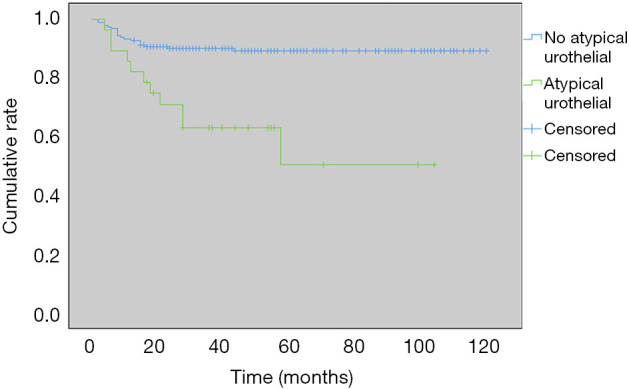
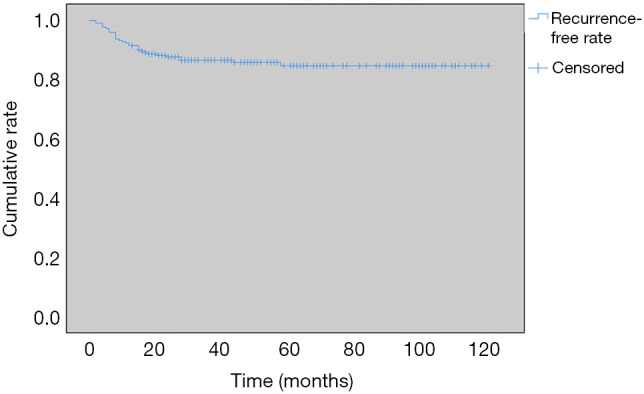
The median follow-up time is 49 (IQR, 12-121) months. Five-year recurrence-free rate (RFR) and 1-year RFR were 86.1% and 91.9%, respectively. Thirty-one patients (13.9%) relapsed of KSM after a median follow-up of 49 months (range, 12-121 months), and none of them developed subsequent bladder cancer. Univariate Cox analysis indicated that urinary tract infection [hazard ratio (HR) =2.111; 95% confidence interval (CI): 1.043-4.271; P=0.038], and atypical urothelial hyperplasia of the bladder (HR =4.191; 95% CI: 2.006-8.756; P<0.001) were significant recurrence factors. Multivariate Cox analysis suggested that atypical urothelial hyperplasia of the bladder (HR =3.506; 95% CI: 1.663-7.392; P=0.001) was the independent risk factor for postoperative recurrence of KSM.
The recurrence rate in patients with KSM was about 13.9%, and atypical urothelial hyperplasia of the bladder was the independent risk factor in patients with KSM recurrence. In cases with bladder atypical urothelial hyperplasia, close follow-ups are necessary. Also, we demonstrated that KSM did not increase the subsequent risk of bladder cancer.
角化性鳞状化生(KSM)是一种临床异质性疾病,缺乏提供明确复发危险因素的研究。因此,我们确定了经尿道切除术(TUR)后膀胱KSM患者的复发因素。我们还试图研究KSM与膀胱癌之间的关联。
回顾性收集2010年1月至2018年11月在湘雅医院接受TUR的257例诊断为KSM患者的临床资料。有223例患者的临床资料可供随访。为确定复发的危险因素,我们分别进行了单因素和多因素Cox回归分析。为探索KSM与膀胱癌之间的关联,我们使用了临床随访数据。
中位随访时间为49(四分位间距,12 - 121)个月。5年无复发生存率(RFR)和1年RFR分别为86.1%和91.9%。31例患者(13.9%)在中位随访49个月(范围12 - 121个月)后复发KSM,且均未发生后续膀胱癌。单因素Cox分析表明,尿路感染[风险比(HR)=2.111;95%置信区间(CI):1.043 - 4.271;P = 0.038]和膀胱非典型尿路上皮增生(HR = 4.191;95% CI:2.006 - 8.756;P < 0.001)是显著的复发因素。多因素Cox分析提示,膀胱非典型尿路上皮增生(HR = 3.506;95% CI:1.663 - 7.392;P = 0.001)是KSM术后复发的独立危险因素。
KSM患者的复发率约为13.9%,膀胱非典型尿路上皮增生是KSM复发患者的独立危险因素。对于膀胱非典型尿路上皮增生的病例,有必要密切随访。此外,我们证明KSM不会增加后续患膀胱癌的风险。