Shang Jin, Han Xiao, Zha Haoran, Tao Haitao, Li Xiaoyan, Yuan Fang, Chen Guangying, Wang Lijie, Ma Junxun, Hu Yi
Department of Oncology, Chinese People's Liberation Army General Hospital, People's Liberation Army School of Medicine, Beijing, China.
Department of Health Service, Guard Bureau of the Joint Staff Department, Central Military Commission of People's Liberation Army, Beijing, China.
Front Oncol. 2021 Feb 24;11:585271. doi: 10.3389/fonc.2021.585271. eCollection 2021.
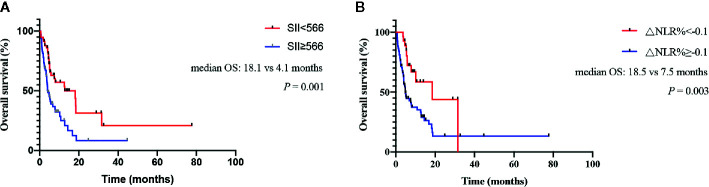
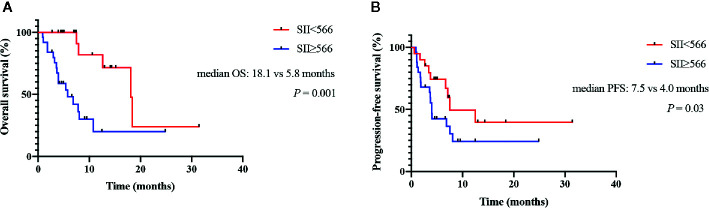
The efficacy of current treatment regimens for pancreatic cancer (PC) remains unsatisfactory. In recent years, immune checkpoint blockade (ICB) therapy has shown promising anti-tumor outcomes in many malignancies, including PC. Inexpensive and readily available biomarkers which predict therapeutic responses and prognosis are in critical need. Systemic immune-inflammation index (SII) and neutrophil-lymphocyte ratio (NLR) are emerging predictors for prognosis of various tumors. We aim to investigate the prognostic significance of baseline SII, NLR, and their changes in PC patients treated with ICB. Our retrospective analysis included PC patients treated with ICB therapy in the Chinese PLA General Hospital. All demographic, biological, and clinical data were extracted from medical records. Relative changes of SII after two doses of ICB were defined as ΔSII% and calculated as (SII-SII)/SII, and so was the case for ΔNLR%. Overall survival (OS) and progression-free survival (PFS) were compared using Kaplan-Meier curves. The prognostic significance of baseline SII, NLR, and their changes was assessed in univariate and multivariate analyses using the Cox proportional hazard regression model. In total, 122 patients with PC treated with ICB were included in the present analysis. Elevated baseline SII (HR=3.28; 95% CI:1.98-5.27; =0.03) and ΔNLR% (HR=2.21; 95% CI:1.03-4.74; =0.04) were significantly correlated with an increased risk of death. For PC patients receiving ICB combined with chemotherapies or radiotherapies as the first-line treatment, increased baseline SII was a negative predictor for both OS (HR=8.06; 95% CI:1.71-37.86; =0.01) and PFS (HR=2.84; 95%CI:1.37-10.38; =0.04). Our study reveals the prognostic value of baseline SII and NLR changes in PC patients receiving ICB therapy. The clinical utility of these prognostic biomarkers needs to be further studied in prospective studies.
目前胰腺癌(PC)治疗方案的疗效仍不尽人意。近年来,免疫检查点阻断(ICB)疗法在包括PC在内的许多恶性肿瘤中显示出了有前景的抗肿瘤效果。迫切需要能够预测治疗反应和预后的廉价且易于获得的生物标志物。全身免疫炎症指数(SII)和中性粒细胞与淋巴细胞比值(NLR)正在成为各种肿瘤预后的预测指标。我们旨在研究基线SII、NLR及其变化在接受ICB治疗的PC患者中的预后意义。我们的回顾性分析纳入了中国人民解放军总医院接受ICB治疗的PC患者。所有人口统计学、生物学和临床数据均从病历中提取。两剂ICB后SII的相对变化定义为ΔSII%,计算方法为(SII - SII)/SII,ΔNLR%的计算方法相同。使用Kaplan-Meier曲线比较总生存期(OS)和无进展生存期(PFS)。使用Cox比例风险回归模型在单变量和多变量分析中评估基线SII、NLR及其变化的预后意义。本分析共纳入了122例接受ICB治疗的PC患者。基线SII升高(HR = 3.28;95%CI:1.98 - 5.27;P = 0.03)和ΔNLR%升高(HR = 2.21;95%CI:1.03 - 4.74;P = 0.04)与死亡风险增加显著相关。对于接受ICB联合化疗或放疗作为一线治疗的PC患者,基线SII升高是OS(HR = 8.06;95%CI:1.71 - 37.86;P = 0.01)和PFS(HR = 2.84;95%CI:1.37 - 10.38;P = 0.04)的负性预测指标。我们的研究揭示了基线SII和NLR变化在接受ICB治疗的PC患者中的预后价值。这些预后生物标志物的临床实用性需要在前瞻性研究中进一步研究。