Finke Daniel, Heckmann Markus B, Herpel Esther, Katus Hugo A, Haberkorn Uwe, Leuschner Florian, Lehmann Lorenz H
Department of Cardiology, University Hospital Heidelberg, Heidelberg, Germany.
DZHK (German Centre for Cardiovascular Research), Partner Site Heidelberg/Mannheim, Heidelberg, Germany.
Front Cardiovasc Med. 2021 Feb 25;8:614997. doi: 10.3389/fcvm.2021.614997. eCollection 2021.
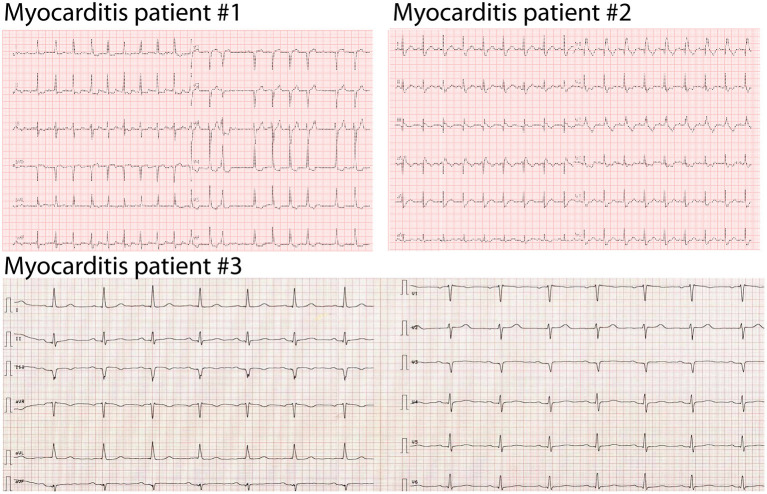
Checkpoint inhibitors (ICIs) have gained importance in recent years regarding the treatment of a variety of oncologic diseases. The possibilities of diagnosing cardiac adverse autoimmune effects of ICIs are still limited. We aimed to implement FAPI PET/CT imaging in detecting ICI-associated myocarditis. In a retrospective study, FAPI PET/CT scans of 26 patients who received ICIs from 01/2017 to 10/2019 were analyzed. We compared tracer enrichment in the heart of patients without any signs of a cardiac disease ( = 23) to three patients with suspected ICI-associated myocarditis. To exclude any significant coronary heart disease, cardiac catherization was performed. All three patients' myocardial biopsies were examined for inflammatory cells. Three patients showed clinical manifestations of an ICI syndrome including myocarditis with elevated levels of hsTnT (175 pg/ml, 1,771 pg/ml, 157 pg/ml). Further cardiological assessments revealed ECG abnormalities, lymphocyte infiltration of the myocardium in the biopsies or wall motion abnormalities in echocardiography. These patients' FAPI PET/CTs showed cardiac enrichment of the marker which was less distinct or absent in patients receiving ICIs without any signs of immunological adverse effects or cardiac impairment ( = 23) [Median SUV myocarditis patients: 1.79 (IQR: 1.65, 1.85), median SUV non-myocarditis patients: 1.15 (IQR: 0.955, 1.52)]. Apart from the successful implementation of ICIs in oncological treatments, ICI-associated myocarditis is still a challenging adverse effect. FAPI PET/CT may be used in order to identify affected patients at an early stage. Moreover, when integrated into cancer stage diagnostics, it contributes to cardiac risk stratification besides biomarker, ECG and echocardiography.
近年来,检查点抑制剂(ICIs)在多种肿瘤疾病的治疗中变得愈发重要。诊断ICIs心脏不良自身免疫效应的可能性仍然有限。我们旨在应用FAPI PET/CT成像检测ICI相关心肌炎。在一项回顾性研究中,分析了2017年1月至2019年10月期间接受ICIs治疗的26例患者的FAPI PET/CT扫描结果。我们将无任何心脏病迹象的患者(n = 23)心脏中的示踪剂富集情况与3例疑似ICI相关心肌炎患者进行了比较。为排除任何显著的冠心病,进行了心脏导管检查。对所有3例患者的心肌活检组织进行了炎性细胞检查。3例患者表现出ICI综合征的临床表现,包括心肌炎,hsTnT水平升高(175 pg/ml、1771 pg/ml、157 pg/ml)。进一步的心脏评估显示心电图异常、活检组织中心肌淋巴细胞浸润或超声心动图显示室壁运动异常。这些患者的FAPI PET/CT显示标志物在心脏中富集,而在未出现任何免疫不良反应或心脏损害迹象的接受ICIs治疗的患者(n = 23)中,这种富集不太明显或不存在[心肌炎患者SUV中位数:1.79(IQR:1.65,1.85),非心肌炎患者SUV中位数:1.15(IQR:0.955,1.52)]。除了ICIs在肿瘤治疗中的成功应用外,ICI相关心肌炎仍然是一种具有挑战性的不良反应。FAPI PET/CT可用于早期识别受影响的患者。此外,当整合到癌症分期诊断中时,除了生物标志物、心电图和超声心动图外,它还有助于心脏风险分层。