Substantive-Methodological Synergy Research Laboratory, Concordia University, Montreal, Canada.
The first two authors-Elizabeth Olivier and Alexandre J.S. Morin contributed equally to this article and their order was determined at random: Both should thus be considered first authors.
J Interpers Violence. 2022 Sep;37(17-18):NP15095-NP15129. doi: 10.1177/0886260521997949. Epub 2021 Mar 14.
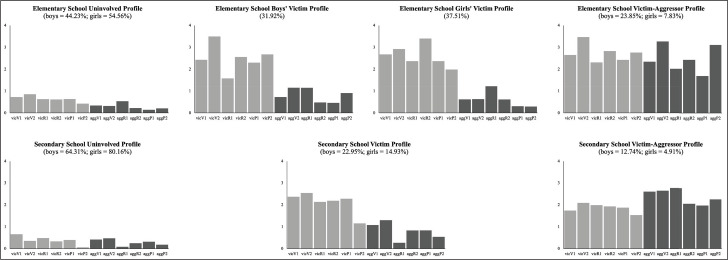
Student involvement in peer aggression is assumed to include the uninvolved, victims, aggressors, and victim-aggressor groups. Yet, evidence supporting this four-group configuration is equivocal. Although most studies report the four groups, several of the aggressor groups could have been labeled as moderate victim-aggressors. This study first reviews studies identifying subgroups of students involved in verbal, relational, and physical aggression. The study then assesses students' perceived involvement in elementary ( = 2,071; Grades 4-6) and secondary school ( = 1,832; Grades 7-10), as well as the associations with outcomes (school belonging, depressive thoughts, and perceived school violence). Latent profile analysis identified three profiles (uninvolved, victim-only, and victim-aggressor) across all grades and genders. In primary school, the uninvolved, victim, and victim-aggressor respectively included 54.56%, 37.51%, and 7.83% of the girls, and 44.23%, 31.92%, and 23.85% of the boys. In secondary school, the uninvolved, victim, and victim-aggressor respectively included 80.16%, 14.93% and 4.91% of the girls, and 64.31%, 22.95% and 12.74% of the boys. Victims and victim-aggressors reported poorer adjustment than uninvolved students. Victims and victim-aggressors reported lower levels of school belonging and higher levels of depressive thoughts than uninvolved students. Also, victim-aggressors perceived more violence in their school than victims and uninvolved students, and victims perceived more violence than uninvolved students. These findings question the existence of an aggressor-only profile, at least, according to student perception, suggesting the need for a new perspective when intervening with students involved in peer aggression.
学生参与同伴攻击被认为包括不参与、受害者、攻击者和受害者-攻击者群体。然而,支持这种四组配置的证据是模棱两可的。尽管大多数研究报告了这四个群体,但其中一些攻击者群体可能被标记为中度受害者-攻击者。本研究首先回顾了识别参与言语、关系和身体攻击的学生亚组的研究。然后,该研究评估了学生在小学(=2071;4-6 年级)和中学(=1832;7-10 年级)的感知参与度,以及与结果(学校归属感、抑郁思维和感知学校暴力)的关联。潜在剖面分析在所有年级和性别中确定了三个特征(不参与、仅受害者和受害者-攻击者)。在小学中,不参与、受害者和受害者-攻击者群体分别包括 54.56%、37.51%和 7.83%的女孩,以及 44.23%、31.92%和 23.85%的男孩。在中学中,不参与、受害者和受害者-攻击者群体分别包括 80.16%、14.93%和 4.91%的女孩,以及 64.31%、22.95%和 12.74%的男孩。受害者和受害者-攻击者报告的调整结果比不参与的学生差。受害者和受害者-攻击者报告的学校归属感水平较低,抑郁思维水平较高,而不参与的学生报告的学校归属感水平较低,抑郁思维水平较高。此外,受害者-攻击者比受害者和不参与的学生感知到更多的学校暴力,而受害者比不参与的学生感知到更多的学校暴力。这些发现对仅存在攻击者的特征提出了质疑,至少根据学生的看法是这样的,这表明在干预涉及同伴攻击的学生时需要一种新的视角。