Amsterdam UMC, Vrije Universiteit Amsterdam, Psychiatry, Amsterdam Public Health Research Institute, Amsterdam, The Netherlands.
GGZ inGeest Specialized Mental Health Care, Amsterdam, The Netherlands.
J Alzheimers Dis. 2021;80(4):1643-1655. doi: 10.3233/JAD-201173.
Sex differences in cognitive functioning in old age are known to exist yet are still poorly understood.
This study examines to what extent differences in cardiovascular risk factors and cardiovascular disease between men and women explain sex differences in cognitive functioning.
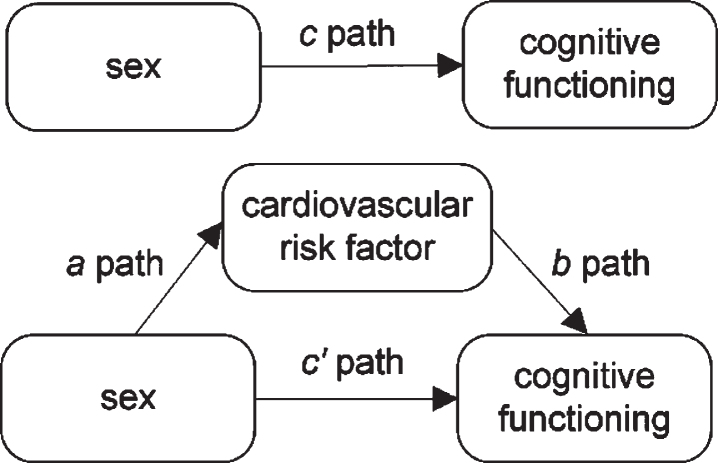
Data from 2,724 older adults from the Longitudinal Aging Study Amsterdam were used. Information processing speed and episodic memory, measured three times during six years of follow-up, served as outcomes. The mediating role of cardiovascular risk factors and cardiovascular disease was examined in single and multiple mediator models. Determinant-mediator effects were estimated using linear or logistic regression, and determinant-outcome and mediator-outcome effects were estimated using linear mixed models. Indirect effects were estimated using the product-of-coefficients estimator.
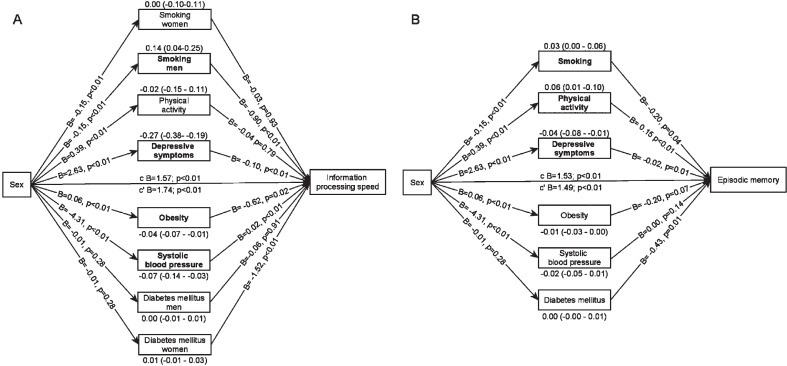
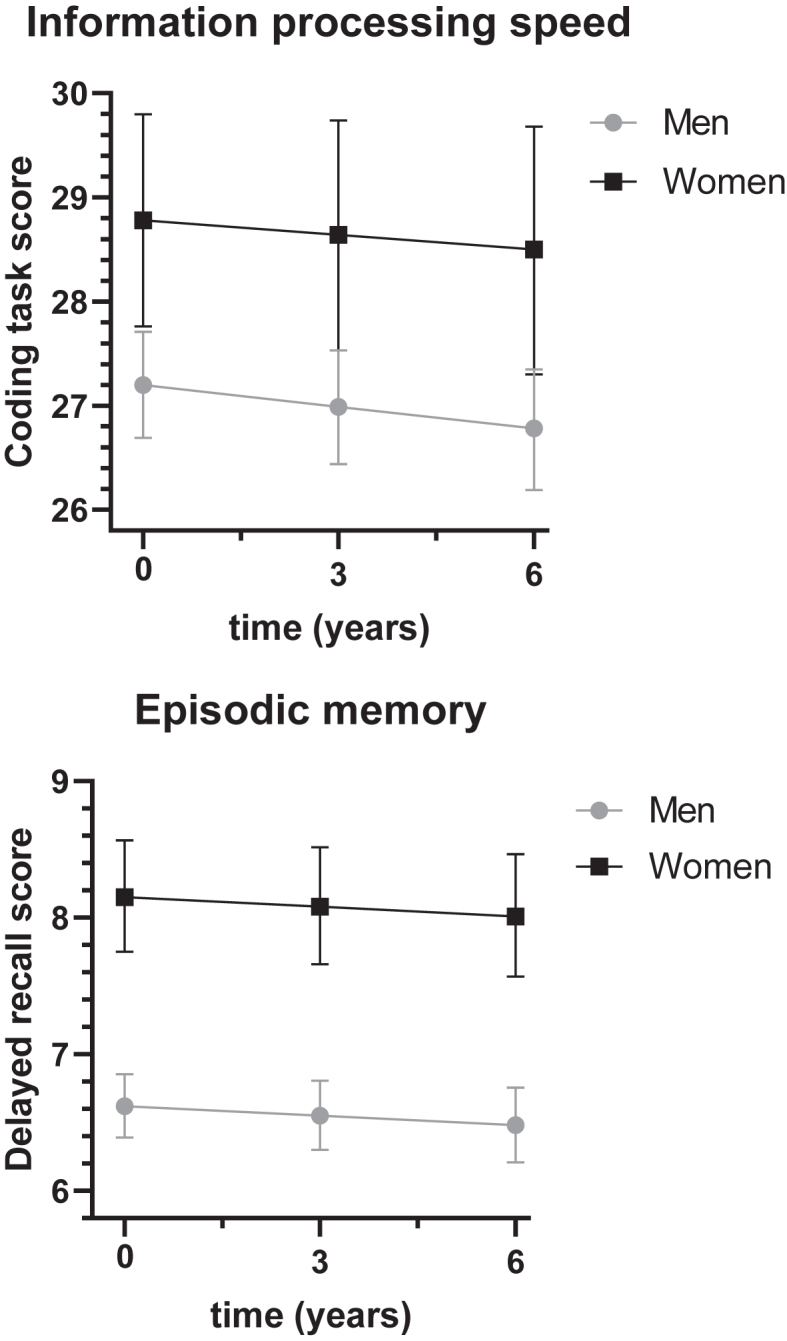
Women scored 1.58 points higher on information processing speed and 1.53 points higher on episodic memory. Several cardiovascular risk factors had small mediating effects. The sex difference in information processing speed was mediated by smoking, depressive symptoms, obesity, and systolic blood pressure. The sex difference in episodic memory was mediated by smoking, physical activity, and depressive symptoms. Effects of smoking, LDL cholesterol, and diabetes mellitus on information processing speed differed between men and women.
Differences in cardiovascular risk factors between women and men partially explained why women had better cognitive functioning. A healthy cardiovascular lifestyle seems beneficial for cognition and sex-specific strategies may be important to preserve cognitive functioning at older age.
已知老年人的认知功能存在性别差异,但仍知之甚少。
本研究旨在探讨心血管危险因素和心血管疾病在男性和女性之间的差异在多大程度上解释了认知功能的性别差异。
使用来自阿姆斯特丹纵向老龄化研究的 2724 名老年人的数据。在六年的随访中,信息处理速度和情景记忆被测量了三次,作为结果。在单因素和多因素中介模型中,研究了心血管危险因素和心血管疾病的中介作用。使用线性或逻辑回归估计决定因素-中介效应,使用线性混合模型估计决定因素-结果和中介-结果效应。使用乘积系数估计器估计间接效应。
女性在信息处理速度方面的得分高 1.58 分,在情景记忆方面的得分高 1.53 分。一些心血管危险因素具有较小的中介作用。信息处理速度的性别差异由吸烟、抑郁症状、肥胖和收缩压介导。情景记忆的性别差异由吸烟、身体活动和抑郁症状介导。吸烟、LDL 胆固醇和糖尿病对信息处理速度的影响在男性和女性之间存在差异。
女性和男性之间心血管危险因素的差异部分解释了为什么女性的认知功能更好。健康的心血管生活方式似乎对认知有益,针对特定性别的策略可能对保护老年人的认知功能很重要。