LaPlume Annalise A, McKetton Larissa, Anderson Nicole D, Troyer Angela K
Rotman Research Institute Baycrest Health Sciences (fully affiliated with the University of Toronto) Toronto Canada.
Department of Psychology University of Toronto Toronto Canada.
Alzheimers Dement (Amst). 2022 Apr 1;14(1):e12301. doi: 10.1002/dad2.12301. eCollection 2022.
More women than men develop Alzheimer's disease, yet women perform better and show less decline on episodic memory measures, a contradiction that may be accounted for by modifiable risk factors for dementia.
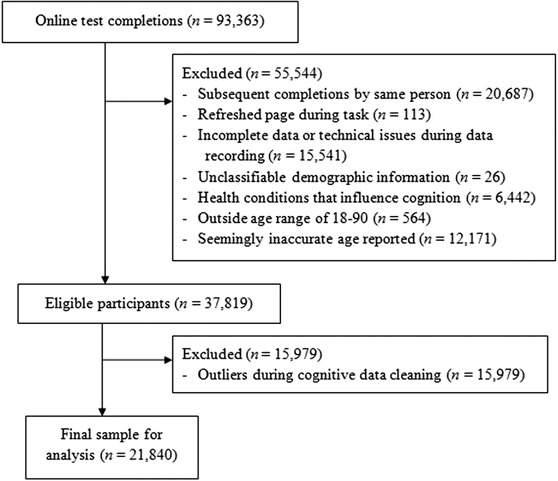
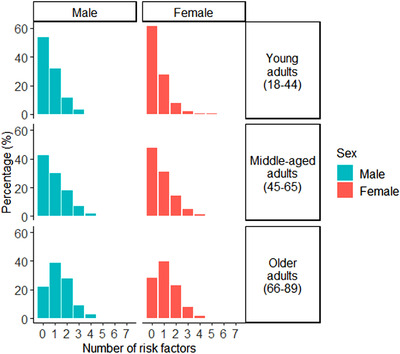
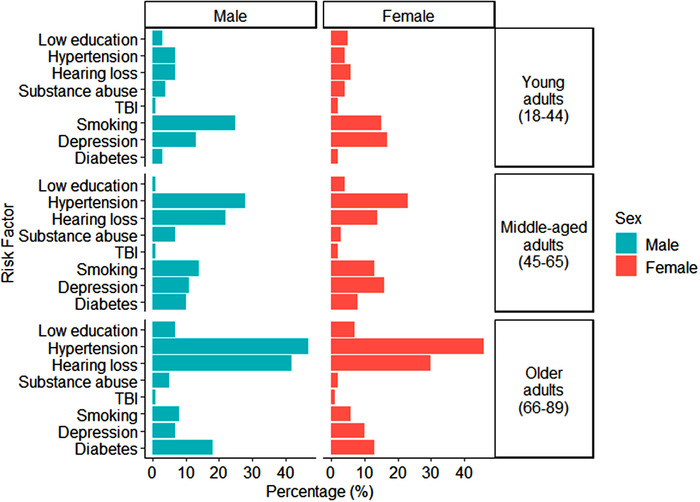
Associations among age, sex, modifiable dementia risk factors, and cognition were measured in a cross-sectional online sample (= 21,840, ages 18 to 89).
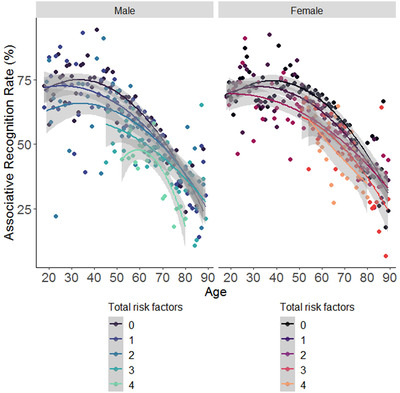
Across four tests of associative memory and executive functions, only a Face-Name Association task revealed sex differences in associative memory that varied by age. Men had worse memory than women (the equivalent of performing similar to someone 4 years older) across ages. Men had larger age differences than women (ie, worse memory in older ages) among people with no to one risk factor, but not those with multiple risk factors.
Because the relationship between dementia risk factors and age-related memory differences varies between men and women, sex-specific dementia prevention approaches are warranted.
患阿尔茨海默病的女性比男性更多,但女性在情景记忆测量方面表现更好且衰退更少,这一矛盾现象可能由痴呆症的可改变风险因素来解释。
在一个横断面在线样本(n = 21840,年龄在18至89岁之间)中测量年龄、性别、可改变的痴呆症风险因素和认知之间的关联。
在四项关于联想记忆和执行功能的测试中,只有一项面孔-名字联想任务显示出联想记忆方面的性别差异随年龄而变化。在各年龄段中,男性的记忆力都比女性差(相当于表现得与比自己大4岁的人相似)。在没有或只有一个风险因素的人群中,男性的年龄差异比女性大(即老年时记忆力更差),但在有多个风险因素的人群中并非如此。
由于痴呆症风险因素与年龄相关记忆差异之间的关系在男性和女性中有所不同,因此有必要采取针对性别的痴呆症预防方法。