Medical Clinic III for Oncology, Hematology, Immune-Oncology and Rheumatology, University Hospital Bonn, Venusberg Campus 1, 53127, Bonn, Germany.
Mol Cancer. 2021 Mar 15;20(1):52. doi: 10.1186/s12943-021-01339-1.
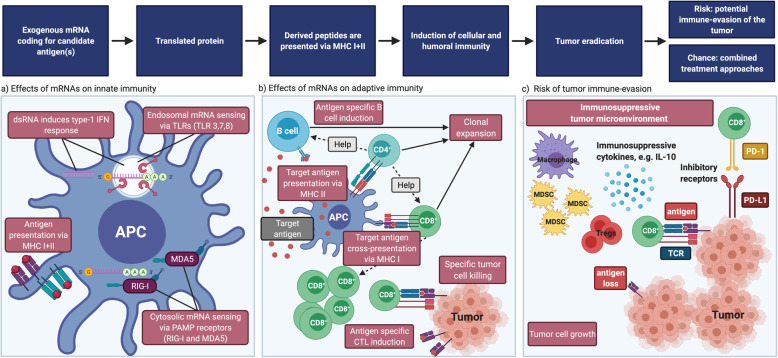
In vitro-transcribed messenger RNA-based therapeutics represent a relatively novel and highly efficient class of drugs. Several recently published studies emphasize the potential efficacy of mRNA vaccines in treating different types of malignant and infectious diseases where conventional vaccine strategies and platforms fail to elicit protective immune responses. mRNA vaccines have lately raised high interest as potent vaccines against SARS-CoV2. Direct application of mRNA or its electroporation into dendritic cells was shown to induce polyclonal CD4+ and CD8+ mediated antigen-specific T cell responses as well as the production of protective antibodies with the ability to eliminate transformed or infected cells. More importantly, the vaccine composition may include two or more mRNAs coding for different proteins or long peptides. This enables the induction of polyclonal immune responses against a broad variety of epitopes within the encoded antigens that are presented on various MHC complexes, thus avoiding the restriction to a certain HLA molecule or possible immune escape due to antigen-loss. The development and design of mRNA therapies was recently boosted by several critical innovations including the development of technologies for the production and delivery of high quality and stable mRNA. Several technical obstacles such as stability, delivery and immunogenicity were addressed in the past and gradually solved in the recent years.This review will summarize the most recent technological developments and application of mRNA vaccines in clinical trials and discusses the results, challenges and future directions with a special focus on the induced innate and adaptive immune responses.
基于体外转录的信使 RNA 治疗药物代表了一类相对较新且高效的药物。最近发表的几项研究强调了 mRNA 疫苗在治疗传统疫苗策略和平台未能引发保护性免疫反应的不同类型恶性和传染性疾病方面的潜在疗效。mRNA 疫苗最近作为针对 SARS-CoV2 的有效疫苗引起了广泛关注。直接应用 mRNA 或其电穿孔到树突状细胞中已被证明可以诱导多克隆 CD4+和 CD8+介导的抗原特异性 T 细胞反应,以及产生具有消除转化或感染细胞能力的保护性抗体。更重要的是,疫苗成分可以包括两种或更多种编码不同蛋白质或长肽的 mRNA。这可以诱导针对编码抗原中广泛多样表位的多克隆免疫反应,从而避免局限于特定的 HLA 分子或由于抗原丢失而可能发生的免疫逃逸。mRNA 疗法的开发和设计最近因包括生产和递送高质量和稳定 mRNA 的技术的几项关键创新而得到推动。过去解决了一些技术障碍,如稳定性、传递和免疫原性,并在近年来逐渐得到解决。这篇综述将总结 mRNA 疫苗在临床试验中的最新技术发展和应用,并讨论结果、挑战和未来方向,特别关注诱导的先天和适应性免疫反应。