Department of Public Health, Erasmus MC, University Medical Center, Rotterdam, The Netherlands.
Br J Cancer. 2021 Apr;124(9):1516-1523. doi: 10.1038/s41416-021-01261-9. Epub 2021 Mar 15.
Many breast, cervical, and colorectal cancer screening programmes were disrupted due to the COVID-19 pandemic. This study aimed to estimate the effects of five restart strategies after the disruption on required screening capacity and cancer burden.
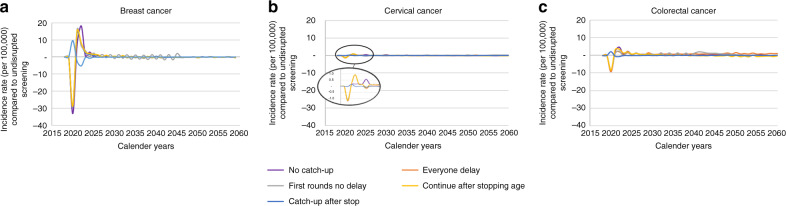
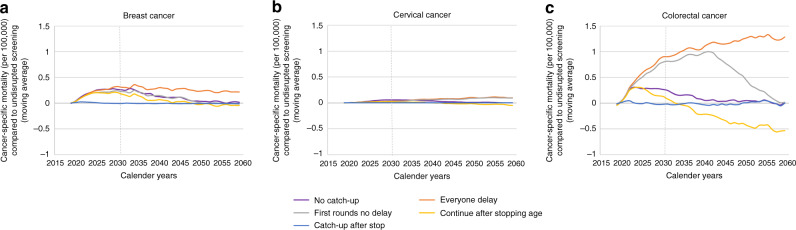
Microsimulation models simulated five restart strategies for breast, cervical, and colorectal cancer screening. The models estimated required screening capacity, cancer incidence, and cancer-specific mortality after a disruption of 6 months. The restart strategies varied in whether screens were caught up or not and, if so, immediately or delayed, and whether the upper age limit was increased.
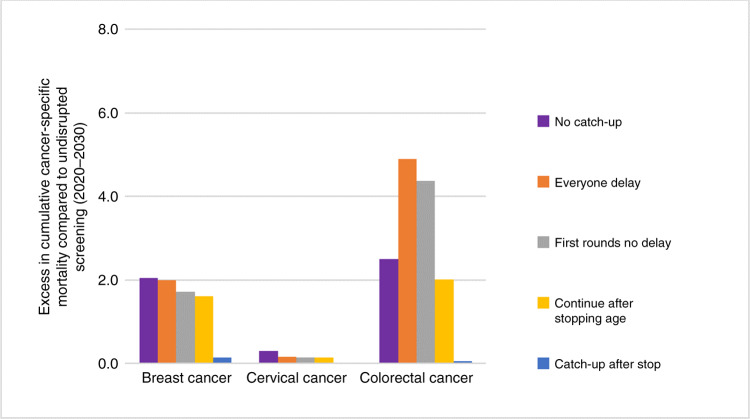
The disruption in screening programmes without catch-up of missed screens led to an increase of 2.0, 0.3, and 2.5 cancer deaths per 100 000 individuals in 10 years in breast, cervical, and colorectal cancer, respectively. Immediately catching-up missed screens minimised the impact of the disruption but required a surge in screening capacity. Delaying screening, but still offering all screening rounds gave the best balance between required capacity, incidence, and mortality.
Strategies with the smallest loss in health effects were also the most burdensome for the screening organisations. Which strategy is preferred depends on the organisation and available capacity in a country.
由于 COVID-19 大流行,许多乳腺癌、宫颈癌和结直肠癌的筛查计划被打乱。本研究旨在评估疫情中断后五种重启策略对所需筛查能力和癌症负担的影响。
使用微模拟模型模拟了乳腺癌、宫颈癌和结直肠癌筛查的五种重启策略。这些模型估计了中断 6 个月后所需的筛查能力、癌症发病率和癌症特异性死亡率。重启策略的差异在于是否弥补错过的筛查以及如果弥补,是立即进行还是延迟进行,以及是否提高上限年龄。
如果不弥补错过的筛查,筛查计划的中断将导致乳腺癌、宫颈癌和结直肠癌的 10 年内癌症死亡人数分别增加 2.0、0.3 和 2.5 人/每 10 万人。立即弥补错过的筛查可以将疫情中断的影响降到最低,但需要大量增加筛查能力。延迟筛查,但仍提供所有筛查轮次,在所需能力、发病率和死亡率之间取得最佳平衡。
对健康影响最小的策略对筛查机构的负担也最大。选择哪种策略取决于国家的组织和可用能力。