Brar Kanwaljit K, Harizaj Albana, Nowak-Wegrzyn Anna
Department of Pediatrics, NYU Grossman School of Medicine, Hassenfeld Children's Hospital, 160 East 32nd Street, LM3, New York, NY 10016 USA.
Department of Internal Medicine, Capital Health Medical Center, Pennington, NJ USA.
Curr Treat Options Allergy. 2021;8(2):88-96. doi: 10.1007/s40521-021-00284-0. Epub 2021 Mar 10.
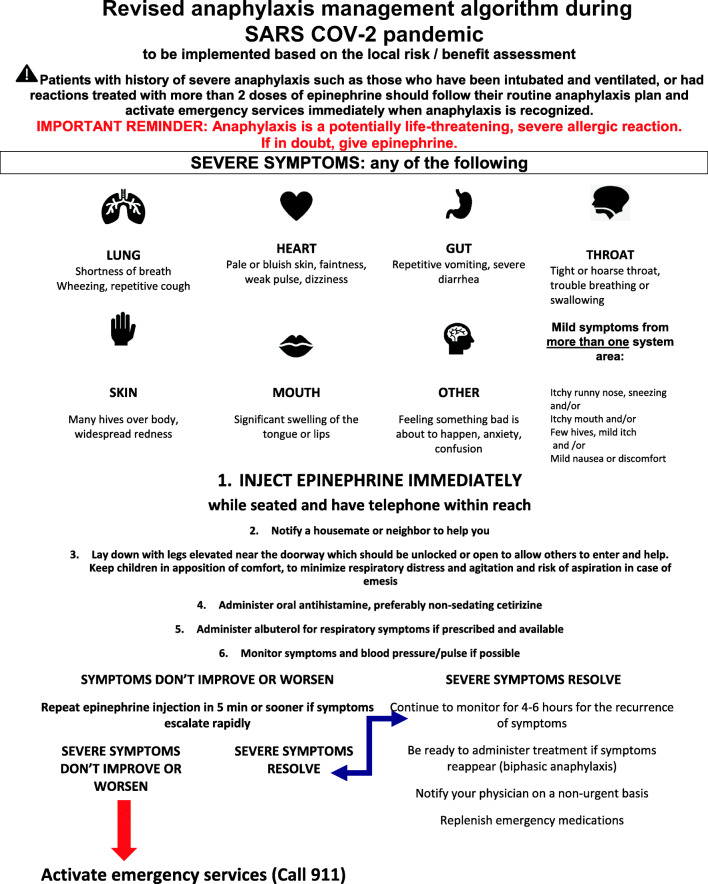
Management of anaphylaxis during the SARS-CoV-2 pandemic should consider local infection rates so as to not burden local ED at times of pandemic, while also protecting patients from infection risks and progression of anaphylaxis. In this review, we identify a treatment strategy for anaphylaxis that balances the risks versus benefits of ED versus home management in this unprecedented time.
Physicians and patients have had to adapt new approaches to medical care during the SARS-CoV-2 pandemic due to restricted access to health care facilities. Telemedicine has substituted in-person visits, and such a drastic change in the patient care paradigm presents a need to revise the acute management of anaphylaxis.
Physicians should utilize telemedicine during this time to engage in shared decision-making with patients and their families to devise an anaphylaxis plan of management that emphasizes home care when symptoms are mild with an exception for ED care if a patient has had severe, near-fatal anaphylaxis episodes in the past. Previous anaphylaxis recommendations should remain in place despite the pandemic, including prompt use of epinephrine when needed, avoidance of known allergens, training of patients and their caregivers, and carrying of epinephrine autoinjector devices at all times to remain prepared in the event of an anaphylaxis episode.
The online version contains supplementary material available at 10.1007/s40521-021-00284-0.
在新型冠状病毒肺炎大流行期间,过敏反应的管理应考虑当地感染率,以免在大流行期间给当地急诊科造成负担,同时也要保护患者免受感染风险以及过敏反应进展的影响。在本综述中,我们确定了一种过敏反应的治疗策略,该策略在这个前所未有的时期平衡了急诊科治疗与家庭管理的风险与益处。
由于获取医疗保健设施受限,在新型冠状病毒肺炎大流行期间,医生和患者不得不采用新的医疗护理方法。远程医疗已取代了面对面就诊,而患者护理模式的这种巨大变化使得有必要修订过敏反应的急性管理方法。
在此期间,医生应利用远程医疗与患者及其家属进行共同决策,制定过敏反应管理计划,该计划强调症状轻微时以家庭护理为主,但如果患者过去曾发生过严重的、近乎致命的过敏反应,则应前往急诊科就诊。尽管处于大流行期间,以前的过敏反应建议仍应适用,包括在需要时及时使用肾上腺素、避免已知过敏原、对患者及其护理人员进行培训以及随时携带肾上腺素自动注射器设备,以便在发生过敏反应时做好准备。
在线版本包含可在10.1007/s40521-021-00284-0获取的补充材料。