Medical Faculty, Heinrich Heine University, Düsseldorf, Germany.
Viela Bio, Gaithersburg, MD.
Ann Neurol. 2021 May;89(5):895-910. doi: 10.1002/ana.26067. Epub 2021 Mar 30.
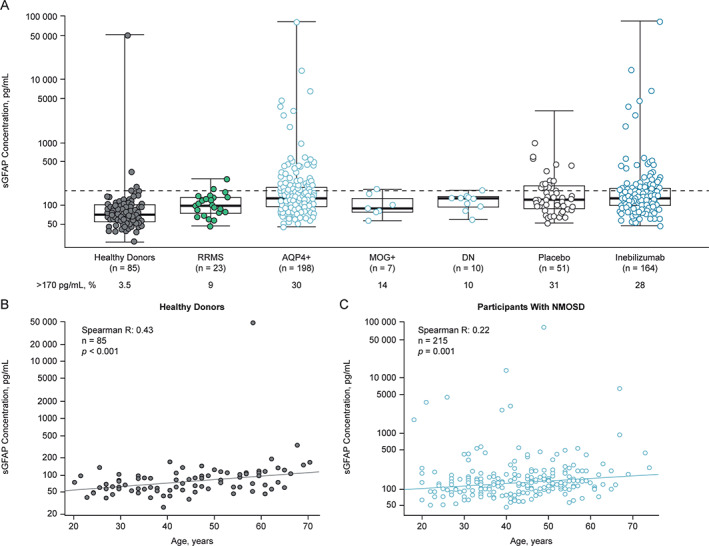
Blood tests to monitor disease activity, attack severity, or treatment impact in neuromyelitis optica spectrum disorder (NMOSD) have not been developed. This study investigated the relationship between serum glial fibrillary acidic protein (sGFAP) concentration and NMOSD activity and assessed the impact of inebilizumab treatment.
N-MOmentum was a prospective, multicenter, double-blind, placebo-controlled, randomized clinical trial in adults with NMOSD. sGFAP levels were measured by single-molecule arrays (SIMOA) in 1,260 serial and attack-related samples from 215 N-MOmentum participants (92% aquaporin 4-immunoglobulin G-seropositive) and in control samples (from healthy donors and patients with relapsing-remitting multiple sclerosis).
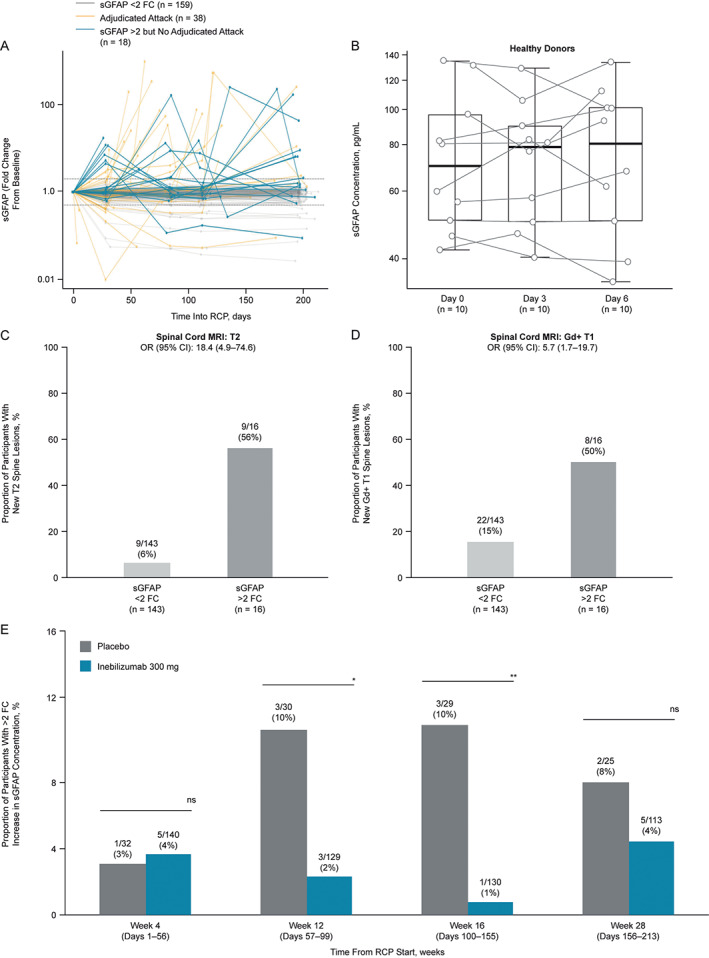
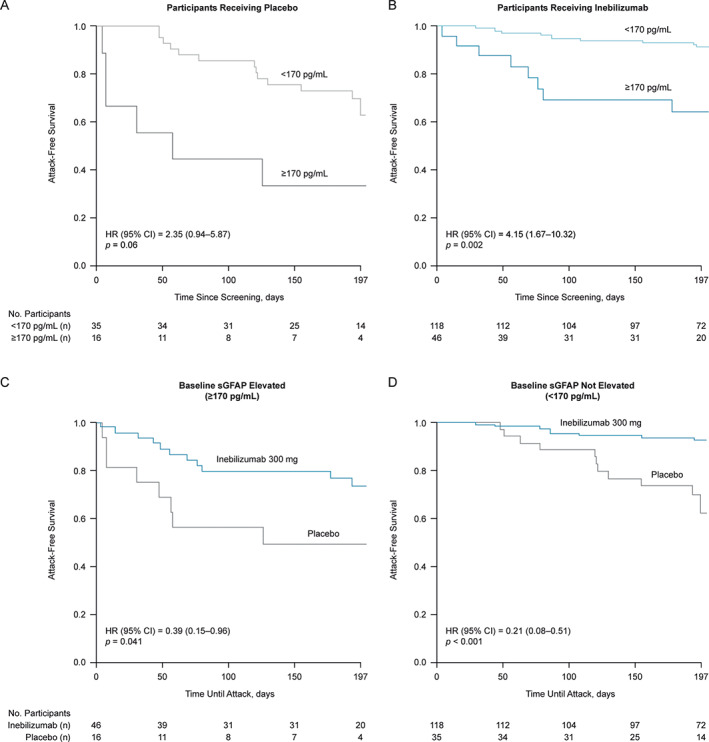
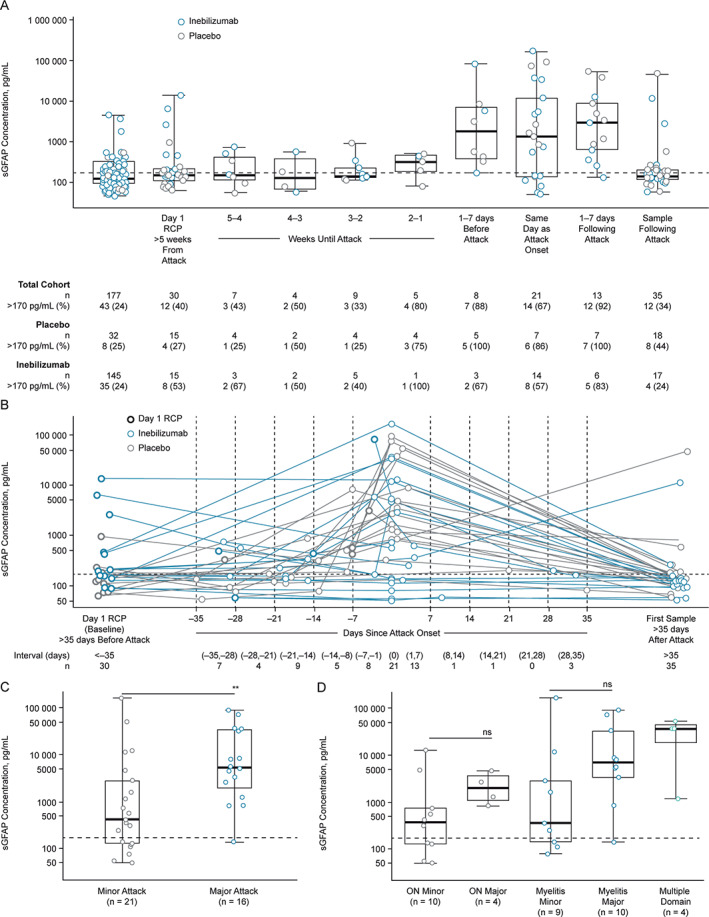
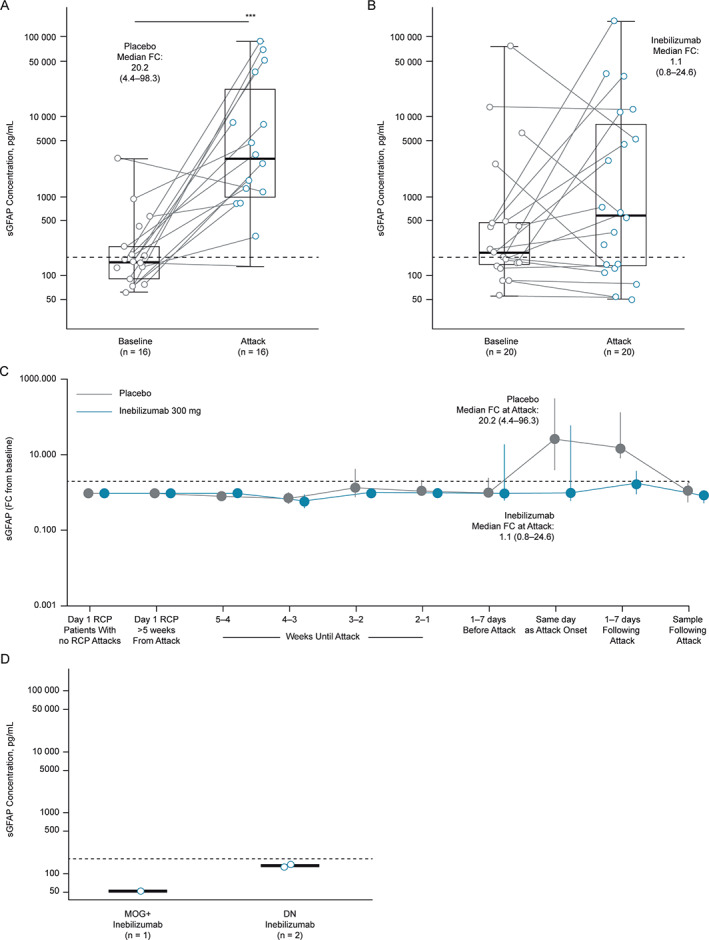
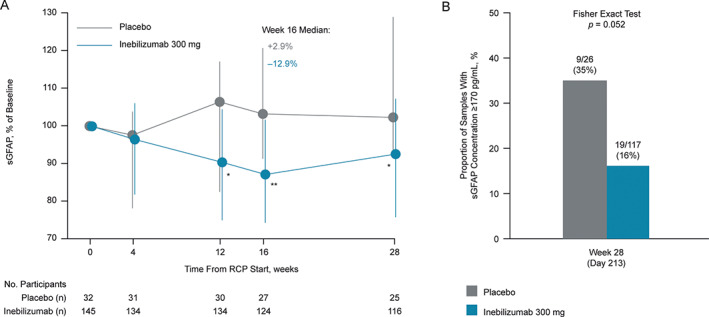
At baseline, 62 participants (29%) exhibited high sGFAP concentrations (≥170 pg/ml; ≥2 standard deviations above healthy donor mean concentration) and were more likely to experience an adjudicated attack than participants with lower baseline concentrations (hazard ratio [95% confidence interval], 3.09 [1.6-6.1], p = 0.001). Median (interquartile range [IQR]) concentrations increased within 1 week of an attack (baseline: 168.4, IQR = 128.9-449.7 pg/ml; attack: 2,160.1, IQR = 302.7-9,455.0 pg/ml, p = 0.0015) and correlated with attack severity (median fold change from baseline [FC], minor attacks: 1.06, IQR = 0.9-7.4; major attacks: 34.32, IQR = 8.7-107.5, p = 0.023). This attack-related increase in sGFAP occurred primarily in placebo-treated participants (FC: 20.2, IQR = 4.4-98.3, p = 0.001) and was not observed in inebilizumab-treated participants (FC: 1.1, IQR = 0.8-24.6, p > 0.05). Five participants (28%) with elevated baseline sGFAP reported neurological symptoms leading to nonadjudicated attack assessments.
Serum GFAP may serve as a biomarker of NMOSD activity, attack risk, and treatment effects. ANN NEUROL 2021;89:895-910.
目前尚未开发出用于监测视神经脊髓炎谱系疾病(NMOSD)疾病活动、发作严重程度或治疗效果的血液检测方法。本研究旨在探讨血清胶质纤维酸性蛋白(sGFAP)浓度与 NMOSD 活动之间的关系,并评估依那西普治疗的影响。
N-MOmentum 是一项针对 NMOSD 成人患者的前瞻性、多中心、双盲、安慰剂对照、随机临床试验。研究共纳入 215 名 N-MOmentum 参与者(92%水通道蛋白 4 免疫球蛋白 G 阳性)和对照组参与者(健康供体和复发性缓解型多发性硬化症患者)的 1260 份连续和与发作相关的样本,通过单分子阵列(SIMOA)检测 sGFAP 水平。
基线时,62 名参与者(29%)表现出高 sGFAP 浓度(≥170pg/ml;高于健康供体平均浓度的 2 个标准差以上),与基线时 sGFAP 浓度较低的参与者相比,更有可能经历经判定的发作(风险比[95%置信区间],3.09[1.6-6.1],p=0.001)。发作后 1 周内 sGFAP 浓度中位数(四分位距[IQR])升高(基线:168.4,IQR=128.9-449.7pg/ml;发作时:2160.1,IQR=302.7-9455.0pg/ml,p=0.0015),与发作严重程度相关(基线时中位数 fold change [FC],轻度发作:1.06,IQR=0.9-7.4;重度发作:34.32,IQR=8.7-107.5,p=0.023)。这种与发作相关的 sGFAP 升高主要发生在安慰剂治疗的参与者中(FC:20.2,IQR=4.4-98.3,p=0.001),而在依那西普治疗的参与者中未观察到(FC:1.1,IQR=0.8-24.6,p>0.05)。5 名基线 sGFAP 升高的参与者(28%)出现了神经系统症状,导致未经判定的发作评估。
血清 GFAP 可能是 NMOSD 活动、发作风险和治疗效果的生物标志物。