Liu Wei, Ma Wei, Liu Hua, Li Chunyan, Zhang Yangwei, Liu Jie, Liang Yu, Zhang Sijia, Wu Zhen, Zang Chenghao, Guo Jianhui, Li Liyan
Institute of Neuroscience, Kunming Medical University, Kunming, Yunnan, China.
Department of Neurology, The Third People's Hospital of Chengdu & The Affiliated Hospital of Southwest Jiaotong University, Chengdu, Sichuan, China.
PLoS One. 2021 Mar 16;16(3):e0248564. doi: 10.1371/journal.pone.0248564. eCollection 2021.
Stroke is a major contributor to the global burden of disease. Although numerous modifiable risk factors (RF) for stroke have been identified, some remain unexplained. Increasing studies have investigated stroke risk in arthritis, but their results are inconsistent. We aimed to synthesize, quantify, and compare the risk of stroke for the major types of arthritis in cohort studies by using a systematic review and meta-analysis approach.
We searched Chinese and English databases to identify relevant studies from inception to April 30, 2020. Only studies adjusting at least for age and sex were included. We calculated pooled effect estimates for relative risk (RR) and 95% confidence interval (CI) and identified potential sources of heterogeneity and publication bias.
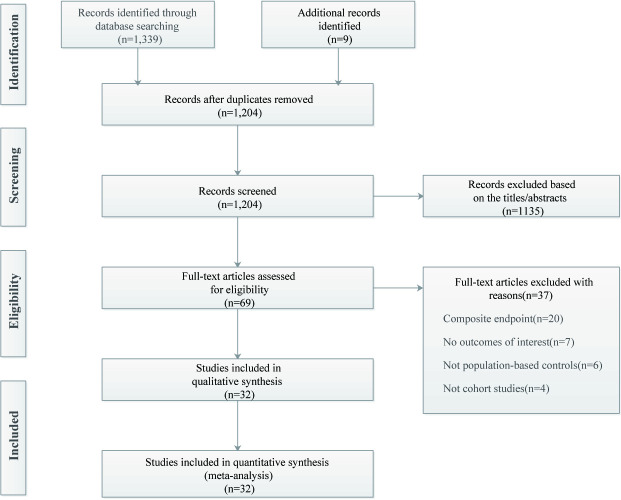
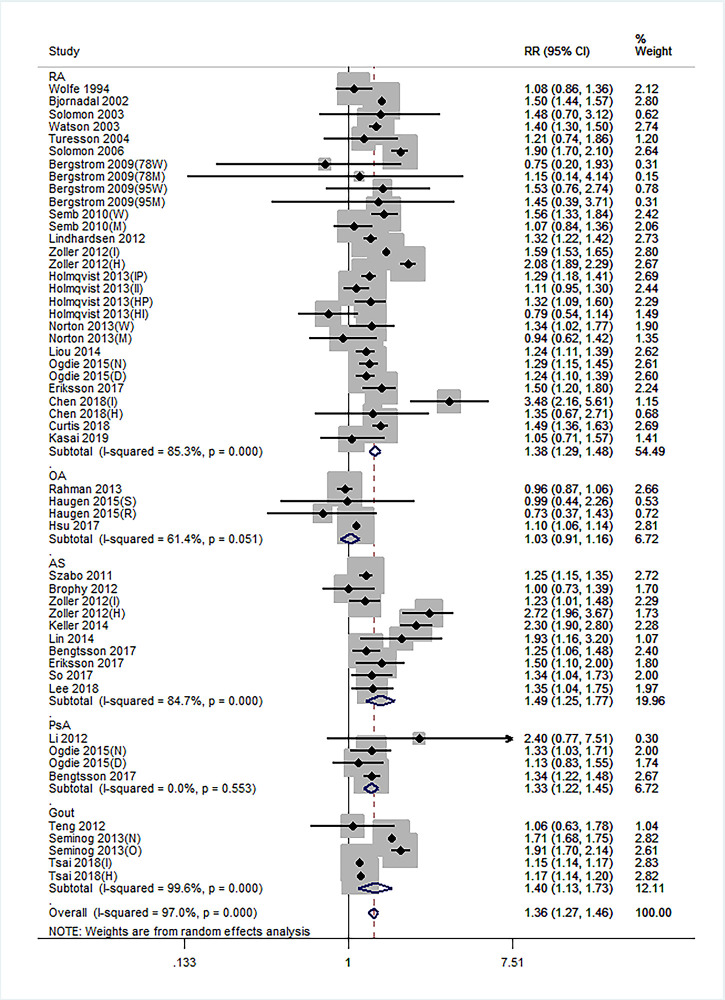
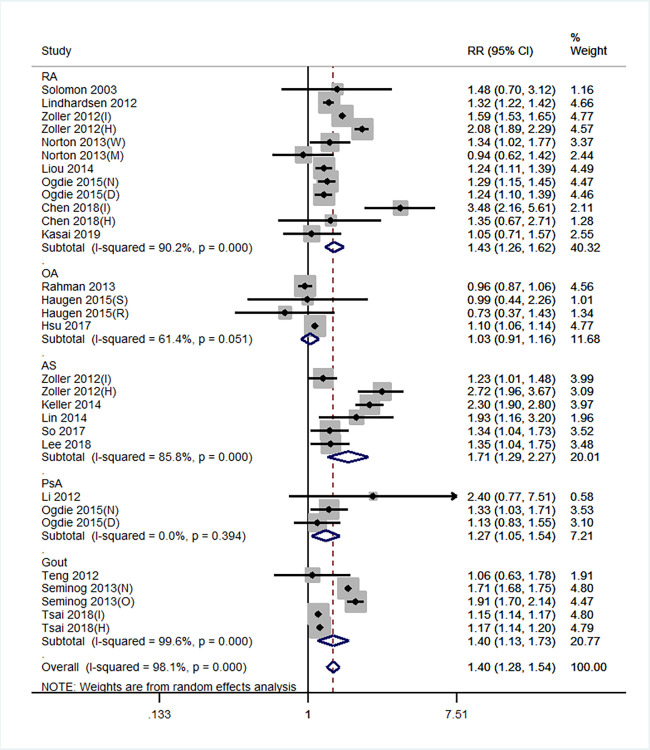
A total of 1,348 articles were retrieved, and after an preliminary screening of titles and abstracts, 69 were reviewed for full text, and finally, 32 met the criteria for meta-analysis. Stroke risk in arthritis was significantly increased in studies adjusting for age and sex (RR = 1.36, 95% CI: 1.27-1.46) and for at least one traditional risk factor (RR = 1.40, 95% CI: 1.28-1.54). The results of studies stratified by stroke subtype were consistent with the main finding (ischemic stroke: RR = 1.53, 95% CI: 1.32-1.78; hemorrhagic stroke: RR = 1.45, 95% CI: 1.15-1.84). In subgroup analysis by arthritis type, stroke risk was significantly increased in rheumatoid arthritis (RR = 1.38, 95% CI: 1.29-1.48), ankylosing spondylitis (RR = 1.49, 95% CI: 1.25-1.77), psoriatic arthritis (RR = 1.33, 95% CI: 1.22-1.45), and gout (RR = 1.40, 95% CI: 1.13-1.73) but not osteoarthritis (RR = 1.03, 95% CI: 0.91-1.16). Age and sex subgroup analyses indicated that stroke risk was similar by sex (women: RR = 1.47, 95% CI: 1.31-1.66; men: RR = 1.44, 95% CI: 1.28-1.61); risk was higher with younger age (<45 years) (RR = 1.46, 95% CI: 1.17-1.82) than older age (≥65 years) (RR = 1.17, 95% CI: 1.08-1.26).
Stroke risk was increased in multiple arthritis and similar between ischemic and hemorrhagic stroke. Young patients with arthritis had the highest risk.
中风是全球疾病负担的主要促成因素。尽管已确定了许多可改变的中风风险因素(RF),但仍有一些无法解释。越来越多的研究调查了关节炎患者的中风风险,但其结果并不一致。我们旨在通过系统评价和荟萃分析方法,综合、量化并比较队列研究中主要类型关节炎患者的中风风险。
我们检索了中文和英文数据库,以识别从研究起始至2020年4月30日的相关研究。仅纳入至少对年龄和性别进行了调整的研究。我们计算了相对风险(RR)的合并效应估计值和95%置信区间(CI),并确定了异质性和发表偏倚的潜在来源。
共检索到1348篇文章,在对标题和摘要进行初步筛选后,对69篇文章进行了全文审查,最终,32篇文章符合荟萃分析标准。在对年龄和性别进行调整的研究中,关节炎患者的中风风险显著增加(RR = 1.36,95% CI:1.27 - 1.46),在对至少一种传统风险因素进行调整的研究中也是如此(RR = 1.40,95% CI:1.28 - 1.54)。按中风亚型分层的研究结果与主要发现一致(缺血性中风:RR = 1.53,95% CI:1.32 - 1.78;出血性中风:RR = 1.45,95% CI:1.15 - 1.84)。在按关节炎类型进行的亚组分析中,类风湿关节炎(RR = 1.38,95% CI:1.29 - 1.48)、强直性脊柱炎(RR = 1.49,95% CI:1.25 - 1.77)、银屑病关节炎(RR = 1.33,95% CI:1.22 - 1.45)和痛风(RR = 1.40,95% CI:1.13 - 1.73)患者的中风风险显著增加,但骨关节炎患者未增加(RR = 1.03,95% CI:0.91 - 1.16)。年龄和性别亚组分析表明,不同性别的中风风险相似(女性:RR = 1.47,95% CI:1.31 - 1.66;男性:RR = 1.44,95% CI:1.28 - 1.61);年龄较小(<45岁)患者的风险(RR = 1.46,95% CI:1.17 - 1.82)高于年龄较大(≥65岁)患者(RR = 1.17,95% CI:1.08 - 1.26)。
多种关节炎患者的中风风险增加,缺血性中风和出血性中风的风险相似。患有关节炎的年轻患者风险最高。