Center for Neuropsychiatric Research of Traumatic Stress, Department of Psychiatry and UHSL, First Faculty of Medicine, and Department of Psychiatry, Faculty of Medicine Pilsen, Charles University.
ESET, Psychotherapeutic and Psychosomatic Clinic, Prague, Czech Republic.
Medicine (Baltimore). 2021 Mar 19;100(11):e25186. doi: 10.1097/MD.0000000000025186.
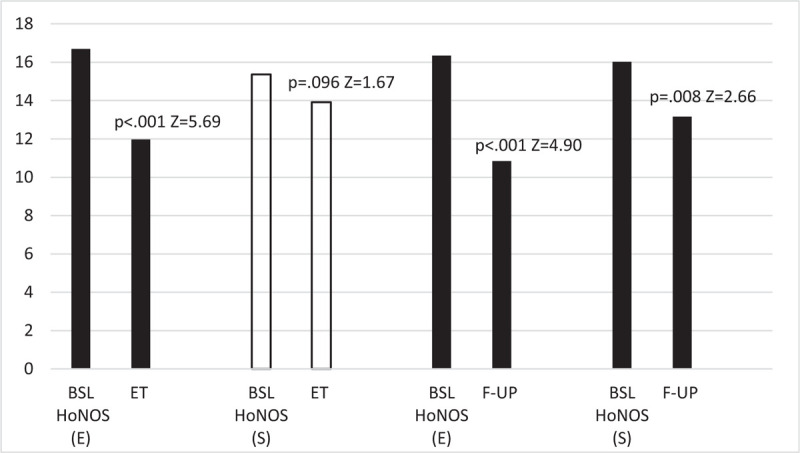
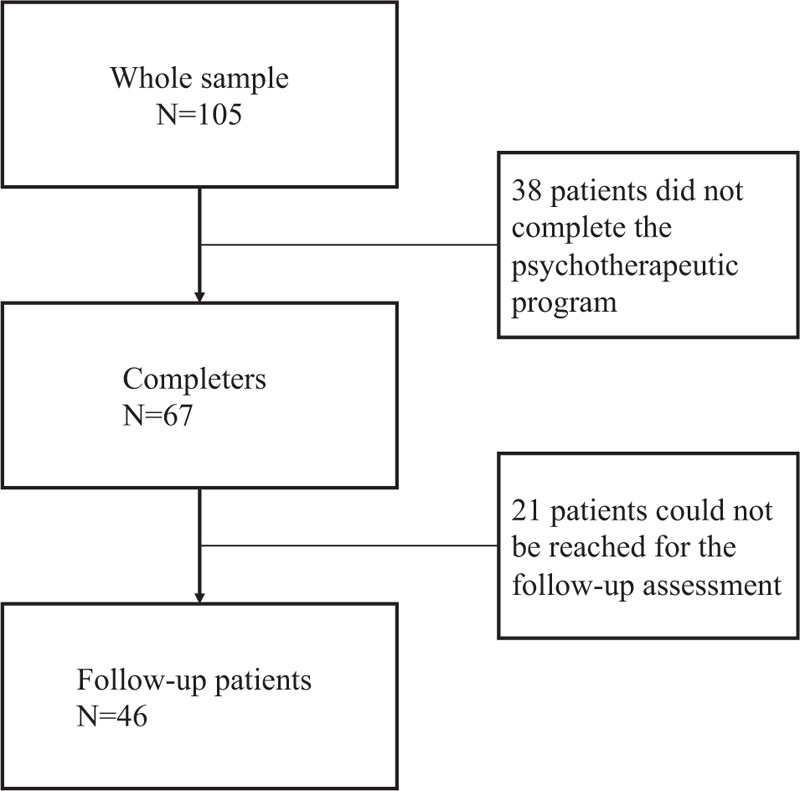
The objective of this study was to ascertain changes in symptoms of patients with borderline personality disorder undergoing psychodynamic day treatment with a duration of 9 months and the factors that predict clinical outcome or dropouts from the program.In an observational study, demographic characteristics (age, number of psychiatric hospitalizations, number of suicide attempts, current involvement in work or study activities), day doses of antipsychotic and antidepressant medication, psychiatric symptoms, and social functioning (Health of the Nation Outcome Scales), and symptoms of dissociation (Dissociative Experiences Scale) were assessed in patients at the beginning of treatment (N = 105). Further, psychiatric symptoms and social functioning were assessed at 3 stages: beginning of the program, end of the program, and 1-year follow-up. To study the differences between baseline values and values at the end of the treatment and follow-up values, the Wilcoxon signed-rank test was used. To discover baseline factors related to the effect of the treatment, Spearman correlation coefficients were calculated. To evaluate the differences between patients who completed the program (N = 67) and patients who dropped out (N = 38), differences in baseline factors between both groups were compared, using the Mann-Whitney test for independent samples.Improvement in symptoms (Health of the Nation Outcome Scales - version for external evaluators) at the end of the therapy (N = 67, P < .001) and at the 1-year follow-up (N = 46, P < .001) was found. Experience of an intimate relationship was positively related to clinical improvement at follow-up examinations (P < .001). Predictors of dropout included a higher number of psychiatric hospitalizations (P = .004), suicide attempts (P = .004), more severe pretreatment symptoms (P = .002), and symptoms of dissociation (P = .046).The results indicate that a psychodynamic day treatment is feasible for the treatment of less clinically disturbed patients with a history of intimate relationships. Patients with a higher number of previous psychiatric hospitalizations, more suicide attempts in the past, more severe pretreatment symptoms, and symptoms of dissociation are more likely not to complete the program.
这项研究的目的是确定接受为期 9 个月的精神动力学日治疗的边缘型人格障碍患者的症状变化,以及预测临床结果或程序退出的因素。在一项观察性研究中,在治疗开始时评估了患者的人口统计学特征(年龄、精神科住院次数、自杀企图次数、当前工作或学习活动参与情况)、抗精神病药物和抗抑郁药物的日剂量、精神症状和社会功能(国民健康结果量表)以及分离症状(分离体验量表)。此外,在治疗的 3 个阶段(项目开始时、项目结束时和 1 年随访时)评估了精神症状和社会功能。为了研究基线值与治疗结束时和随访时值之间的差异,使用了 Wilcoxon 符号秩检验。为了发现与治疗效果相关的基线因素,计算了 Spearman 相关系数。为了评估完成项目的患者(N=67)和退出项目的患者(N=38)之间的差异,使用独立样本的 Mann-Whitney 检验比较了两组之间的基线因素差异。在治疗结束时(N=67,P<.001)和 1 年随访时(N=46,P<.001)发现症状改善(外部评估者使用的国民健康结果量表-版本)。亲密关系经历与随访检查中的临床改善呈正相关(P<.001)。退出的预测因素包括更多的精神科住院次数(P=.004)、自杀企图(P=.004)、更严重的治疗前症状(P=.002)和分离症状(P=.046)。结果表明,精神动力学日治疗对于治疗有亲密关系史的、临床症状较轻的患者是可行的。以前有更多精神科住院次数、过去自杀企图次数更多、治疗前症状更严重、有分离症状的患者更有可能无法完成该项目。