Department of Psychiatry, University of Alberta, Edmonton, AB, Canada.
Associated Counselling, Calgary, AB, Canada.
Aust N Z J Psychiatry. 2022 Oct;56(10):1252-1264. doi: 10.1177/00048674221077029. Epub 2022 Feb 13.
Borderline Personality Disorder (BPD) is frequently complicated by the presence of dissociative symptoms. Pathological dissociation is linked with earlier and more severe trauma exposure, emotional dysregulation and worse treatment outcomes in Posttraumatic Stress Disorder and Dissociative Disorders, with implications for BPD.
A systematic scoping review was conducted to assess the extent of current literature regarding the impact of dissociation on BPD and to identify knowledge gaps.
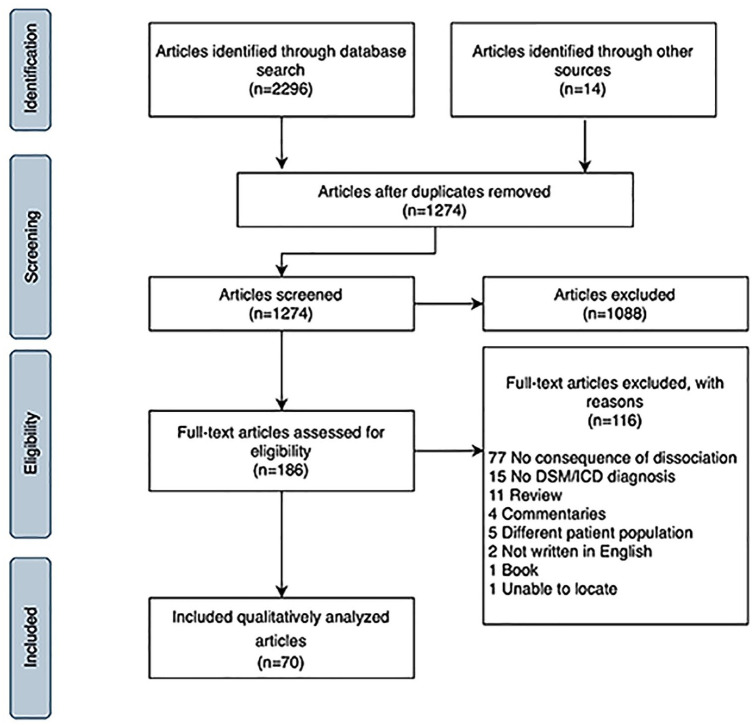
Four electronic databases (MEDLINE, APA PsycINFO, EMBASE, CINAHL Plus) were searched, and English peer-reviewed studies with adults with BPD were included, following Preferred Reporting Items for Systematic reviews and Meta-Analysis (PRISMA) extension for scoping reviews (PRISMA-ScR) 2018 guidelines.
Most of the 70 included studies were observational (98%) with first authors from Germany (59%). Overall, dissociation was associated with increased BPD symptom severity, self-harm and reduced psychotherapy treatment response; findings regarding suicide risk were mixed. Dissociation was associated with working memory and cognitive deficits, decreased pain perception, altered body ownership, no substance abuse or the abuse of sedative substances, increased fantasy proneness, personality fragmentation, fearful attachment, dream anxiety, perceived stress and altered stress responses, increased cumulative body mass index, decreased water consumption, several neurological correlates and changes in gene expression.
BPD with significant dissociative symptoms may constitute a more severe and at-risk subgroup of BPD patients. However, there are significant research gaps and methodological issues in the area, including the possibility of unrecognized Dissociative Disorders in BPD study populations confounding results. Further studies are needed to better understand the impact of dissociation on BPD course and treatment, and to clarify the most appropriate assessment tools for clinical practice. In addition, interventional studies are needed to develop dissociation-specific BPD treatments to determine whether targeting dissociation in BPD can improve treatment outcomes.
边缘型人格障碍(BPD)常伴有分离症状。病理性分离与创伤暴露的更早、更严重、情绪调节障碍以及创伤后应激障碍和分离障碍的治疗效果较差有关,这对 BPD 有影响。
系统综述旨在评估目前关于分离对 BPD 影响的文献程度,并确定知识空白。
检索了四个电子数据库(MEDLINE、APA PsycINFO、EMBASE、CINAHL Plus),纳入了有 BPD 成人的英文同行评审研究,遵循系统评价和荟萃分析(PRISMA)扩展的范围综述(PRISMA-ScR)2018 指南。
70 项纳入研究中,大多数为观察性研究(98%),第一作者来自德国(59%)。总体而言,分离与 BPD 症状严重程度增加、自残和心理治疗反应降低有关;自杀风险的研究结果不一。分离与工作记忆和认知缺陷、疼痛感知降低、身体所有权改变、无物质滥用或镇静物质滥用、幻想倾向增加、人格碎片化、恐惧依恋、梦境焦虑、感知压力和压力反应改变、体重指数增加、水摄入减少、几个神经学相关因素和基因表达改变有关。
有明显分离症状的 BPD 可能构成 BPD 患者中更严重和高危亚组。然而,该领域存在重大研究空白和方法问题,包括 BPD 研究人群中可能存在未被识别的分离障碍,这会使结果产生混淆。需要进一步研究以更好地了解分离对 BPD 病程和治疗的影响,并澄清临床实践中最合适的评估工具。此外,还需要进行干预性研究,制定针对分离的 BPD 治疗方法,以确定针对 BPD 中的分离是否可以改善治疗效果。