Urdal Jarle, Engan Kjersti, Eftestøl Trygve, Haaland Solveig H, Kamala Benjamin, Mdoe Paschal, Kidanto Hussein, Ersdal Hege
Department of Electrical Engineering and Computer Science, University of Stavanger, Stavanger, Norway.
Strategic Research, Laerdal Medical AS, Stavanger, Norway.
Biomed Eng Online. 2021 Mar 16;20(1):26. doi: 10.1186/s12938-021-00861-z.
Fresh stillbirths (FSB) and very early neonatal deaths (VEND) are important global challenges with 2.6 million deaths annually. The vast majority of these deaths occur in low- and low-middle income countries. Assessment of the fetal well-being during pregnancy, labour, and birth is normally conducted by monitoring the fetal heart rate (FHR). The heart rate of newborns is reported to increase shortly after birth, but a corresponding trend in how FHR changes just before birth for normal and adverse outcomes has not been studied. In this work, we utilise FHR measurements collected from 3711 labours from a low and low-middle income country to study how the FHR changes towards the end of the labour. The FHR development is also studied in groups defined by the neonatal well-being 24 h after birth.
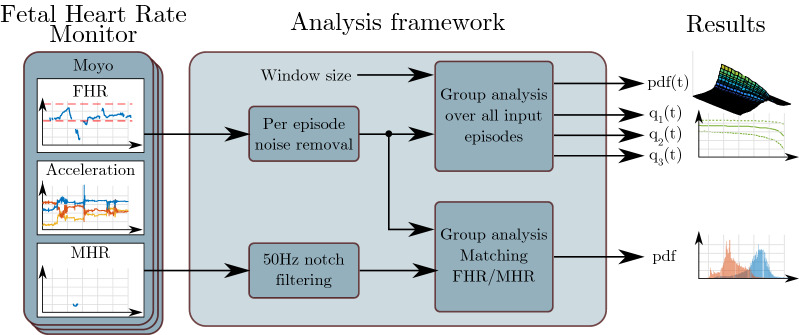
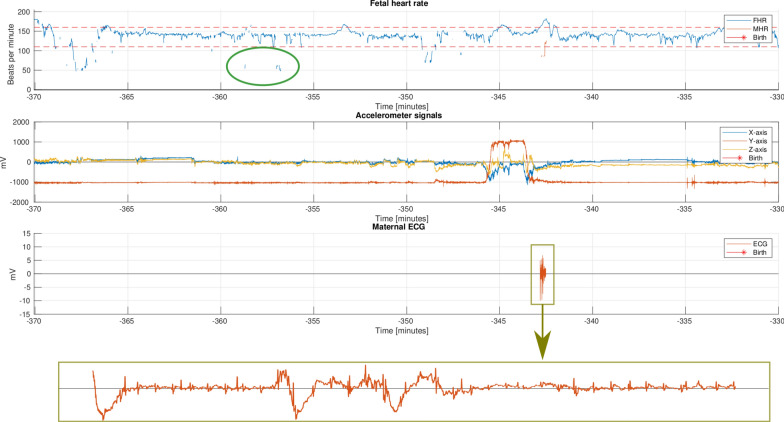
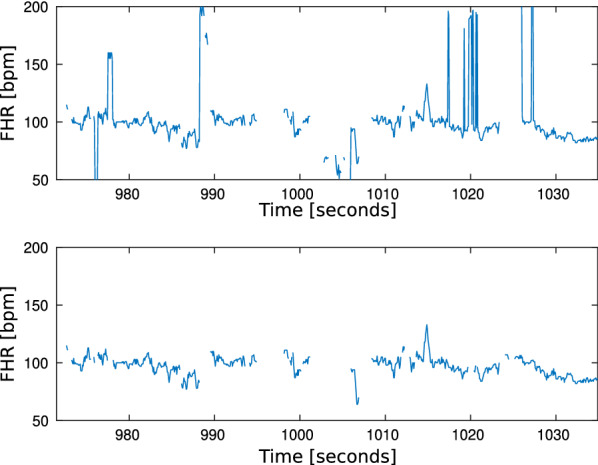
A signal pre-processing method was applied to identify and remove time periods in the FHR signal where the signal is less trustworthy. We suggest an analysis framework to study the FHR development using the median FHR of all measured heart rates within a 10-min window. The FHR trend is found for labours with a normal outcome, neonates still admitted for observation and perinatal mortality, i.e. FSB and VEND. Finally, we study how the spread of the FHR changes over time during labour.
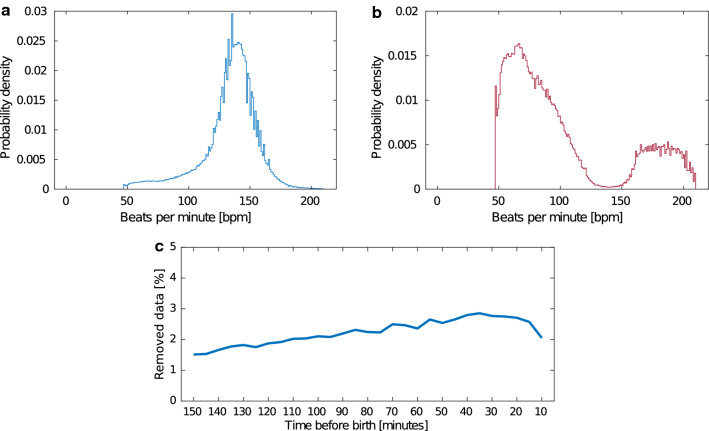
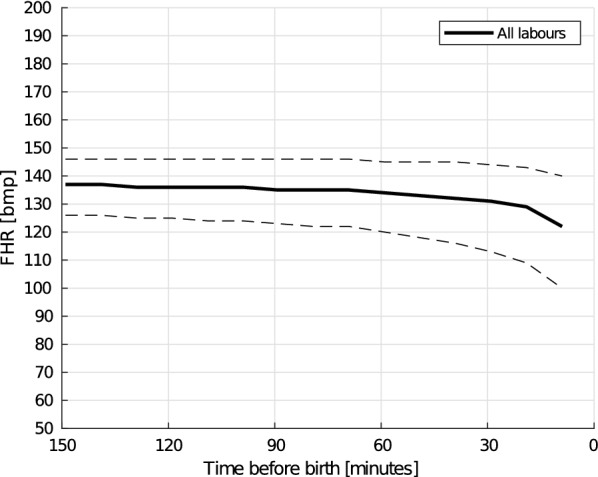
When studying all labours, there is a drop in median FHR from 134 beats per minute (bpm) to 119 bpm the last 150 min before birth. The change in FHR was significant ([Formula: see text]) using Wilcoxon signed-rank test. A drop in median FHR as well as an increased spread in FHR is observed for all defined outcome groups in the same interval.
A significant drop in FHR the last 150 min before birth is seen for all neonates with a normal outcome or still admitted to the NCU at 24 h after birth. The observed earlier and larger drop in the perinatal mortality group may indicate that they struggle to endure the physical strain of labour, and that an earlier intervention could potentially save lives. Due to the low amount of data in the perinatal mortality group, a larger dataset is required to validate the drop for this group.
新鲜死产(FSB)和极早期新生儿死亡(VEND)是重大的全球挑战,每年导致260万人死亡。这些死亡绝大多数发生在低收入和中低收入国家。孕期、分娩期和产时胎儿健康状况的评估通常通过监测胎儿心率(FHR)来进行。据报道,新生儿出生后心率会迅速上升,但正常和不良结局情况下出生前FHR如何变化的相应趋势尚未得到研究。在这项研究中,我们利用从一个低收入和中低收入国家的3711例分娩中收集的FHR测量数据,来研究分娩末期FHR的变化情况。还在根据出生后24小时新生儿健康状况定义的组中研究了FHR的发展情况。
应用一种信号预处理方法来识别和去除FHR信号中可信度较低的时间段。我们提出了一个分析框架,使用10分钟窗口内所有测量心率的中位数FHR来研究FHR的发展情况。发现了正常结局分娩、仍需留院观察的新生儿以及围产期死亡率(即FSB和VEND)的FHR趋势。最后,我们研究了分娩过程中FHR的离散度如何随时间变化。
在研究所有分娩时,出生前最后150分钟的FHR中位数从每分钟134次心跳(bpm)降至119 bpm。使用Wilcoxon符号秩检验,FHR的变化具有显著性([公式:见原文])。在相同时间段内,所有定义的结局组均观察到FHR中位数下降以及FHR离散度增加。
对于所有结局正常或出生后24小时仍入住新生儿重症监护病房(NCU)的新生儿,出生前最后150分钟的FHR显著下降。在围产期死亡率组中观察到的更早、更大幅度的下降可能表明他们难以承受分娩的身体压力,更早的干预可能挽救生命。由于围产期死亡率组的数据量较少,需要更大的数据集来验证该组的下降情况。