Section of Oral and Maxillofacial Oncology, Division of Maxillofacial Diagnostic and Surgical Sciences, Faculty of Dental Science, Kyushu University, 3-1-1 Maidashi, Higashi-ku, Fukuoka, 812-8582, Japan.
Stem Cell Res Ther. 2021 Mar 16;12(1):182. doi: 10.1186/s13287-021-02236-6.
Sjögren's syndrome (SS) is a chronic autoimmune disease primarily characterized by inflammation in the salivary and lacrimal glands. Activated T cells contribute to disease pathogenesis by producing proinflammatory cytokines, which leads to a positive feedback loop establishment. The study aimed to evaluate the effects of secreted factors derived from dental pulp stem cells (DPSCs) or bone marrow mesenchymal stem cells (BMMSCs) on hyposalivation in SS and to investigate the mechanism involved.
Eighty percent confluent stem cells were replenished with serum-free Dulbecco's modified Eagle's medium and incubated for 48 h; following which, conditioned media from DPSCs (DPSC-CM) and BMMSCs (BMMSC-CM) were collected. Cytokine array analysis was performed to assess the types of cytokines present in the media. Flow cytometric analysis was performed to evaluate the number of activated T cells cultured in DPSC-CM or BMMSC-CM. Subsequently, DPSC-CM or BMMSC-CM was administered to an SS mouse model. The mice were categorized into the following groups (n = 6 each): non-treatment, Dulbecco's modified Eagle's medium (-), BMMSC-CM, and DPSC-CM. Histological analysis of the salivary glands was performed. The gene and protein expression levels of cytokines associated with T helper subsets in the submandibular glands (SMGs) were evaluated.
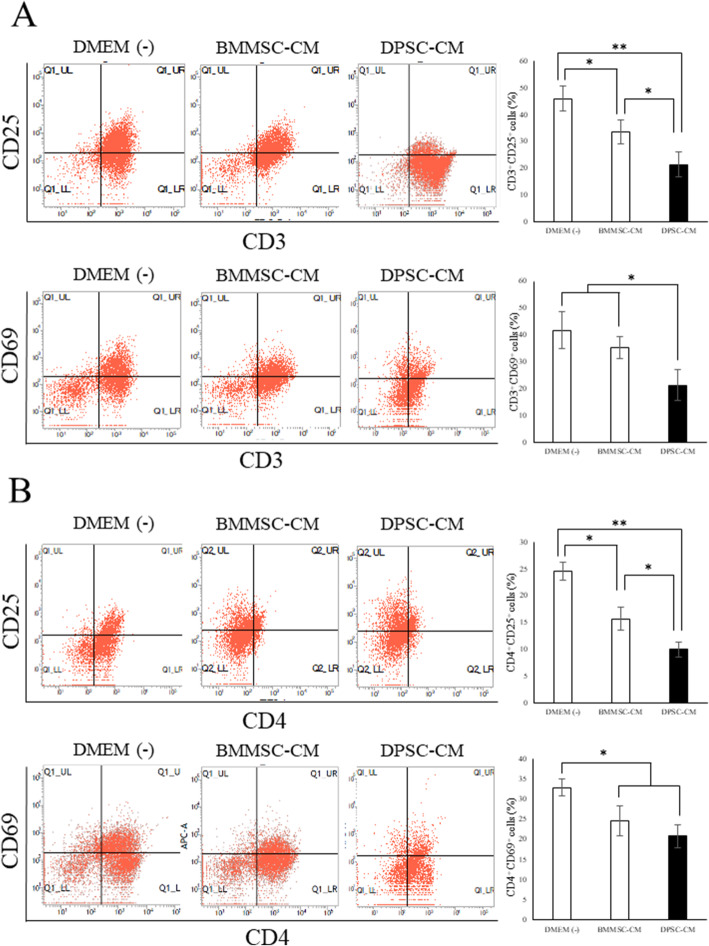
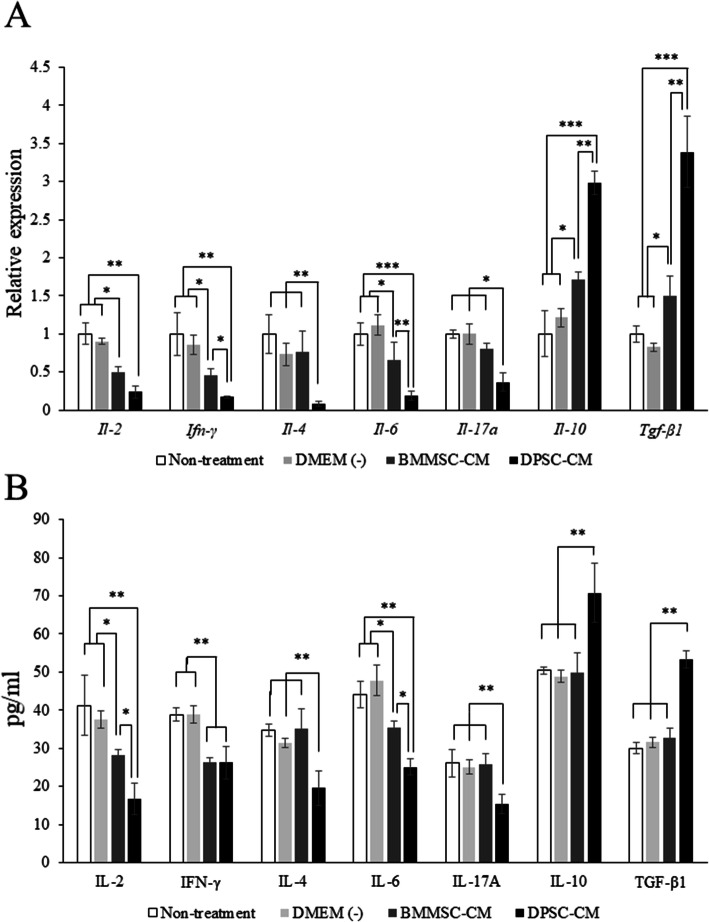
DPSC-CM contained more secreted factors with tissue-regenerating mechanisms, such as cell proliferation, anti-inflammatory effects, and immunomodulatory effects. DPSC-CM was more effective in suppressing the activated T cells than other groups in the flow cytometric analysis. The stimulated salivary flow rate increased in SS mice with DPSC-CM compared with that in the other groups. In addition, the number of inflammation sites in SMGs of the mice administered with DPSC-CM was lower than that in the other groups. The expression levels of interleukin (Il)-10 and transforming growth factor-β1 were upregulated in the DPSC-CM group, whereas those of Il-4 and Il-17a were downregulated. The DPSC-CM-administered group presented with a significantly increased percentage of regulatory T (Treg) cells and a significantly decreased percentage of type 17 Th (Th17) cells compared with the other groups.
These results indicated that DPSC-CM ameliorated SS by promoting Treg cell differentiation and inhibiting Th17 cell differentiation in the mouse spleen.
干燥综合征(SS)是一种主要以唾液腺和泪腺炎症为特征的慢性自身免疫性疾病。激活的 T 细胞通过产生促炎细胞因子导致疾病发病机制,从而建立正反馈回路。本研究旨在评估牙髓干细胞(DPSC)或骨髓间充质干细胞(BMMSC)来源的分泌因子对 SS 低分泌的影响,并探讨其涉及的机制。
将 80%汇合的干细胞用无血清 Dulbecco 改良 Eagle 培养基补充,并孵育 48 小时;之后,收集牙髓干细胞(DPSC-CM)和骨髓间充质干细胞(BMMSC-CM)的条件培养基。采用细胞因子阵列分析评估培养基中存在的细胞因子类型。采用流式细胞术分析评估在 DPSC-CM 或 BMMSC-CM 中培养的激活 T 细胞的数量。随后,将 DPSC-CM 或 BMMSC-CM 给予 SS 小鼠模型。将小鼠分为以下几组(每组 n=6):未治疗、Dulbecco 改良 Eagle 培养基(-)、BMMSC-CM 和 DPSC-CM。对颌下腺(SMG)进行组织学分析。评估 SMG 中与辅助性 T 细胞亚群相关的细胞因子的基因和蛋白表达水平。
DPSC-CM 含有更多具有组织再生机制的分泌因子,如细胞增殖、抗炎作用和免疫调节作用。与其他组相比,DPSC-CM 在流式细胞术分析中更有效地抑制激活的 T 细胞。与其他组相比,DPSC-CM 处理的 SS 小鼠的刺激唾液流量增加。此外,给予 DPSC-CM 的小鼠 SMG 中的炎症部位数量少于其他组。DPSC-CM 组白细胞介素(IL)-10 和转化生长因子-β1 的表达上调,而 IL-4 和 IL-17a 的表达下调。与其他组相比,DPSC-CM 处理组的调节性 T(Treg)细胞比例显著增加,17 型 Th(Th17)细胞比例显著降低。
这些结果表明,DPSC-CM 通过促进 Treg 细胞分化和抑制小鼠脾脏中的 Th17 细胞分化来改善 SS。