Guangdong Engineering Research Center of Oral Restoration and Reconstruction, Affiliated Stomatology Hospital of Guangzhou Medical University, #195 Dongfeng West Road, Guangzhou, 510140, Guangdong, China.
Chemical Biology Research Group, RIKEN Center for Sustainable Resource Science, Wako, Saitama, 351-0198, Japan.
J Transl Med. 2023 Jun 3;21(1):361. doi: 10.1186/s12967-023-04198-0.
Restoration of salivary gland function in Sjogren's syndrome (SS) is still a challenge. Dental pulp stem cells (DPSCs) derived exosomes had shown anti-inflammatory, anti-oxidative, immunomodulatory, and tissue function restorative abilities. However, the salivary gland function restoration potential of DPSCs-derived exosomes (DPSC-Exos) during SS has not been investigated yet.
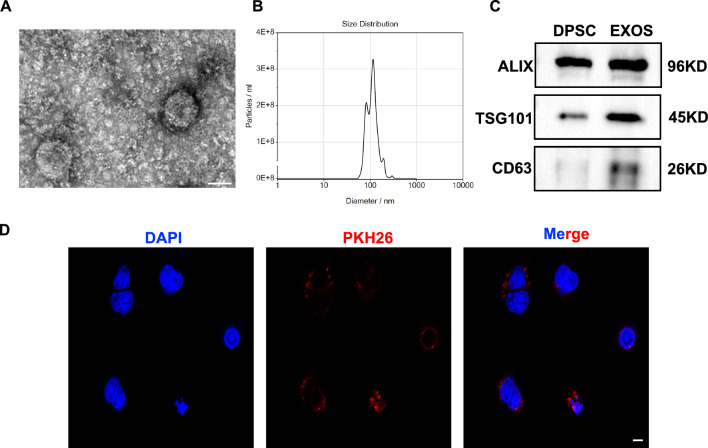
DPSC-Exos was isolated by ultracentrifugation methods and characterized. Salivary gland epithelial cells (SGEC) were treated with interferon-gamma (IFN-γ) to mimic SS in vitro and cultured with or without DPSC-Exos. SGEC survival and aquaporin 5 (AQP5) expression were analyzed. mRNA sequencing and bioinformatics analysis were performed in IFN-γ vs. DPSC-Exos+ IFN-γ treated SGEC. Non-obese diabetic (NOD)/ltj female mice (SS model), were intravenously administered with DPSC-Exos, and salivary gland functions and SS pathogenicity were analyzed. Furthermore, the mRNA sequencing and bioinformatics predicted mechanism of the therapeutic effect of DPSC-Exos was further investigated both in vitro and in vivo using RT-qPCR, Western blot, immunohistochemistry, immunofluorescence, flowcytometry analysis.
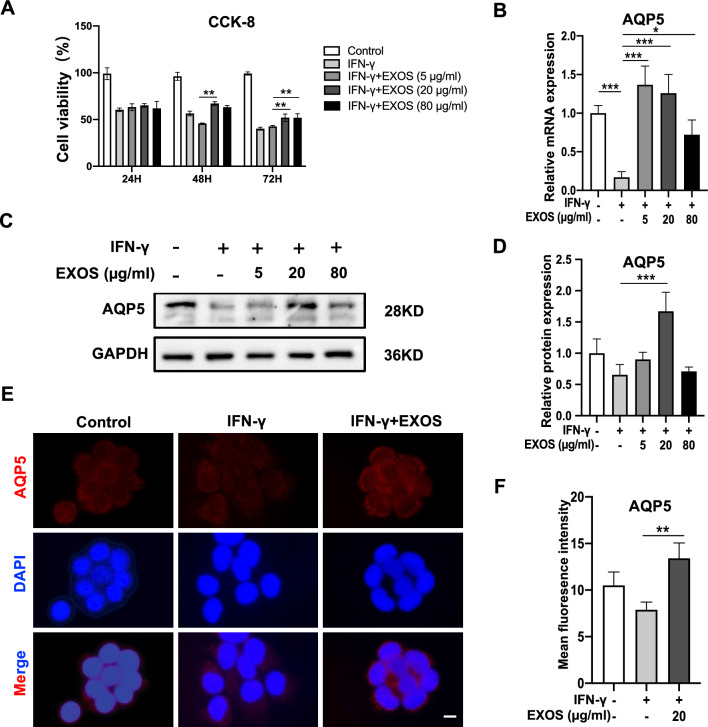
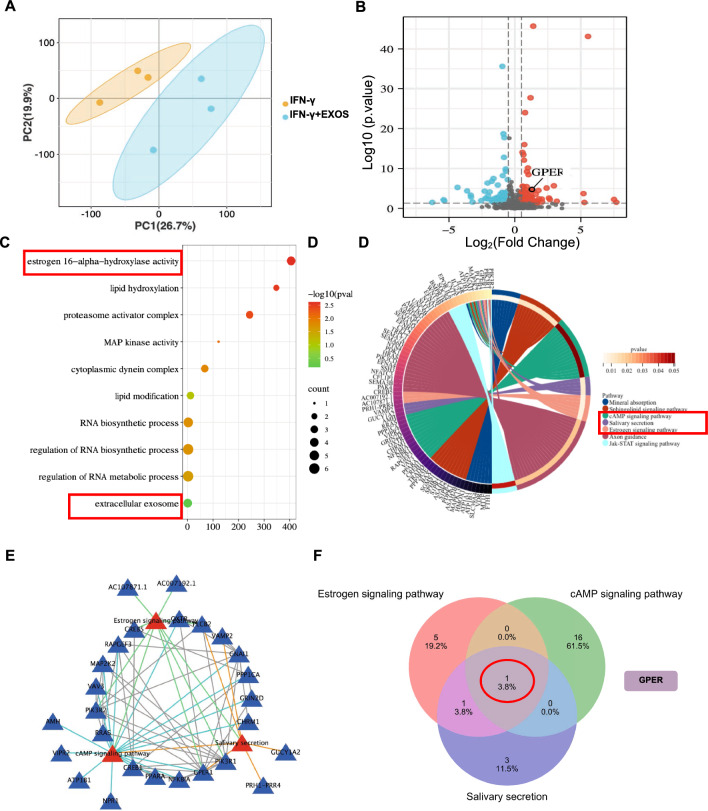
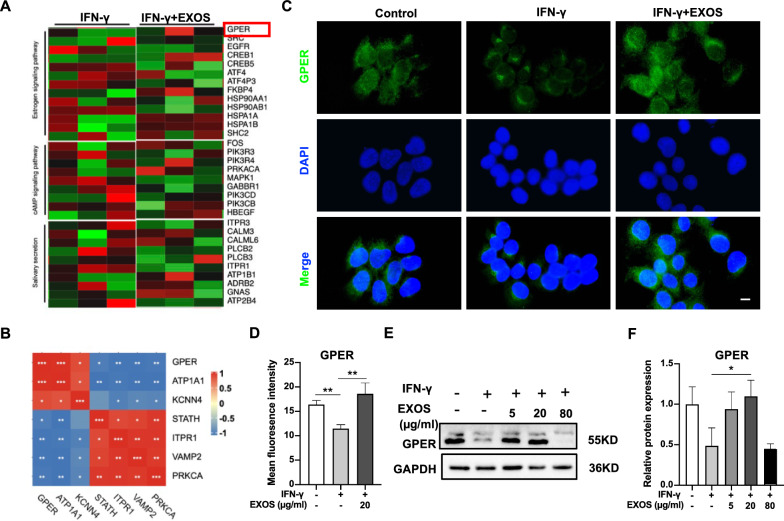
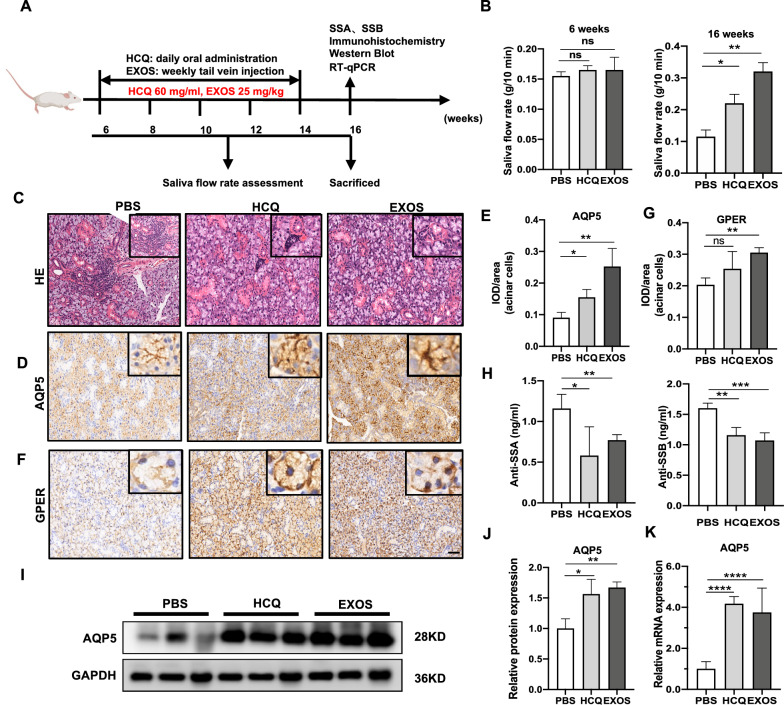
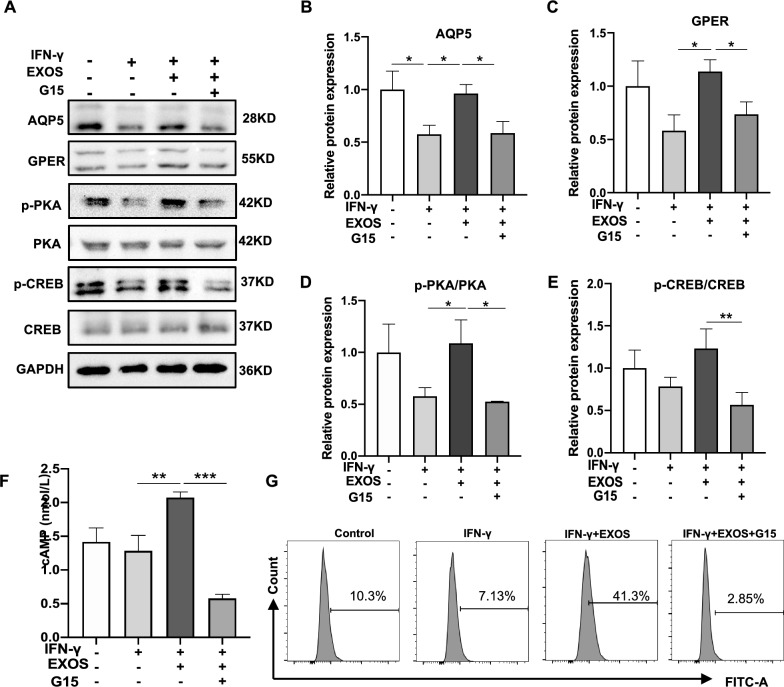
DPSC-Exos partially rescued IFN-γ triggered SGEC death. IFN-γ inhibited AQP5 expression in SGEC and DPSC-Exos reversed this effect. Transcriptome analysis showed GPER was the upregulated DEG in DPSC-Exos-treated SGEC with a positive correlation with salivary secretion-related DEGs. Pathway enrichment analysis revealed that DEGs were mainly attributed to estrogen 16 alpha-hydroxylase activity, extracellular exosome function, cAMP signaling, salivary secretion, and estrogen signaling. Intravenous injection of DPSC-Exos in NOD/ltj mice alleviated the SS syndrome as indicated by the increased salivary flow rate, attenuated glandular inflammation, and increased AQP5 expression. GPER was also upregulated in the salivary gland of DPSC-Exos-treated NOD/ltj mice compared with the PBS-treated NOD/ltj mice. IFN-γ+DPSC-Exos-treated SGEC showed higher expression of AQP5, p-PKA, cAMP, and intracellular Ca levels compared with IFN-γ-treated SGEC. These effects were reversed by the inhibition of GPER.
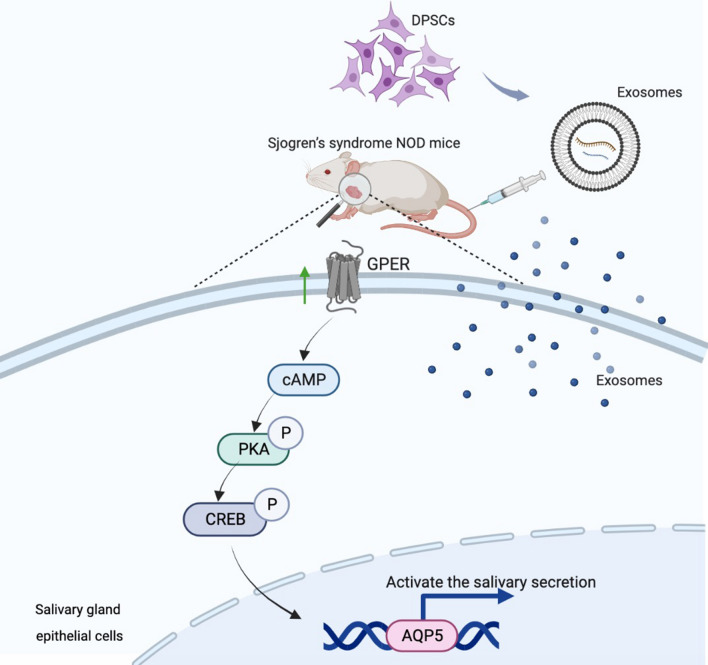
Our results showed that DPSC-Exos revitalize salivary gland epithelial cell function during SS via the GPER-mediated cAMP/PKA/CREB pathway suggesting the possible therapeutic potential of DPSC-Exos in SS-treatment.
干燥综合征(SS)患者唾液腺功能的恢复仍然是一个挑战。牙髓干细胞(DPSCs)衍生的外泌体具有抗炎、抗氧化、免疫调节和组织功能修复能力。然而,DPSCs 衍生的外泌体(DPSC-Exos)在 SS 期间对唾液腺功能恢复的潜力尚未得到研究。
通过超速离心法分离 DPSC-Exos 并进行鉴定。体外采用干扰素-γ(IFN-γ)处理唾液腺上皮细胞(SGEC)模拟 SS,并与或不与 DPSC-Exos 共培养。分析 SGEC 的存活率和水通道蛋白 5(AQP5)的表达。对 IFN-γ与 DPSC-Exos+IFN-γ处理的 SGEC 进行 mRNA 测序和生物信息学分析。非肥胖型糖尿病(NOD)/ltj 雌性小鼠(SS 模型)静脉注射 DPSC-Exos,分析唾液腺功能和 SS 发病机制。此外,通过 RT-qPCR、Western blot、免疫组织化学、免疫荧光、流式细胞术分析,进一步研究了 DPSC-Exos 在体外和体内的治疗效果的 mRNA 测序和生物信息学预测机制。
DPSC-Exos 部分挽救了 IFN-γ 触发的 SGEC 死亡。IFN-γ 抑制了 SGEC 中的 AQP5 表达,而 DPSC-Exos 逆转了这种作用。转录组分析显示,GPER 是 DPSC-Exos 处理的 SGEC 中上调的差异表达基因(DEG),与唾液分泌相关的 DEG 呈正相关。通路富集分析显示,DEG 主要与雌激素 16α-羟化酶活性、细胞外外泌体功能、cAMP 信号转导、唾液分泌和雌激素信号转导有关。DPSC-Exos 静脉注射到 NOD/ltj 小鼠中,增加了唾液流量、减轻了腺体炎症、增加了 AQP5 表达,从而缓解了 SS 综合征。与 PBS 处理的 NOD/ltj 小鼠相比,DPSC-Exos 处理的 NOD/ltj 小鼠的唾液腺中 GPER 也上调。IFN-γ+DPSC-Exos 处理的 SGEC 与 IFN-γ 处理的 SGEC 相比,AQP5、p-PKA、cAMP 和细胞内 Ca 水平的表达更高。这些作用被 GPER 抑制剂逆转。
我们的研究结果表明,DPSC-Exos 通过 GPER 介导的 cAMP/PKA/CREB 通路恢复 SS 期间唾液腺上皮细胞功能,提示 DPSC-Exos 在 SS 治疗中的潜在治疗潜力。