National Institute for Drug Clinical Trial, Beijing Tongren Hospital, Capital Medical University, 1 Dongjiaominxiang Road, Beijing, 100730, China.
College of Chemical Biology and Pharmaceutical Sciences, Capital Medical University, 10 Xitoutiao Road, Beijing, 100069, China.
Stem Cell Res Ther. 2019 Jan 22;10(1):39. doi: 10.1186/s13287-019-1134-z.
Several studies have demonstrated that mesenchymal stem cells can ameliorate the inflammation of allergic rhinitis (AR) and correct the Th1/Th2 immune imbalance.
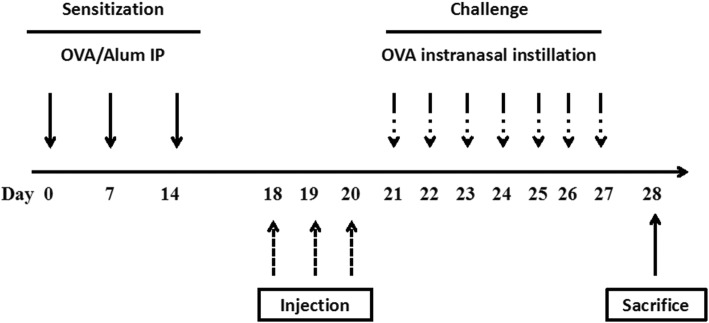
This study was performed to explore the immunomodulation properties of stem cells from human exfoliated deciduous teeth (SHEDs) in the treatment of AR in vivo and in vitro. BALB/c mice were sensitized to ovalbumin (OVA) by intraperitoneal injection, and then SHEDs or bone marrow mesenchymal stem cells (BMMSCs) were injected intravenously before challenge. We evaluated nasal symptoms, inflammatory infiltration of nasal mucosa, immunoglobulin secretion, cytokine production, and mRNA expression in the spleen. In addition, peripheral blood mononuclear cells (PBMCs) from AR patients were cultured with SHEDs or BMMSCs in the presence of phytohemagglutinin (PHA). PBMCs cultured alone with or without PHA served as controls. After 3 days of culture, we examined the effect of SHEDs on T lymphocyte proliferation, cytokine secretion, and the proportion of Foxp3 Treg cells via flow cytometry. Finally, to determine the role of soluble factors (TGF-β, PGE) in the immunomodulatory mechanism, a cytokine neutralization assay was performed.
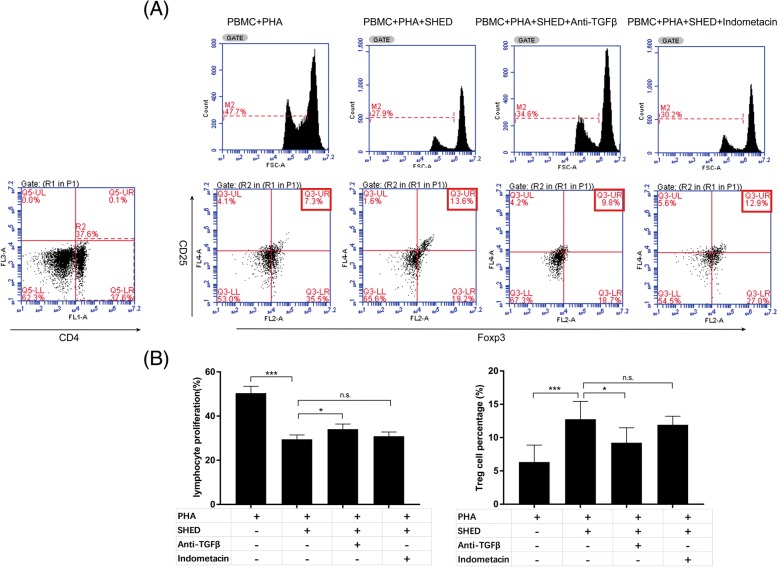
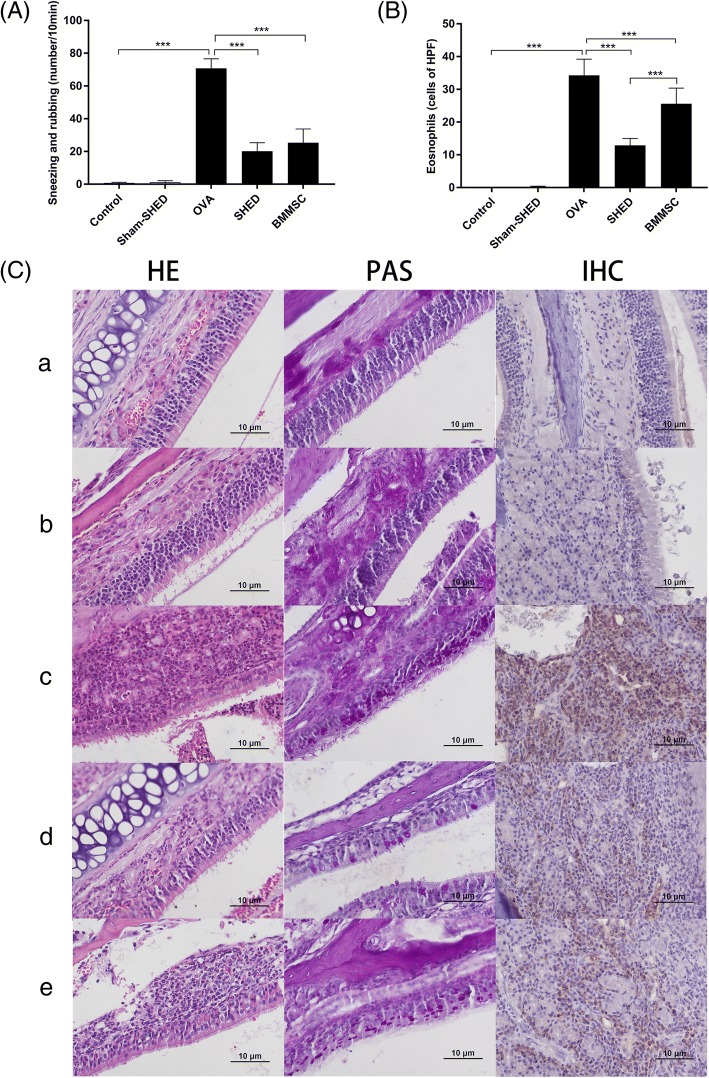
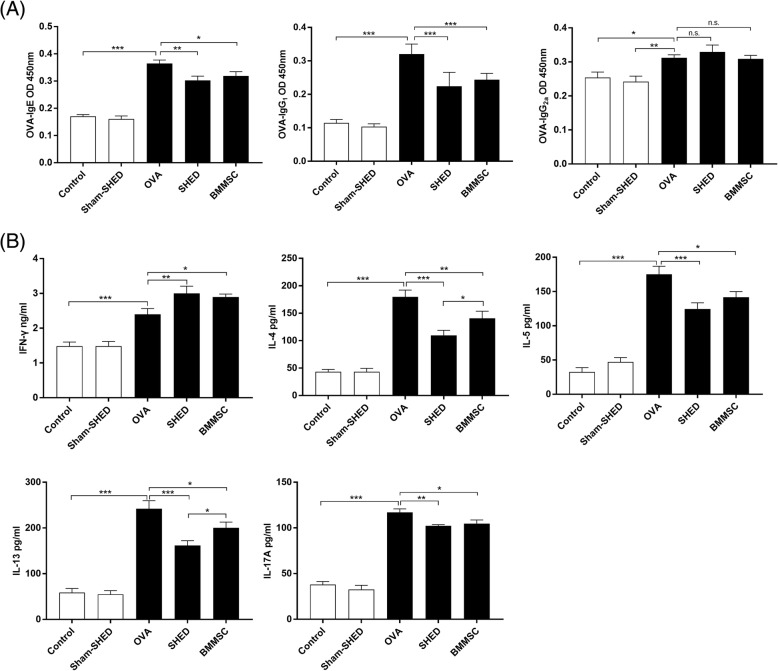
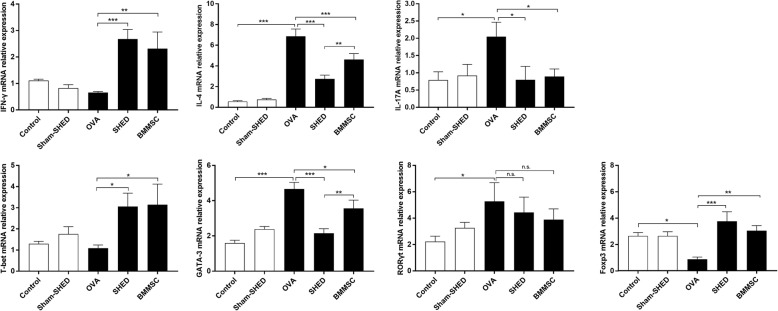
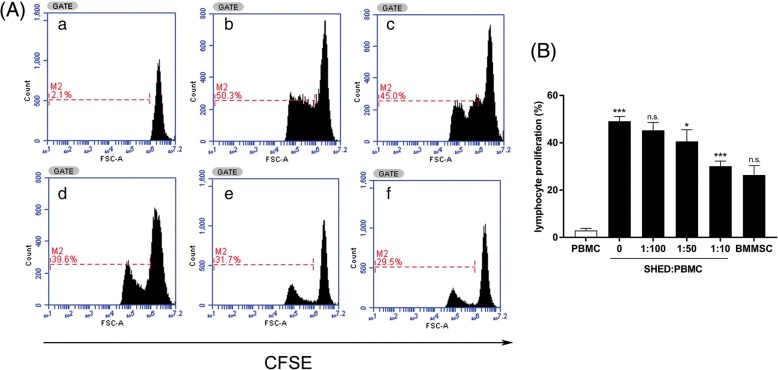
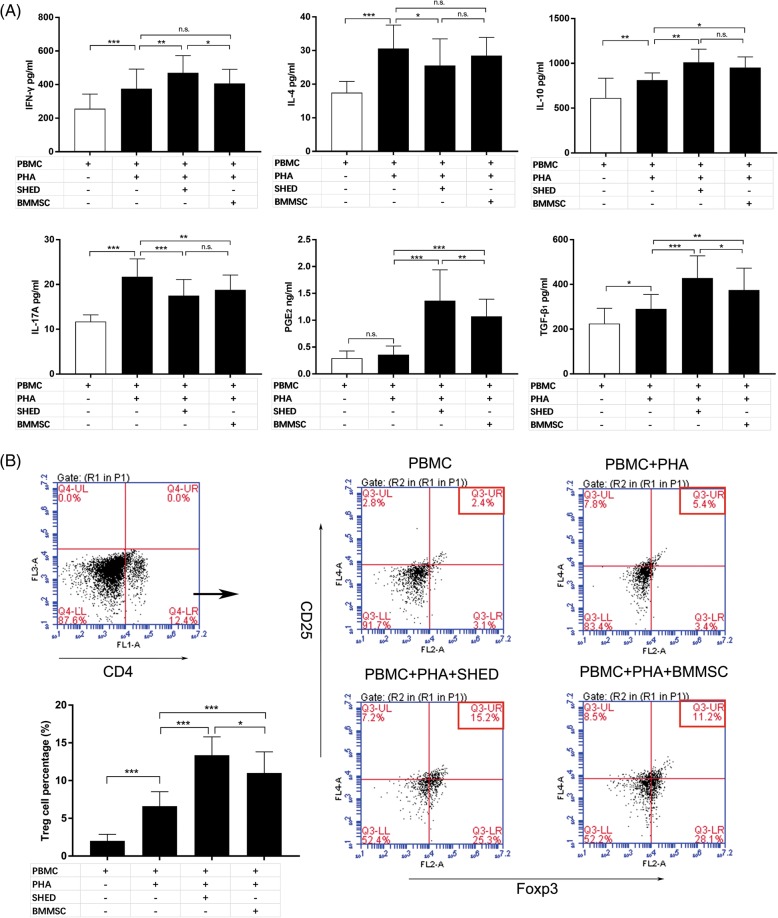
Nasal symptoms and inflammatory infiltration were significantly reduced after SHED administration. The OVA-specific IgE and IgG levels in serum were significantly decreased, and the increased IL-4, IL-5, IL-13, and IL-17A levels in the spleen after OVA challenge were markedly downregulated, while the level of IFN-γ was upregulated by SHED administration. The mRNA expression levels also changed correspondingly. SHEDs significantly inhibited the proliferation of T lymphocytes; increased the levels of IFN-γ, IL-10, PGE, and TGF-β; decreased the levels of IL-4 and IL-17A; and induced the expansion of Treg cells in the coculture system. The neutralization of TGF-β partly relieved the immunosuppression of SHEDs, but blocking PGE did not. In addition, SHEDs were superior to BMMSCs in inhibiting the Th2 immune response in vivo and inducing the expansion of Treg cells in vitro.
These results suggest that SHEDs could correct the CD4 T cell immune imbalance via Treg cells and may be potential therapeutic agents for the treatment of allergic diseases, such as AR, in the future.
多项研究表明间充质干细胞可改善变应性鼻炎(AR)的炎症,并纠正 Th1/Th2 免疫失衡。
本研究旨在探讨人脱落乳牙来源的间充质干细胞(SHED)在体内和体外治疗 AR 的免疫调节特性。BALB/c 小鼠通过腹腔注射卵清蛋白(OVA)致敏,然后在激发前静脉注射 SHED 或骨髓间充质干细胞(BMMSCs)。我们评估了鼻症状、鼻黏膜炎症浸润、免疫球蛋白分泌、细胞因子产生以及脾内 mRNA 表达。此外,将 AR 患者的外周血单个核细胞(PBMCs)与 SHED 或 BMMSCs 在植物血球凝集素(PHA)存在下共培养,单独培养的 PBMCs 加或不加 PHA 作为对照。培养 3 天后,通过流式细胞术检测 SHED 对 T 淋巴细胞增殖、细胞因子分泌和 Foxp3+Treg 细胞比例的影响。最后,为了确定可溶性因子(TGF-β、PGE)在免疫调节机制中的作用,进行了细胞因子中和测定。
SHED 给药后,鼻症状和炎症浸润明显减轻。血清中 OVA 特异性 IgE 和 IgG 水平显著降低,OVA 激发后脾内升高的 IL-4、IL-5、IL-13 和 IL-17A 水平显著下调,而 SHED 给药后 IFN-γ 水平上调。mRNA 表达水平也相应改变。SHED 显著抑制 T 淋巴细胞增殖;增加 IFN-γ、IL-10、PGE 和 TGF-β水平;降低 IL-4 和 IL-17A 水平;并在共培养体系中诱导 Treg 细胞扩增。TGF-β 的中和部分缓解了 SHED 的免疫抑制作用,但阻断 PGE 则没有。此外,SHED 在体内抑制 Th2 免疫反应和体外诱导 Treg 细胞扩增方面优于 BMMSCs。
这些结果表明,SHED 可通过 Treg 细胞纠正 CD4 T 细胞免疫失衡,可能成为未来治疗 AR 等过敏性疾病的潜在治疗药物。