School of Nursing, University of Washington, Seattle, WA.
School of Nursing, University of Washington, Seattle, WA; Harborview Injury Prevention and Research Center, Seattle, WA.
Chest. 2021 Aug;160(2):509-518. doi: 10.1016/j.chest.2021.03.008. Epub 2021 Mar 14.
Joblessness is common after ARDS, but related risk factors are not fully understood.
What is the association between survivors' pre-ARDS workload and post-ARDS functional impairment, pain, and fatigue with their return to work (RTW) status?
The U.S. Occupational Information Network (O∗NET) was used to determine pre-ARDS workload for participants in the ARDS Network Long-Term Outcomes Study (ALTOS). Post-ARDS functional impairment was assessed using the Mini-Mental State Examination and SF-36 Physical Functioning, Social Functioning, and Mental Health sub-scales, and categorized as either no impairments, only psychosocial impairment, physical with low psychosocial impairment, or physical with high psychosocial impairment. Post-ARDS pain and fatigue were assessed using the SF-36 pain item and Functional Assessment of Chronic Illness Therapy-Fatigue Scale fatigue scale, respectively. Generalized linear mixed modeling methods were used to evaluate associations among pre-ARDS workload, post-ARDS functional impairment, and symptoms of pain and fatigue with post-ARDS RTW.
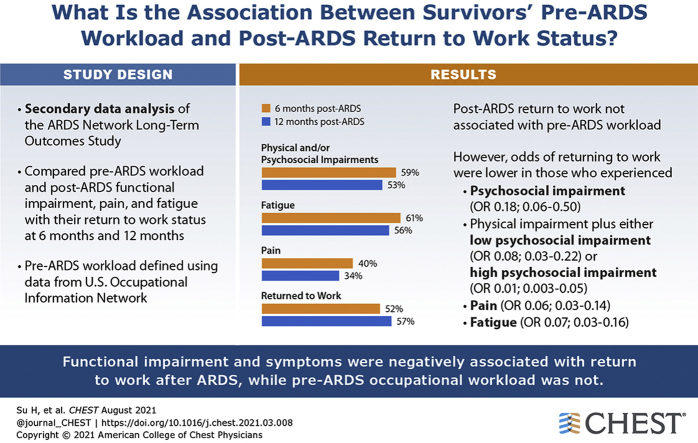
Pre-ARDS workload was not associated with post-ARDS RTW. However, as compared with survivors with no functional impairment, those with only psychosocial impairment (OR [CI]: 0.18 [0.06-0.50]), as well as physical impairment plus either low psychosocial impairment (0.08 [0.03-0.22]) or high psychosocial impairment (0.01 [0.003-0.05]) had lower odds of working. Pain (0.06 [0.03-0.14]) and fatigue (0.07 [0.03-0.16]) were also negatively associated with RTW.
For previously employed survivors of ARDS, post-ARDS psychosocial and physical impairments, pain, and fatigue were negatively associated with RTW, whereas pre-ARDS workload was not associated. These findings are important for designing and implementing vocational interventions for ARDS survivors.
ARDS 后失业很常见,但相关风险因素尚未完全了解。
ARDS 幸存者发病前的工作量与 ARDS 后功能障碍、疼痛和疲劳对其重返工作岗位(RTW)状态的关联是什么?
使用美国职业信息网络(O∗NET)确定 ARDS 网络长期结果研究(ALTOS)参与者发病前的工作量。采用 Mini-Mental State Examination 和 SF-36 身体功能、社会功能和心理健康子量表评估 ARDS 后功能障碍,并将其分为无功能障碍、仅有心理社会障碍、身体功能障碍伴低心理社会障碍或身体功能障碍伴高心理社会障碍。采用 SF-36 疼痛条目和慢性疾病治疗疲劳量表功能评估量表评估 ARDS 后疼痛和疲劳。采用广义线性混合模型方法评估发病前工作量、 ARDS 后功能障碍以及疼痛和疲劳症状与 ARDS 后 RTW 之间的关系。
发病前工作量与 ARDS 后 RTW 无关。然而,与无功能障碍的幸存者相比,仅有心理社会障碍(比值比 [OR] [95%CI]:0.18 [0.06-0.50])以及伴有低心理社会障碍(0.08 [0.03-0.22])或高心理社会障碍(0.01 [0.003-0.05])的身体功能障碍幸存者的工作几率更低。疼痛(0.06 [0.03-0.14])和疲劳(0.07 [0.03-0.16])也与 RTW 呈负相关。
对于曾有工作的 ARDS 幸存者,ARDS 后心理社会和身体功能障碍、疼痛和疲劳与 RTW 呈负相关,而发病前工作量与 RTW 无关。这些发现对为 ARDS 幸存者设计和实施职业干预措施具有重要意义。